The Oklahoma City Bombing: Homegrown Terror in the Heartland
On April 19 1995 a decorated Army veteran detonated a truck bomb that killed 168 people — including 19 children — in the deadliest act of domestic terrorism before 9/11.
The Oklahoma City Bombing: Homegrown Terror in the Heartland
The Oklahoma City bombing killed 168 people — including 19 children — in a single morning in 1995. The man who built the bomb was not a foreign operative. He was a decorated American veteran who had concluded that the federal government was at war with its own citizens and that bombing a federal building was a legitimate military response. The attack was the deadliest act of domestic terrorism on American soil until September 11, and it grew from the same ideological soil that would feed the militia movement for decades.^1^
What McVeigh Built and How He Used It
At 9:02 a.m. on April 19, 1995, a truck bomb detonated in front of the Alfred P. Murrah Federal Building in downtown Oklahoma City, Oklahoma. The blast collapsed the building’s north face, destroying nine floors of offices, and killed 168 people — including 19 children who were in the building’s America’s Kids Day Care Center on the second floor. It was, at that moment, the deadliest terrorist attack on American soil in history. The perpetrator was not a foreign operative. He was a 26-year-old Army veteran from Lockport, New York, named Timothy James McVeigh, and he had chosen April 19 deliberately: it was the second anniversary of the FBI’s assault on the Branch Davidian compound in Waco, Texas.
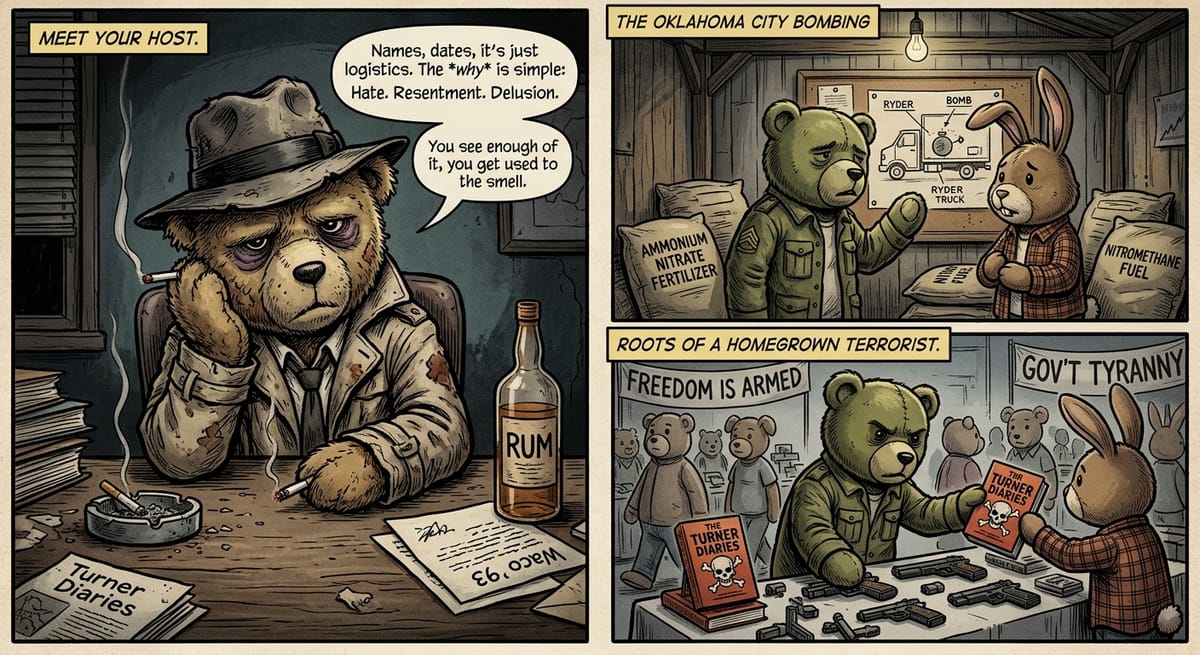
The bomb was a 4,800-pound device made from ammonium nitrate fertilizer and nitromethane racing fuel, packed into a rented Ryder truck. McVeigh and his co-conspirator Terry Lynn Nichols had spent months acquiring materials — stealing explosives from a quarry in Marion, Kansas, in October 1994, purchasing 2,000 pounds of ammonium nitrate from a farm supply co-op in McPherson, Kansas, using false names.^1^
McVeigh drove the truck from Junction City, Kansas, parked it in front of the Murrah Building shortly before 9 a.m., lit two fuses, and walked away. The explosion left a crater 30 feet wide and 8 feet deep. Buildings up to 16 blocks away sustained damage. 324 buildings in the surrounding area were destroyed or damaged. The Oklahoma City Fire Department’s initial response was overwhelmed within minutes; FEMA Urban Search and Rescue teams began arriving within hours, eventually fielding 462 personnel from across the country.
Recovery efforts continued for 16 days. The final body — Christy Rosas, 22 — was recovered on May 4, 1995. A 167th victim, nurse Rebecca Anderson, died after being struck by debris while responding to the scene. More than 680 people were injured.^2^
Why McVeigh Wasn’t Stopped Before the Bombing
Timothy McVeigh was arrested within 90 minutes of the bombing — not because of any sophisticated investigative work, but because an Oklahoma State Trooper named Charles Hanger stopped him north of Perry, Oklahoma, for driving a car without a license plate and noticed that McVeigh was carrying a concealed Glock 21 without a permit. McVeigh was in jail on a weapons charge when investigators connected him to the bombing through the truck’s vehicle identification number, which survived the blast.
McVeigh was not acting alone, and the question of how alone he was became one of the contested threads of the investigation. Terry Nichols, a Michigan farmer and Army acquaintance, was convicted of conspiracy and involuntary manslaughter for his role in acquiring materials and helping build the bomb. He received life in prison. Michael Fortier, another Army acquaintance who had prior knowledge of the plot and helped McVeigh case the building, received 12 years in exchange for his testimony. Investigators and journalists have debated ever since whether the conspiracy extended further — to white nationalist networks, or to a third unidentified perpetrator seen with McVeigh — but no additional convictions resulted.^3^
McVeigh’s ideology was explicit and documented. He had attended gun shows across the Midwest in the early 1990s, selling copies of The Turner Diaries — a 1978 novel by neo-Nazi William Luther Pierce depicting a white nationalist revolution against the federal government, in which domestic terrorists detonate a truck bomb in front of FBI headquarters in Washington, D.C. McVeigh had highlighted passages and mailed them to family members. He told investigators and journalists that he viewed the bombing as a military strike against a legitimate target — the federal government — in retaliation for Waco, Ruby Ridge, and what he characterized as federal tyranny.
He was not a loner drifted into extremism. He was a decorated Gulf War veteran — a specialist with the Army’s 2nd Armored Division who had received the Bronze Star — who had become radicalized through militia movement literature and anti-government ideology in the years following his return from Iraq. He had applied to the Army Special Forces program and been rejected. He had traveled to Waco during the 51-day standoff in 1993.
How the Militia Movement Made McVeigh Possible
April 19, 1995, fell on the second anniversary of the Waco fire and the 220th anniversary of the 1775 Battle of Lexington, which McVeigh regarded as symbolically significant. The anti-government militia movement had grown substantially in the early 1990s, fueled by the Brady Handgun Violence Prevention Act of 1993, the assault weapons ban of 1994, and the federal actions at Ruby Ridge in 1992 and Waco in 1993. Militia groups had formed in all 50 states; the Michigan Militia, with which Nichols had loose ties, claimed 12,000 members.
The Southern Poverty Law Center tracked 441 active militia groups in 1995, up from approximately 200 in 1994.^4^ McVeigh moved through this world, absorbed its literature, and concluded that the federal government had declared war on American citizens — that armed resistance was both justified and necessary.
The targeting of the Murrah Building was not random. It housed offices of the Bureau of Alcohol, Tobacco, and Firearms — the agency that had led the initial raid on the Davidian compound in Waco — as well as the Secret Service, the Drug Enforcement Administration, and the Department of Housing and Urban Development. McVeigh saw ATF agents specifically as his enemy. The day care center was not a target; it was a consequence he had accepted.
What the Trial Established and What It Left Open
The bombing’s immediate political effect was significant and, in retrospect, complicated. President Bill Clinton spoke at a memorial service in Oklahoma City on April 23, 1995, attended by tens of thousands. The Antiterrorism and Effective Death Penalty Act passed in 1996, expanding federal surveillance powers and streamlining deportation procedures — aimed, the bill’s sponsors said, at preventing future attacks. Critics noted that most of its provisions addressed foreign terrorism rather than the domestic variety McVeigh represented.
McVeigh was tried in federal court in Denver, Colorado, before Judge Richard Matsch. The trial began March 31, 1997. On June 2, 1997, the jury convicted him on all 11 counts, including use of a weapon of mass destruction and first-degree murder of eight federal law enforcement officers. On June 13, 1997, the jury returned a death sentence. He was executed by lethal injection at the Federal Correctional Complex in Terre Haute, Indiana, on June 11, 2001 — the first federal execution since 1963.^5^
Before his execution, McVeigh gave multiple interviews to journalists and authorized Lou Michel and Dan Herbeck to write a biography, American Terrorist, published in 2001. He offered no apology. He called the children killed in the day care center “collateral damage.”
Terry Nichols received life without parole after his federal trial in 1997, then was tried again on state murder charges in Oklahoma in 2004, receiving 161 additional life sentences — one for each victim other than the eight covered by his federal conviction.
168 people died in 9 seconds. The man who killed them was tried, convicted by a jury, and executed by the government he had declared war on. That accountability is real and documented, and it stands in sharp contrast to the decades of impunity that followed other acts of domestic terrorism in American history — including the KKK’s three eras of organized racial violence.
What the Oklahoma City bombing did not resolve was the movement that produced McVeigh. The militia movement contracted in the years following 1995, partly because the bombing had discredited its most violent expressions, but it did not disappear. By the early 2000s, it had regrouped under different names. The ideological current that ran from The Turner Diaries to Ruby Ridge to Waco to the Murrah Building has continued flowing through American political life, emerging again at the Bundy Ranch standoff in Nevada in 2014, at the Malheur National Wildlife Refuge occupation in Oregon in 2016, and at the Capitol on January 6, 2021.
McVeigh was not the endpoint of an ideology. He was its most destructive single expression. The 19 children who died in the America’s Kids Day Care Center — the youngest was 4 months old — had names: Aleisha, Anthony, Baylee, Blake, Brenda, Chase, Colton, Dominique, Elijah, Enrico, Gabreon, Jaci, Jake, Kayla, Kevin, Nekia, Peachlyn, Rechelle, Scott. They are not abstractions. The ideology that killed them has not been abstracted into history.
─────────
Part of Ideological Terror — ← Back to series hub
Sources:
- Michel, Lou, and Dan Herbeck. American Terrorist: Timothy McVeigh and the Oklahoma City Bombing. ReganBooks, 2001.
- Oklahoma City National Memorial & Museum. The Official Record of the Oklahoma City Bombing. Oklahoma City National Memorial Foundation, 2000.
- Serrano, Richard A. One of Ours: Timothy McVeigh and the Oklahoma City Bombing. W.W. Norton, 1998.
- Southern Poverty Law Center. False Patriots: The Threat of Antigovernment Extremists. SPLC, 1996.
- Federal Bureau of Investigation. OKBOMB: Summary of the Oklahoma City Bombing Investigation. U.S. Department of Justice, 1996.