Ruby Ridge: The Standoff That Radicalized a Movement
In 1992 federal agents killed a 14-year-old boy and his mother at a remote Idaho homestead over a minor gun charge — and created the founding grievance of the militia movement.
Ruby Ridge: The Standoff That Radicalized a Movement
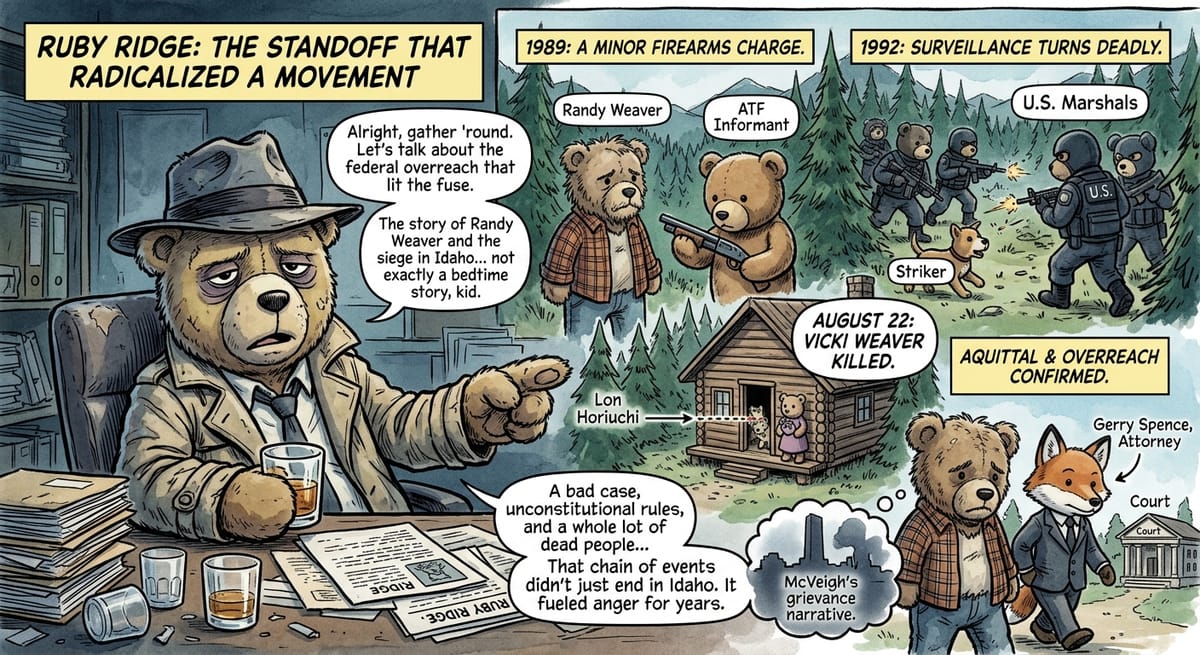
In August 1992, federal agents killed a dog, a 14-year-old boy, and a woman holding her infant daughter at a remote homestead in northern Idaho. The Ruby Ridge standoff — triggered by a minor firearms charge — became the foundational grievance of the American anti-government militia movement, cited by Timothy McVeigh as justification for the Oklahoma City bombing and by armed groups ever since as proof that the federal government was willing to kill its own citizens on their own land.^1^
The incident at Ruby Ridge was, at its origin, a small-time weapons case. What it became was a national rupture.
Part of Standoffs and Sieges — ← Back to series hub
How a Minor Gun Charge Became a Federal Siege
Randy Weaver was a white separatist who had moved his family to an isolated homestead on Ruby Ridge, a remote mountain in Boundary County, Idaho, in 1983. He was not a member of the Aryan Nations, though he had attended some of their meetings at their compound in Hayden Lake, Idaho. He was suspicious of the federal government, deeply religious, and committed to living apart from what he considered a corrupt society.
In the mid-1980s, Weaver befriended a man named Kenneth Fadeley, who was working as an informant for the Bureau of Alcohol, Tobacco, and Firearms. In October 1989, Weaver sold Fadeley two sawed-off shotguns, the barrels of which were a quarter-inch shorter than the legal minimum under the National Firearms Act. Federal agents used that sale to attempt to turn Weaver into an informant himself. He refused. He was indicted on firearms charges in June 1990.^2^
Weaver failed to appear for his trial, partly due to a miscommunication about the court date. A bench warrant was issued. The U.S. Marshals Service began surveillance of the Ruby Ridge property in 1991. By August 1992, a tactical team was in position in the woods around the cabin.
On August 21, 1992, Weaver’s teenage son Samuel, his friend Kevin Harris, and the family dog Striker encountered a Marshals surveillance team in the woods. A firefight broke out. Deputy Marshal William Degan was shot and killed. Samuel Weaver, 14 years old, was shot in the back and killed while running back toward the cabin. Who fired first, and in what sequence, remained contested in subsequent court proceedings.^3^
The FBI’s Hostage Rescue Team deployed to Ruby Ridge the following day. Rules of engagement were issued that authorized agents to shoot any armed adult male on sight — rules that FBI Director Louis Freeh later characterized as unconstitutional and that a subsequent Senate inquiry agreed with. On August 22, HRT sniper Lon Horiuchi shot Randy Weaver in the shoulder. When Weaver and Kevin Harris ran for the cabin door, Horiuchi fired a second shot. The bullet passed through the door and killed Vicki Weaver, who was standing behind it holding her 10-month-old daughter, Elisheba. She died at the threshold of her own home. The siege continued for nine days before Weaver agreed to surrender.^4^
Did Anyone Face Consequences for Killing Vicki Weaver?
Randy Weaver was tried in federal court in Boise, Idaho, in 1993. He was acquitted of murder charges and the original firearms charge. He was convicted only of failure to appear in court and received 18 months, which was reduced to time served. His attorney, Gerry Spence, argued successfully that the government had engaged in deliberate entrapment and unconstitutional use of force.
Kevin Harris was acquitted of all charges, including the murder of William Degan, on the grounds of self-defense.
The government’s conduct at Ruby Ridge was examined by a Senate subcommittee investigation in 1995. The subcommittee found that the rules of engagement issued to HRT were unconstitutional, that the FBI had initially attempted to cover up the circumstances of Vicki Weaver’s death, and that there had been a pattern of poor judgment and escalating force disproportionate to the original offense — a failed firearm sale of two shotguns with slightly shortened barrels.
Lon Horiuchi, the sniper who fired the shot that killed Vicki Weaver, was charged with manslaughter by state authorities in Idaho in 1997. A federal court ruled that as a federal agent acting in the course of his duties, he was immune from state prosecution. The charge was dropped.^5^
Ruby Ridge Didn’t Happen in a Political Vacuum
Ruby Ridge came in the context of a federal law enforcement culture that had shifted toward aggressive tactical responses to perceived threats from armed anti-government groups. The Weaver case had been building for years through surveillance, informant operations, and what Weaver’s supporters characterized as entrapment. Whatever the exact legal status of the original firearms sale, the government’s response — deploying the FBI Hostage Rescue Team, issuing shoot-on-sight rules for armed adults — was dramatically disproportionate to the underlying crime.
The political timing mattered. The standoff occurred two months before the 1992 presidential election, during a period of rising anti-government sentiment in rural America, during a recession, and during the same summer that the Los Angeles riots had demonstrated the fragility of social order. The militia movement, already growing in reaction to the Brady Bill and gun control debates, absorbed Ruby Ridge as proof of its core argument: the federal government was willing to kill American citizens on their own land to enforce its authority.
The Senate Inquiry Confirmed the Overreach — Three Years Too Late
The Senate hearings in 1995, chaired by Senator Arlen Specter and including testimony from Randy Weaver himself, produced extensive documentation of federal overreach and subsequent attempts to manage information about what had happened. Former Deputy Attorney General Larry Potts, who had supervised the operation, was initially promoted after Ruby Ridge and then demoted after the Senate investigation revealed his role in approving the controversial rules of engagement.
The Justice Department paid the Weaver family $3.1 million to settle a civil lawsuit without admission of wrongdoing in 1995. Randy Weaver wrote a memoir. He toured militia and anti-government circuits as a speaker. His story became the founding grievance narrative of a specific strand of American political radicalism.
Timothy McVeigh cited Ruby Ridge and Waco when explaining his motivations for the Oklahoma City bombing. The connection is not metaphorical — McVeigh had been to Waco during the standoff, sold The Turner Diaries at gun shows, and built his ideology around exactly the kind of federal overreach that Ruby Ridge represented. The 168 people killed in Oklahoma City on April 19, 1995, were McVeigh’s response to August 1992 and April 1993.
That chain — a bad firearms case, a federal overreach, a botched siege, a Senate investigation that confirmed the overreach, and then 168 dead in Oklahoma City three years later — is not a justification for anything. It is a sequence of events that shows how consequential federal conduct can be when it validates extremist narratives with actual facts.
What the Government Settled Without Admitting
Vicki Weaver was buried at the family property on Ruby Ridge. Randy Weaver was acquitted and paid. The agents who killed her faced no criminal consequences. The federal government acknowledged through its civil settlement that something had gone wrong, without saying what. Senator Specter’s committee called the rules of engagement unconstitutional. No one went to prison.
What contained Ruby Ridge, operationally, was Randy Weaver’s decision to surrender after 11 days — brokered by former Green Beret and negotiator Bo Gritz, who drove to the mountain and talked Weaver down. Without that negotiated surrender, the standoff might have ended differently.
What did not get contained was the meaning. Ruby Ridge entered the mythology of the American anti-government right as the moment the mask came off — when it became undeniable, in the telling, that the federal government would kill a mother holding her baby if you stood in the wrong place with the wrong politics. That mythology produced real violence. The KKK and the militia movement fed from the same anti-government well. The dead in Oklahoma City are Ruby Ridge’s most direct consequence.
─────────
Sources:
- Bock, Alan W. Ambush at Ruby Ridge: How Government Agents Set Randy Weaver Up and Took His Family Down. Dickens Press, 1995.
- Spence, Gerry. From Freedom to Slavery: The Rebirth of Tyranny in America. St. Martin’s Press, 1993.
- United States Senate. Ruby Ridge: Report of the Subcommittee on Terrorism, Technology and Government Information. Senate Judiciary Committee, 1995.
- Bovard, James. Lost Rights: The Destruction of American Liberty. St. Martin’s Press, 1994.
- Walter, Jess. Every Knee Shall Bow: The Truth and Tragedy of Ruby Ridge and the Randy Weaver Family. ReganBooks, 1995.