Waco: The Siege the Fire and the Fallout
The 1993 Waco siege ended with 76 dead including 25 children after a botched ATF raid and 51 days of FBI negotiation collapsed into fire and ash.
Waco: The Siege, the Fire, and the Fallout
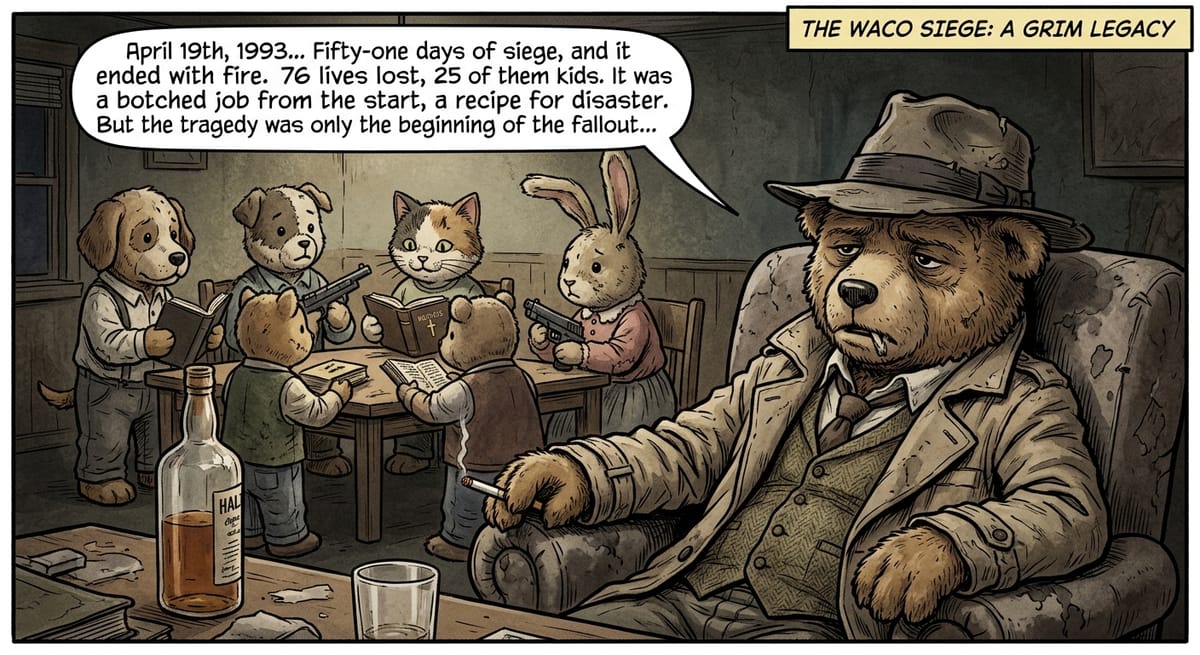
On April 19, 1993, fire swept through the Mount Carmel Center outside Waco, Texas, killing 76 people — including 25 children — after a 51-day FBI siege of the Branch Davidian compound. The Waco standoff began with a botched ATF raid on a religious community suspected of illegal weapons modifications and ended in one of the deadliest law enforcement actions in American history, becoming alongside Ruby Ridge the foundational grievance text of the anti-government militia movement that produced Timothy McVeigh.^1^
The 51-day siege that preceded the fire began with a catastrophically failed raid.
Part of Standoffs and Sieges — ← Back to series hub
The ATF Proceeded with the Raid After Learning Koresh Knew It Was Coming
The Bureau of Alcohol, Tobacco, and Firearms had been investigating the Branch Davidians since 1992 on suspicion that they had converted semiautomatic weapons to automatic fire and were stockpiling illegal firearms and explosives at Mount Carmel. An undercover agent, Robert Rodriguez, had infiltrated the group and confirmed that weapons were present. Plans for a search warrant raid proceeded through early 1993.
On the morning of February 28, 1993, 76 ATF agents arrived at Mount Carmel in cattle trailers. The element of surprise was gone: a local television cameraman had asked a mail carrier for directions to the compound, the mail carrier happened to be a Branch Davidian who warned Koresh, and ATF’s own undercover agent Rodriguez had phoned his supervisor — Special Agent Charles Sarabyn — to report that Koresh knew the raid was coming. Sarabyn proceeded with the raid anyway.^2^
The result was a firefight that killed four ATF agents — Special Agent Conway Le Bleu, Todd McKeehan, Robert Williams, and Steven Willis — and wounded 16 more. Six Branch Davidians were also killed. The ATF withdrew. The FBI’s Hostage Rescue Team took over negotiations. The siege began.
For 51 days, FBI negotiators worked to bring Koresh and the Davidians out peacefully. Koresh released 21 children in the early days of the siege and occasionally expressed willingness to surrender once he had finished writing a religious document — a commentary on the Seven Seals of the Book of Revelation. Negotiations produced periodic releases of individuals but not a resolution.^3^
On April 19, 1993 — the same April 19 that Timothy McVeigh would choose two years later for the Oklahoma City bombing — the FBI initiated an assault using Combat Engineering Vehicles to breach the compound’s walls and inject CS gas, a form of tear gas, throughout the building. The assault was intended to force occupants out. Instead, the compound caught fire approximately six hours after the assault began. The fire burned so rapidly that few people escaped; survivors reported walls of flame that moved in seconds.
Who Was David Koresh and Why Did People Follow Him?
David Koresh was born Vernon Wayne Howell on August 17, 1959, in Houston, Texas. He had dyslexia, a difficult childhood, and a capacity for memorizing and interpreting scripture that drew followers. He joined the Branch Davidians — a splinter group of the Davidian Seventh-day Adventists — in the 1980s, took control of the group through a combination of spiritual authority and personal conflict, and renamed himself David Koresh (“Koresh” being the Hebrew transliteration of Cyrus, as in Cyrus the Great) in 1990.
By the early 1990s, Koresh had established a community of roughly 130 people at Mount Carmel, 10 miles northeast of Waco. He taught an idiosyncratic interpretation of the Book of Revelation in which he was the fulfillment of biblical prophecy. He had multiple “spiritual wives,” including women who were legally minors. Sexual abuse of children in the compound was documented in testimony from former members and in the Children’s Protective Services investigation conducted by the Texas Department of Human Services in 1992 — an investigation that ultimately found insufficient evidence to act, in part because Koresh cooperated.^4^
The Branch Davidians were not a simple story of a deluded flock and a charismatic predator, though those elements were real. They were also a community of people who had chosen to be there, who held genuine religious convictions, and who included attorneys, musicians, and teachers who were not simply passive followers. That complexity does not mitigate Koresh’s abuse of children — it does complicate the government’s depiction of the situation as straightforwardly requiring tactical resolution.
The CS Gas Decision Remains Unexplained
The FBI’s tactical decisions at Waco were shaped partly by the failures of Ruby Ridge six months earlier and partly by institutional pressure to resolve a standoff that had become a media spectacle. Attorney General Janet Reno, who had been confirmed just weeks before the siege began, approved the April 19 assault on the basis of FBI representations that children in the compound were being abused and that the situation was deteriorating. Reno later said she took personal responsibility for the decision.
The specific choice to use CS gas was consequential in ways that were debated afterward. CS gas is banned by the Chemical Weapons Convention from use in warfare — though its domestic law enforcement use remains legal. Research has indicated that it can be particularly dangerous in enclosed spaces and for children and infants. Whether the gas contributed to the fire, or whether the fire was deliberately set by Davidians under orders from Koresh, has never been definitively resolved.^5^
A 1999 investigation ordered by Congress and conducted by Special Counsel John Danforth concluded that the government was not responsible for the fire, that the fire was set by the Davidians, and that pyrotechnic devices used in the assault — which the FBI had denied using for six years before acknowledging them in 1999 — had been used before the fire began but had not caused it. Civil litigation brought by Branch Davidian survivors was dismissed.
The Names of the Dead
Among the 76 people who died on April 19, 1993: David Koresh, 33. Judy Schneider, 41, a mother. Her daughter Mayanah, 2 years old. Steve Schneider, 43. Katherine Andrade, 24. Paiges Anderson, 13. Kimmie Anderson, 1. Cyrus Koresh, 8. Star Koresh, 6. Bobby Howell, 6. Dayland Gent, 3. Page Gent, 1. Melissa Morrison, 6. Serenity Jones, 4. Chica Jones, 2. Little One Jones, 2. Twenty-five of the dead were children.^3^
The ATF agents who died in the initial raid — Le Bleu, McKeehan, Williams, and Willis — were buried with full honors. Their names are on a memorial at ATF headquarters in Washington, D.C.
Waco Became the Template for an Armed Movement’s Grievance
The fallout from Waco was immediate and lasting. Militia groups that had already begun organizing in response to Ruby Ridge cited Waco as confirmation that the federal government was conducting a war against American citizens and their religious liberty. The specific date — April 19 — became loaded with political meaning in anti-government circles. McVeigh chose it deliberately and named Waco as a primary motivation.
Congressional hearings in 1995 — the same summer as the Ruby Ridge hearings — examined the FBI’s conduct and the Justice Department’s decision-making. Attorney General Reno testified multiple times. FBI Director William Sessions had been fired during the siege; his successor, Louis Freeh, oversaw the subsequent review.
The siege also transformed public and political debate about federal law enforcement tactics, the use of force against religious communities, and the rights of paramilitary-style law enforcement. David Kopel and other legal scholars argued that the entire operation — from the initial ATF raid to the final assault — had been a series of escalating errors in which tactical decision-making repeatedly displaced negotiated resolution as the preferred approach. The Weather Underground had bombed federal buildings in an earlier era for different ideological reasons; Waco produced a different kind of violent reaction, rooted in rural anti-government politics rather than left-wing radicalism.
The compound burned to the ground. The property remained in litigation for years. A memorial and visitors center was eventually built on the site by Branch Davidian survivors and supporters.
What the Government Concluded and What Didn’t Get Settled
The survivors of the Waco siege faced prosecution for their roles in the February 28 firefight. Eleven Branch Davidians were tried in 1994; five were acquitted of all charges, and several others were convicted of lesser charges. Judge Walter Smith imposed sentences that were appealed to the Fifth Circuit Court of Appeals and ultimately produced a resentencing in 2000 that reduced prison terms for most defendants.
What was not contained was the event’s meaning in American political life. Waco became, alongside Ruby Ridge, the foundational grievance text of the anti-government militia movement. Its details — the CS gas, the tanks, the fire, the 25 children — were repeated in militia publications, gun show conversations, and online forums throughout the 1990s and beyond. The Bundy standoffs in 2014 and 2016 invoked Waco. The January 6 insurrection drew from the same tradition.
The 51-day siege ended on April 19, 1993. Seventy-six people died. The government concluded it bore no responsibility for the fire. That conclusion has not settled the political meaning of what happened in the hills outside Waco — a meaning that has shaped American domestic political violence for more than 30 years.
─────────
Sources:
- Thibodeau, David, and Leon Whiteson. A Place Called Waco: A Survivor’s Story. PublicAffairs, 1999.
- Wright, Stuart A., ed. Armageddon in Waco: Critical Perspectives on the Branch Davidian Conflict. University of Chicago Press, 1995.
- Danforth, John C. Final Report to the Deputy Attorney General Concerning the 1993 Confrontation at the Mt. Carmel Complex, Waco, Texas. U.S. Department of Justice, 2000.
- Tabor, James D., and Eugene V. Gallagher. Why Waco? Cults and the Battle for Religious Freedom in America. University of California Press, 1995.
- House of Representatives. Investigation into the Activities of Federal Law Enforcement Agencies Toward the Branch Davidians. 104th Congress, 2nd Session, 1996.