Eric Rudolph: The Olympic Bomber Who Hid in the Mountains
Eric Rudolph bombed the 1996 Olympics and three more targets then vanished into a national forest for five years — the FBI spent $24 million and never found him.
Eric Rudolph: The Olympic Bomber Who Hid in the Mountains
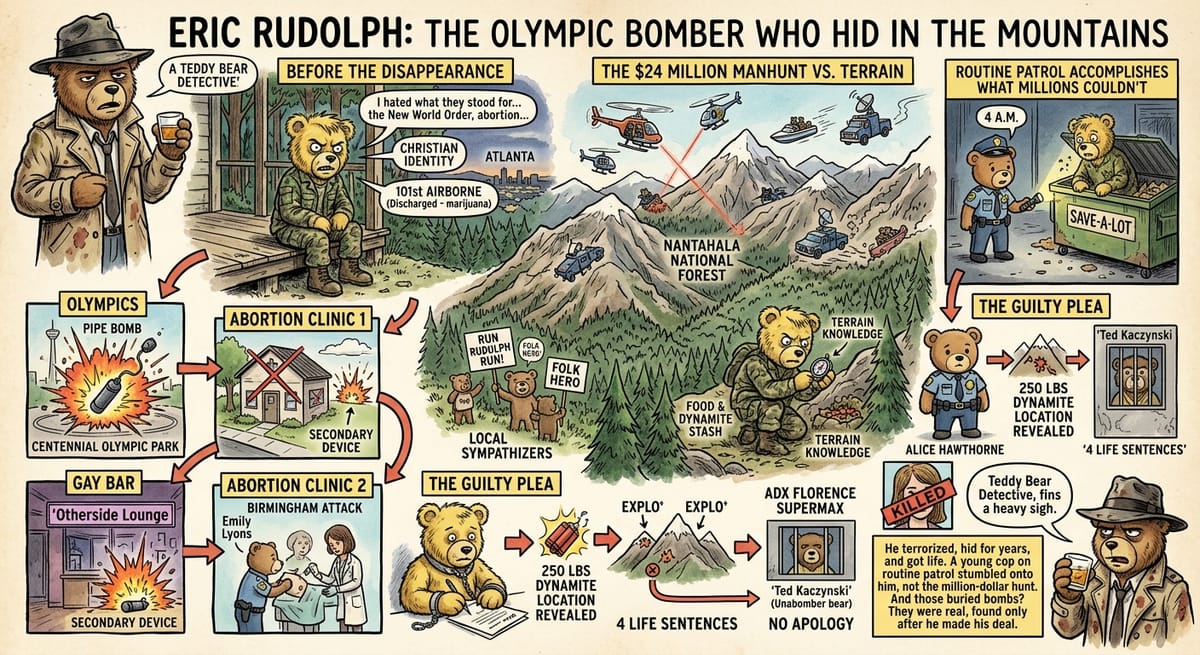
Eric Rudolph bombed the 1996 Olympics, two abortion clinics, and a gay bar — then vanished into a national forest for five years while the FBI spent $24 million looking for him. He wasn’t caught by that manhunt. A 21-year-old officer on a routine patrol noticed someone digging through a dumpster at 4 a.m. and arrested him on suspicion of vagrancy. Rudolph is the clearest example in American domestic terrorism history of how ideological coherence and terrain knowledge can defeat a federal law enforcement apparatus that lacks both.^1^
On July 27, 1996, a pipe bomb exploded in Centennial Olympic Park in Atlanta, Georgia, during a concert at the Summer Olympics. Two people died. Alice Hawthorne, a 44-year-old woman from Albany, Georgia, was killed by the blast; Turkish journalist Melih Uzunyol died of a heart attack while running toward the explosion. More than 100 others were injured. For several years, the FBI pursued the wrong man — a security guard named Richard Jewell, who had actually spotted the bomb and helped evacuate the area — before the real bomber had already moved on to his next targets.
Who Rudolph Was Before He Disappeared
Eric Robert Rudolph was born on September 19, 1966, in Merritt Island, Florida. His family moved to rural North Carolina when he was a teenager, settling in a community with ties to Christian Identity — an extremist theological movement that claimed Anglo-Saxons were the true Israelites and that Jews and nonwhite people were subhuman. His mother had a connection to these circles. Rudolph later described being drawn to the movement’s rejection of what he called the “New World Order” and its radical opposition to abortion.
He served in the United States Army from 1987 to 1989, including a stint as a paratrooper with the 101st Airborne Division at Fort Campbell, Kentucky. He was discharged — officially for marijuana use — and returned to North Carolina. By the mid-1990s, he was living in rural Andrews, North Carolina, farming marijuana, and moving toward violent action.^2^
Rudolph was ideologically coherent in a way that made him more dangerous, not less. He did not strike randomly. He selected targets that embodied what he opposed: international events (the Olympics), abortion providers, gay bars. His campaign was four attacks over two years, all in the Southeast.
Four Bombings Designed to Kill Twice: The Secondary Device Strategy
After the Centennial Olympic Park bombing on July 27, 1996, Rudolph struck three more times. On January 16, 1997, he detonated two bombs at an abortion clinic — the Sandy Spring Family Resource Center in Sandy Springs, Georgia, a suburb north of Atlanta. The second bomb was designed to explode as first responders arrived — a technique called a “secondary device,” intended to maximize casualties among law enforcement and emergency personnel. Seven people were injured.
On February 21, 1997, he bombed The Otherside Lounge, a lesbian bar in Atlanta. Five people were injured in that attack, again with a secondary device planted to target first responders.
His most destructive single act came on January 29, 1998, at the New Woman All Women Health Care clinic in Birmingham, Alabama. The bomb killed Robert Sanderson, an off-duty Birmingham police officer working as a clinic security guard, and critically injured nurse Emily Lyons, who lost an eye, part of her hand, and suffered lasting internal injuries from the blast.^3^ Rudolph had observed the clinic beforehand, placing the device with precision. A medical student named Jermaine Hughes spotted Rudolph near the scene and was able to describe his truck and a partial license plate number, which the FBI traced — finally giving investigators a concrete lead.
Rudolph fled into the Nantahala National Forest in January 1998 and disappeared. The FBI launched what they called the largest manhunt in North American history: more than 200 agents at its peak, infrared surveillance, helicopter searches, military assistance. Local residents in the rural area — many of whom shared Rudolph’s political sympathies or simply valued privacy from federal intrusion — did not cooperate extensively. Some were openly supportive. He was not found.
Why a $24 Million Manhunt Failed Where a Rookie Officer Succeeded
The manhunt cost an estimated $24 million and consumed enormous investigative resources that produced nothing for five years. Meanwhile, Rudolph was surviving on acorns, wild plants, and occasional raided stores — he later told investigators he lost 50 pounds in the first two years. He had stashed large quantities of food before disappearing. He knew the terrain in a way federal investigators did not.
The five-year fugitive period raised uncomfortable questions about how a wanted domestic terrorist with multiple murders on his record could evade one of the largest law enforcement operations in American history for five years in a national forest in North Carolina. Part of the answer was terrain. Part was the political environment: Rudolph had sympathizers. “Run, Rudolph, Run” bumper stickers appeared in Cherokee County, North Carolina. Some residents in Murphy held him as a folk hero.^4^
That local sympathy is itself a data point. Rudolph’s targets — abortion clinics, a gay bar, international institutions — aligned with a specific strain of American political and religious sentiment. He was a terrorist, but he was also someone whose ideology was widely shared, if not his methods. That gap between ideology and action is where radicalization lives, and it’s the same gap documented in the Army of God’s four-decade campaign against abortion providers.
What His Guilty Plea Required and What It Didn’t Settle
Officer Jeff Postell arrested Rudolph at approximately 4 a.m. on May 31, 2003, outside a Save-A-Lot grocery store in Murphy, North Carolina. Postell was a 21-year-old police officer on routine patrol. He noticed a man behind the store, approached him, and Rudolph gave a false name. Postell ran the name, got no hits, and arrested him anyway on suspicion of vagrancy. Fingerprints confirmed his identity.
Rudolph was charged with four bombings across two states — Georgia and Alabama — under federal anti-terrorism statutes. In April 2005, he pleaded guilty to all charges in two separate plea agreements negotiated simultaneously in Georgia and Alabama. The terms required him to reveal the locations of hidden explosives — including 250 pounds of dynamite he had buried in different caches, which had to be safely recovered. In exchange, he received four consecutive life sentences without the possibility of parole, avoiding the death penalty.^5^
He is currently incarcerated at ADX Florence in Colorado — the same federal supermax where Ted Kaczynski spent his final decades. Rudolph has written extensively from prison, maintaining a website through which he has published essays defending his ideology and his actions. He has never apologized.
Robert Sanderson, killed in Birmingham on January 29, 1998, was 35 years old. He left a wife and two children. Emily Lyons has had more than 30 surgeries since the bombing and has become a public advocate for abortion access, speaking at congressional hearings and in media appearances. Alice Hawthorne, killed at the Olympics, had brought her daughter, Fallon, to Atlanta specifically to watch the Games.
Rudolph’s capture after five years in the wilderness was accidental. The $24 million manhunt did not find him. A young officer on a routine patrol did. Rudolph had been effective: he had killed two people directly, critically injured two more, and terrorized abortion clinic workers and LGBTQ spaces across the Southeast for years. He had made it clear to providers and patients alike that showing up was dangerous. He is in prison for life. His bombs are not. The 250 pounds of explosives he buried in the North Carolina mountains — recovered under the terms of his plea — were real. The caches were real. The planning was real. And none of it was neutralized by anything the FBI did over five years. It was neutralized by Rudolph’s own willingness to trade information to avoid execution, and by a 21-year-old officer who noticed someone digging in a dumpster at 4 in the morning.
─────────
Part of Ideological Terror — ← Back to series hub
Sources:
- Schuster, Henry, and Charles Stone. Hunting Eric Rudolph. Berkley Books, 2005.
- Vollers, Maryanne. Lone Wolf: Eric Rudolph — Murder, Myth, and the Pursuit of an American Outlaw. HarperCollins, 2006.
- United States Department of Justice. United States v. Eric Robert Rudolph: Plea Agreement Documents. U.S. District Court, Northern District of Alabama, April 2005.
- Gettleman, Jeffrey. “After 5 Years, Olympic Bombing Suspect Is Caught.” New York Times, June 1, 2003.
- Federal Bureau of Investigation. CENTBOM/SHOCK/TWINBOM/WASBOM Task Force Records. U.S. Department of Justice, 1996–2005.