American Assassinations: When the Country Kills Its Leaders
Four presidents killed by gunfire. At least seven more survived. From Lincoln in 1865 to Reagan in 1981 — the full history of political violence against American leaders.
American Assassinations: When the Country Kills Its Leaders
Four American presidents have been killed in office by gunfire. At least seven more survived attempts. The span runs from 1835 — when Richard Lawrence’s two pistols misfired at Andrew Jackson on the Capitol steps — to the present, a nearly 200-year thread of political violence that no other comparable democracy has come close to matching. The United Kingdom has not had a head of government assassinated since Spencer Perceval in 1812. France has not lost a president to assassination. The pattern in America is not an aberration. It is a recurrence.
The Violence Never Produced the Consequences the Killers Wanted
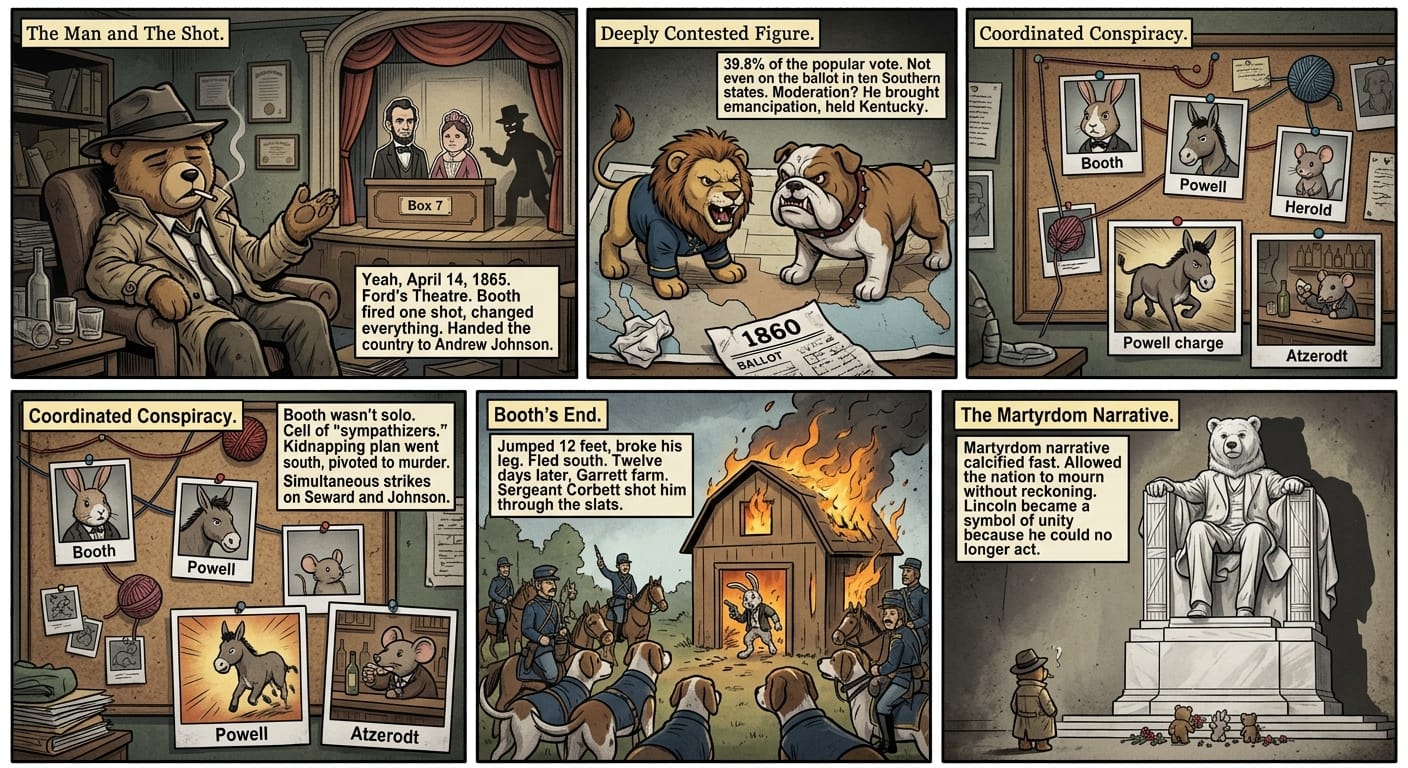
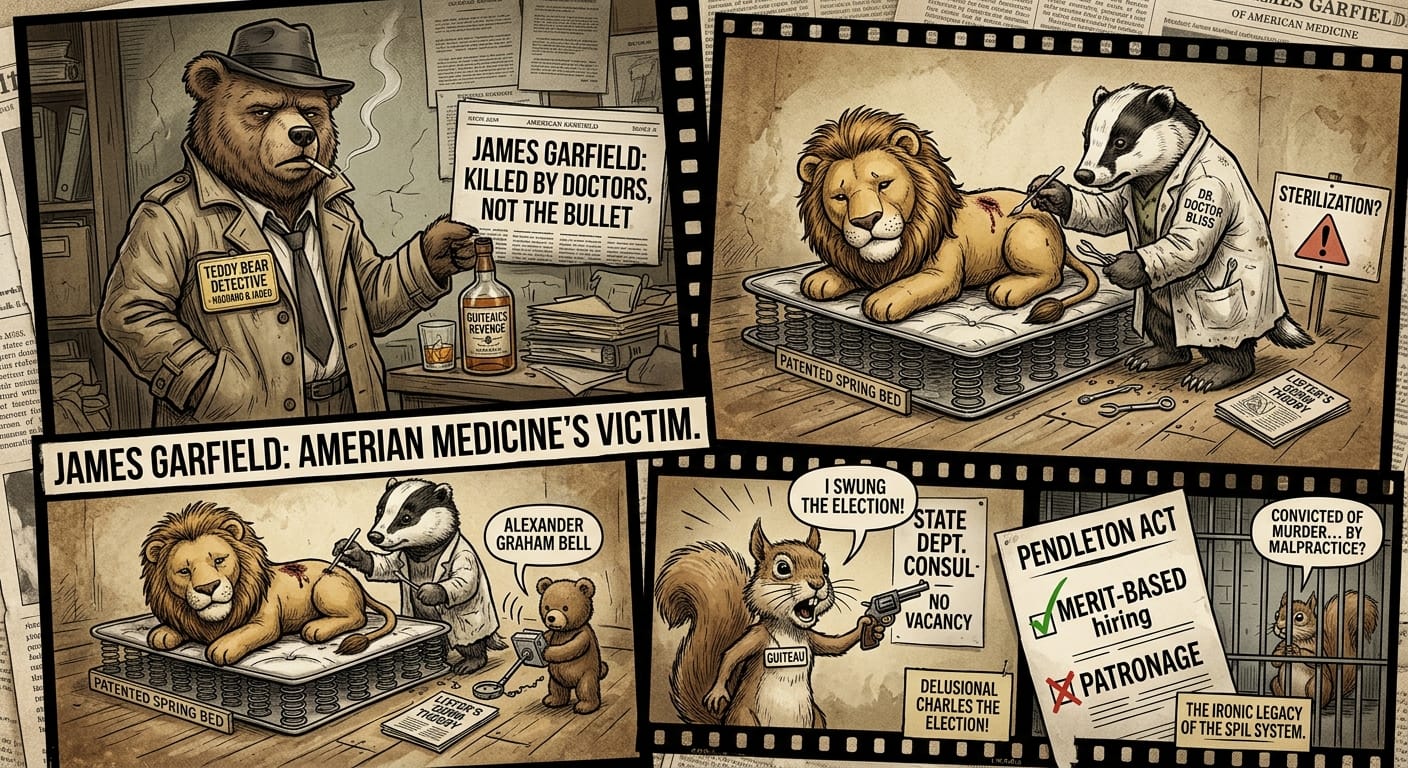
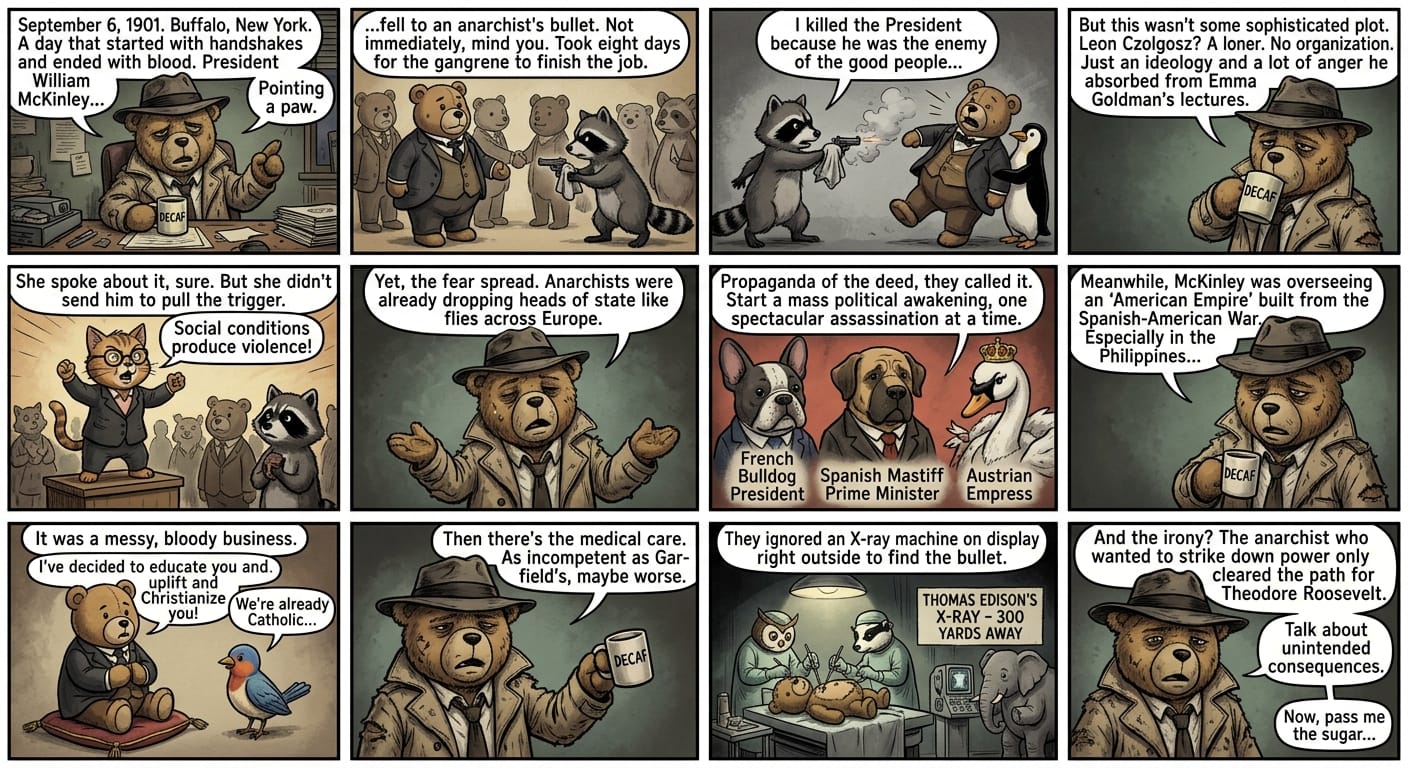
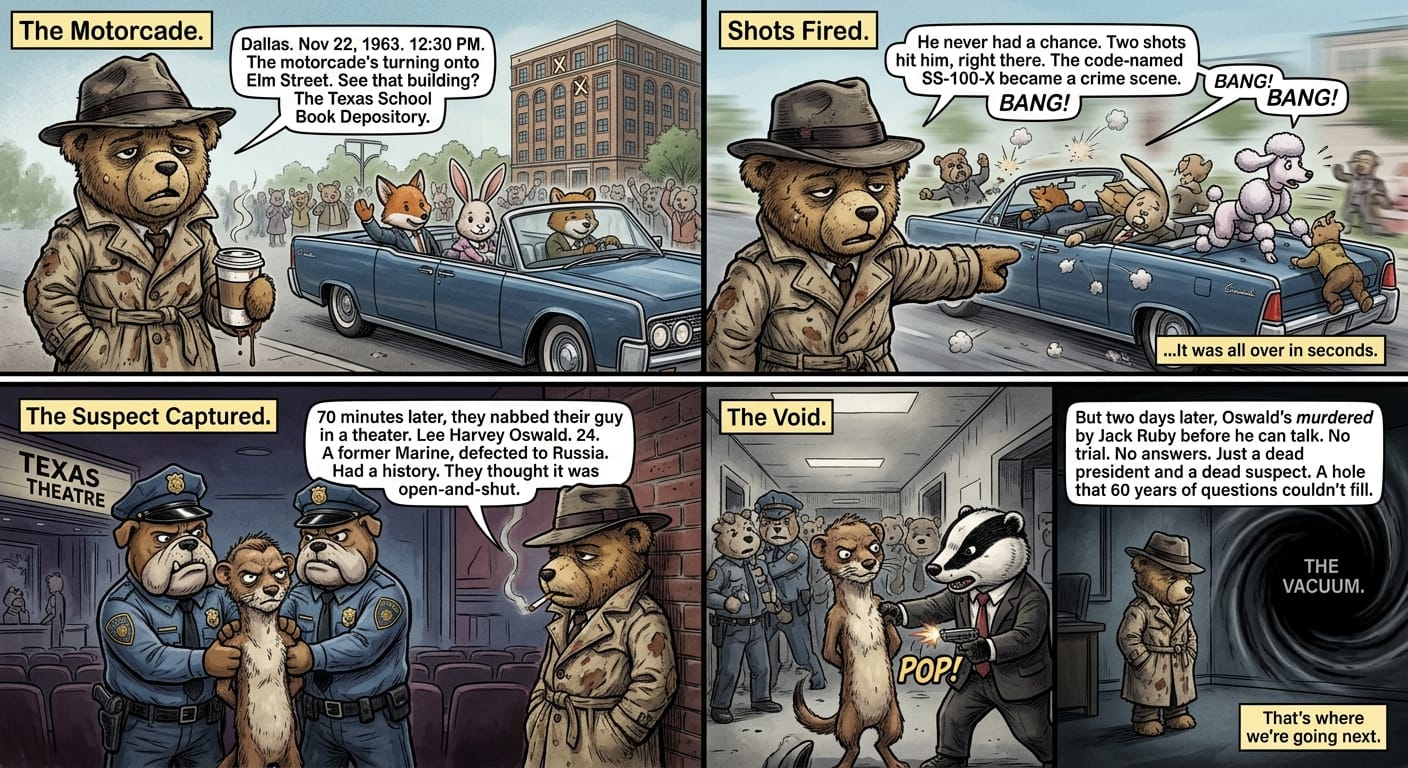
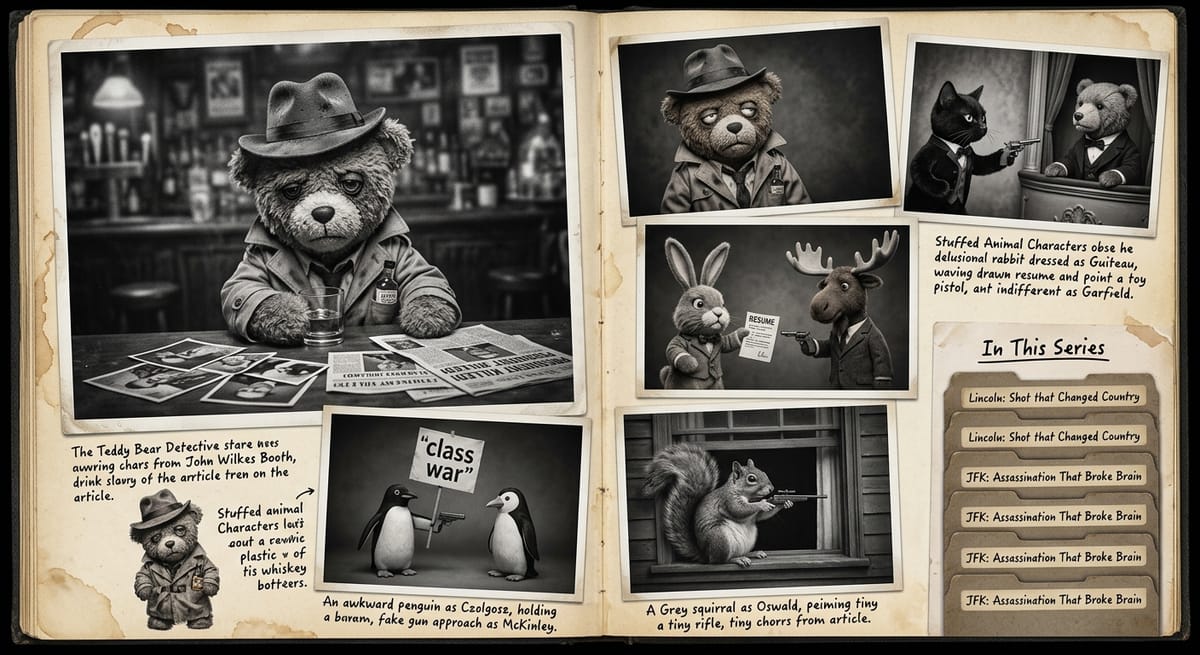
The four successful assassinations — Lincoln in 1865, Garfield in 1881, McKinley in 1901, Kennedy in 1963 — were carried out by four different kinds of men for four different reasons. John Wilkes Booth was a Confederate sympathizer avenging a lost war. Charles J. Guiteau was a delusional office-seeker who believed he was acting for a political faction. Leon Czolgosz was a self-radicalized anarchist motivated by class war ideology. Lee Harvey Oswald’s full motivation remains genuinely disputed, though his history of documented political grievances and violence is not.
No single profile fits all four. No consistent ideology, no consistent grievance structure, no consistent organizational backing. What they share is a belief — each in his own framework — that killing the president was a meaningful political act. That belief was wrong in every case. Lincoln’s death accelerated the collapse of Reconstruction. Garfield’s death reformed the spoils system Guiteau had been trying to exploit. McKinley’s death elevated Theodore Roosevelt, arguably the most progressive president since Lincoln. Kennedy’s death helped pass the Civil Rights Act that Kennedy had been unable to push through Congress himself. The violence consistently produced consequences the killers did not intend and, in several cases, the opposite of what they wanted.
The Institutional Response Has Always Been Reactive
The Secret Service was established in 1865 to combat counterfeiting — on the same day Lincoln was shot, though the two events were unrelated. It did not take on presidential protection as a primary function until after McKinley’s assassination in 1901. The rigorous security architecture surrounding the modern presidency — armored vehicles, counter-sniper teams, advance security sweeps, magnetometers — is the cumulative product of every assassination and every near-miss, built backward from specific failures. The Presidential Protection division was rebuilt after Dallas. The Brady Act of 1993 was passed because James Brady’s 1981 injuries finally moved Congress to act on background checks, 12 years after he was shot standing next to Ronald Reagan.
American institutions respond to political violence by closing the barn door after the horse is gone. That is the record.
Why This History Keeps Getting Distorted
Lincoln became a martyr so useful to national unity that his assassination was politically metabolized within his own era. The mythology calcified quickly enough that his death could be mourned without examining what it made possible — Johnson’s presidency, the rapid dismantling of Reconstruction, the century of Jim Crow. Garfield is largely forgotten, which is itself a distortion: a president whose death produced lasting structural reform deserves more than footnote status. McKinley is similarly underexamined, despite dying while governing an expanding American empire. Kennedy has the opposite problem — so much has been written, theorized, and mythologized that the actual documented history of Lee Harvey Oswald and November 22, 1963 can be hard to locate beneath the accumulated conspiracy literature.
The distortions are not random. They follow the pattern of what America has found useful to believe about its own political violence — that it is exceptional, explicable, and resolved. None of those three things has consistently been true. The same impulse toward acceptable mythology shaped how the country processed the assassinations of MLK and Malcolm X in the same decade as Kennedy and RFK.
In This Series
The six articles in this series cover each assassination and the cluster of survival stories in full:
- Abraham Lincoln: The Shot That Changed the Country — The first presidential assassination, and what happened when it removed the one man who might have held Reconstruction together.
- James Garfield: Killed by a Man Who Wanted a Government Job — The assassination no one remembers, and the reform law it produced.
- William McKinley: The Anarchist’s Bullet — The anarchist movement, the Pan-American Exposition, and the accidental elevation of Theodore Roosevelt.
- JFK: The Assassination That Broke America’s Brain — What is actually known about November 22, 1963, and why the conspiracy ecosystem exists.
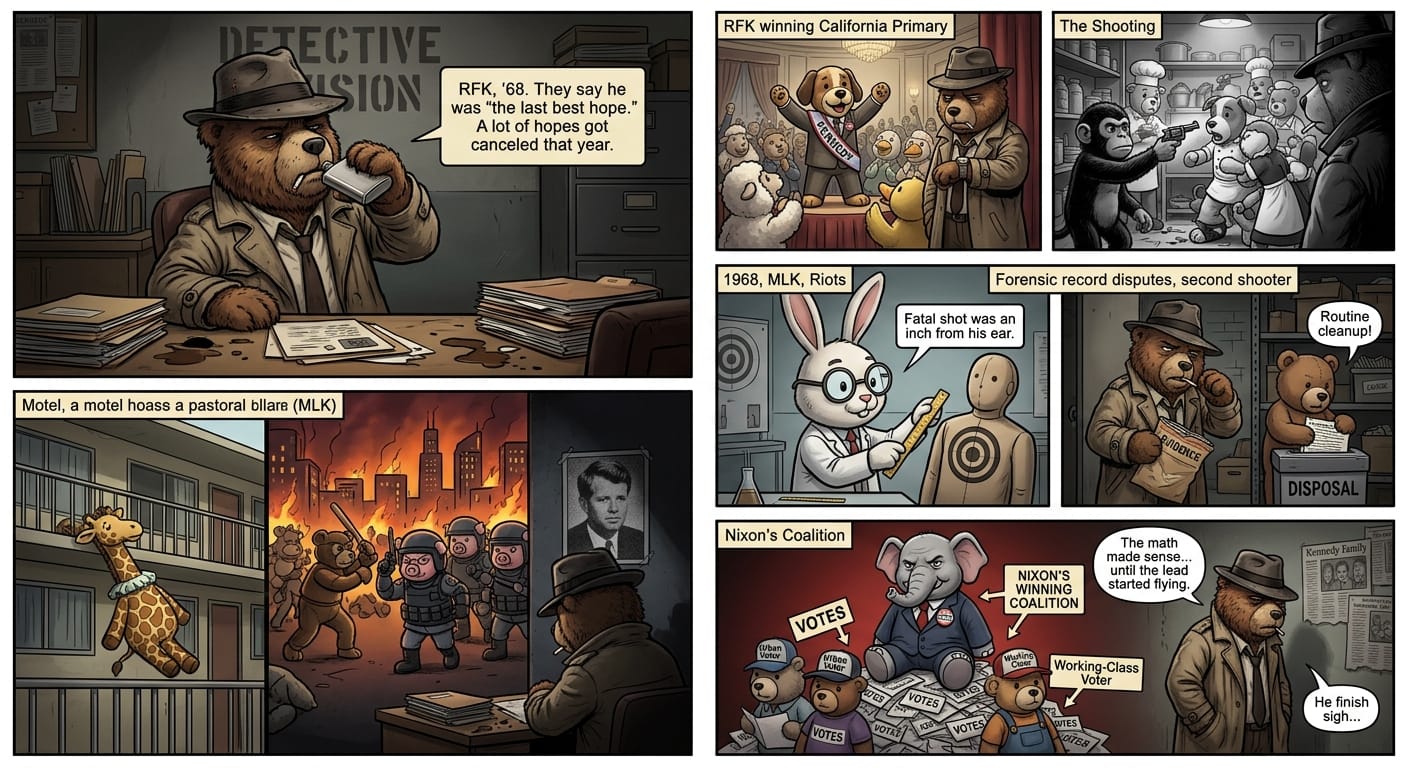
- RFK: The Second Kennedy to Die by Assassination — 1968, the weight of the year, and what the second Kennedy killing meant for American politics.
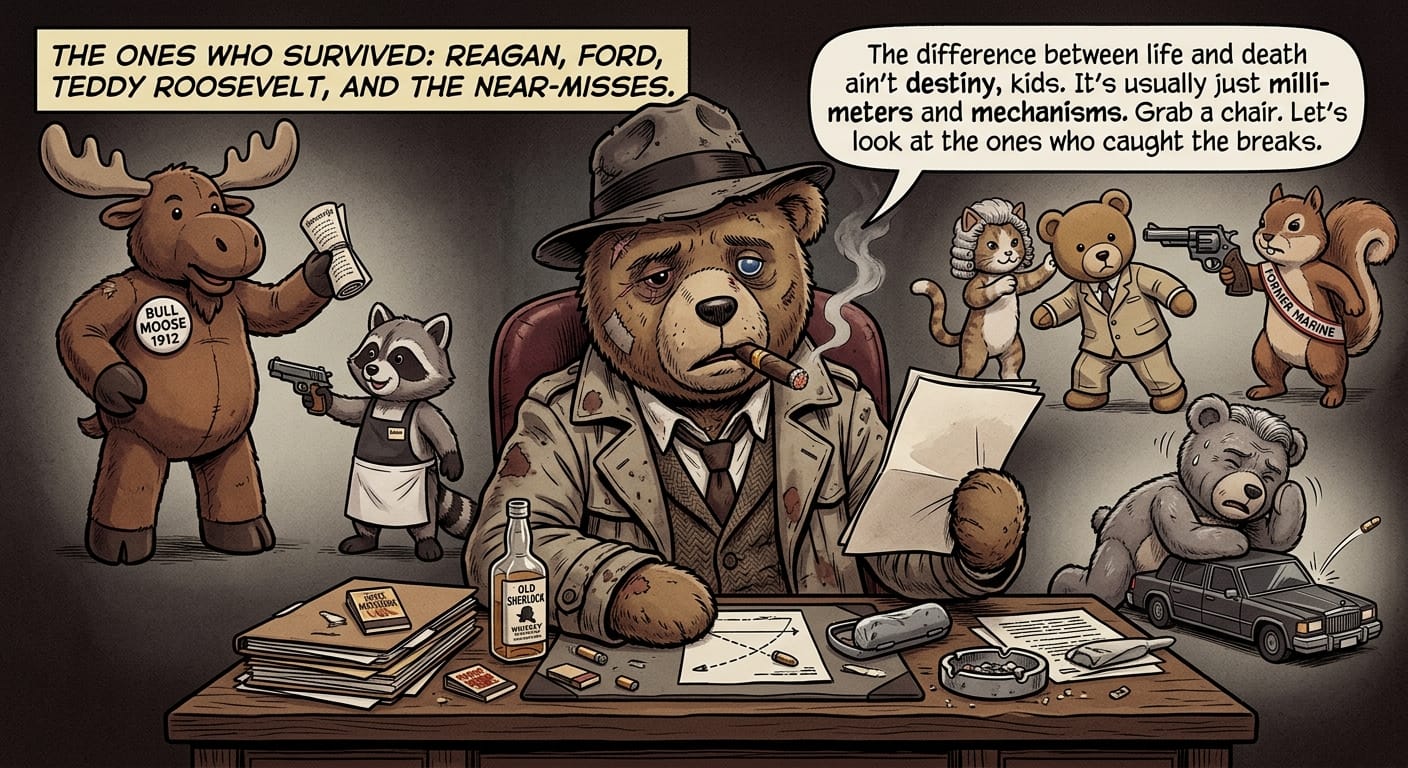
- The Ones Who Survived: Reagan, Ford, Teddy Roosevelt, and the Near-Misses — Seven attempts, seven different stories, and what the survival column reveals.
Four presidents killed. Roughly a dozen more targeted. An institution that survived all of it, though the men themselves did not. The presidency has proven more durable than the presidents — which is either a testament to American institutional design or a reminder that the office continues regardless of what happens to the person inside it. That distinction is worth sitting with.
─────────
Sources:
- Ackerman, Kenneth D. Dark Horse: The Surprise Election and Political Murder of President James A. Garfield. Carroll & Graf, 2003.
- Swanson, James L. Manhunt: The 12-Day Chase for Lincoln’s Killer. William Morrow, 2006.
- Rauchway, Eric. Murdering McKinley: The Making of Theodore Roosevelt’s America. Hill and Wang, 2003.
- Kaiser, Frederick M. “Presidential Protection: The Historical Record.” Congressional Research Service, Library of Congress, 2011.
The Series