JFK: The Assassination That Broke America's Brain
Kennedy was shot in Dealey Plaza on November 22 1963 — and the murder of his accused killer two days later created a vacuum 60 years of conspiracy theories still fill.
JFK: The Assassination That Broke America’s Brain
John F. Kennedy was shot and killed in Dallas, Texas on November 22, 1963. The man charged with the killing was murdered two days later before he could stand trial. That gap — a dead president and a dead suspect — is where more than 60 years of conspiracy theories have lived ever since.
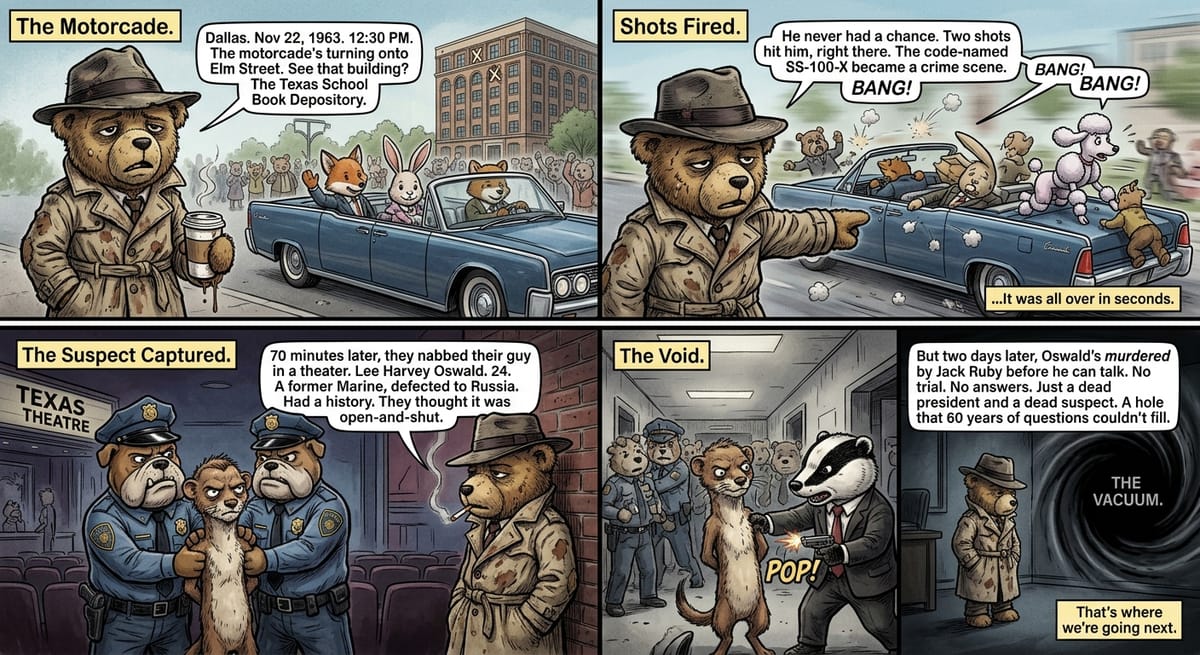
At 12:30 p.m. on November 22, 1963, John F. Kennedy was shot while riding in a presidential motorcade through Dealey Plaza in Dallas, Texas. The presidential limousine — a 1961 Lincoln Continental convertible, code-named SS-100-X — was passing the Texas School Book Depository at 411 Elm Street when the shots were fired. Kennedy was hit twice: once in the upper back, once in the head. He was pronounced dead at Parkland Memorial Hospital at 1:00 p.m. He was 46 years old.
The man charged with the killing, Lee Harvey Oswald, was arrested 70 minutes after the shooting at a movie theater in the Oak Cliff neighborhood of Dallas. Two days later, on November 24, while being transferred from the Dallas Police headquarters to the county jail, Oswald was shot and killed in the basement of the police building by Jack Ruby, a nightclub owner who said he acted to spare Jacqueline Kennedy the ordeal of a trial. Oswald died without trial and without giving a coherent account of his actions.
Those two facts — the assassination itself, and the murder of the accused assassin two days later — created a vacuum that American public life has never fully filled.
Kennedy Was Governing at the Edge of Nuclear War When He Was Killed
Kennedy had been president since January 20, 1961, and had governed through a period of maximal Cold War tension. The Bay of Pigs invasion, April 1961, was a catastrophic failure: a CIA-trained force of approximately 1,400 Cuban exiles landed at the Bay of Pigs in Cuba and was defeated within three days. Kennedy publicly accepted responsibility, but privately blamed the CIA and the Joint Chiefs. The relationship between Kennedy and the intelligence apparatus deteriorated from that point forward.
The Cuban Missile Crisis of October 1962 brought the world closer to nuclear war than at any other documented point in history. Soviet missiles had been installed in Cuba, within 90 miles of Florida. For thirteen days, Kennedy managed negotiations with Soviet Premier Nikita Khrushchev, ultimately securing the removal of the missiles in exchange for a private pledge not to invade Cuba and the later removal of American Jupiter missiles from Turkey. Kennedy’s handling of the crisis is widely credited with preventing nuclear war. Classified documents from both American and Soviet archives, declassified in the 1990s, reveal that tactical nuclear weapons had already been authorized for use by Soviet field commanders in Cuba if the island was invaded.^1^
By November 1963, Kennedy was also deepening American involvement in Vietnam. There were approximately 16,000 U.S. military advisers in South Vietnam at the time of his death. Whether Kennedy would have escalated to full combat deployment — as Lyndon Johnson did — is one of the permanent open questions of the era. National Security Action Memorandum 263, signed October 11, 1963, called for the withdrawal of 1,000 advisers by the end of the year. Johnson reversed this with NSAM 273, signed November 26, 1963, four days after the assassination.
What the Record Actually Shows About Oswald
Lee Harvey Oswald was 24 years old at the time of the shooting. He had served in the U.S. Marine Corps, where he had been trained as a radar operator and achieved the rank of private first class before being reduced to private. He had defected to the Soviet Union in October 1959, lived in Minsk for nearly three years, married a Soviet woman named Marina Prusakova, and returned to the United States in June 1962 with his wife and infant daughter. The State Department helped facilitate his return.
In the spring of 1963, Oswald ordered a Mannlicher-Carcano 6.5mm rifle by mail under the name A. Hidell, using a post office box in Dallas. The rifle, serial number C2766, was identified as the murder weapon by the Warren Commission. In April 1963, Oswald attempted to assassinate retired Army General Edwin Walker at his home in Dallas, firing a single shot that narrowly missed. Walker survived. The Walker shooting was not publicly connected to Oswald until after the Kennedy assassination.
In the fall of 1963, Oswald was in New Orleans, distributing Fair Play for Cuba Committee leaflets. In late September, he traveled to Mexico City and visited both the Cuban and Soviet consulates, apparently trying to obtain a visa to travel to Cuba via the Soviet Union. Both consulates turned him down.^2^
The Warren Commission, established by Lyndon Johnson and chaired by Chief Justice Earl Warren, concluded in September 1964 after ten months of investigation that Oswald acted alone. The House Select Committee on Assassinations, which re-investigated the case in 1979, concluded that Kennedy was “probably assassinated as a result of a conspiracy,” based partly on acoustic evidence from a Dallas Police Department dictabelt recording that seemed to indicate a fourth shot from the grassy knoll. That acoustic evidence was subsequently challenged and largely debunked by the National Research Council in 1982.
Why Do So Many Americans Still Believe in a JFK Conspiracy?
The conspiracy theories surrounding Kennedy’s assassination are not simply the product of irrationality. They are the product of opacity. The Warren Commission conducted its investigation with significant amounts of classified information withheld from public view. The CIA did not fully disclose its pre-assassination contacts with Oswald or its knowledge of his Mexico City visit. FBI Director J. Edgar Hoover — the same Hoover running COINTELPRO against civil rights leaders at the same time — suppressed information about Oswald’s file. Jack Ruby had documented ties to organized crime figures in Dallas and Chicago.
The Assassination Records Collection Act of 1992 mandated the release of all government records related to the assassination by 2017. That deadline was extended, first by President Trump, then by President Biden, and then again. As of early 2025, thousands of documents remain classified or partially redacted, more than 61 years after the event. The continued classification fuels suspicion in direct proportion to the secrecy.^3^
Polling consistently shows that a majority of Americans believe a conspiracy was involved. A 2023 Reuters/Ipsos poll found that 65% of Americans did not believe the “lone gunman” account. What this reflects is not a finding about what happened in Dealey Plaza — it reflects a finding about trust in government institutions that were demonstrably not telling the full truth about what they knew, even if they were not conspiring in the killing itself.
Kennedy’s Death Passed His Civil Rights Agenda — and Rewrote His Security Forever
Kennedy’s assassination transformed the Secret Service. The Presidential Protection division was overhauled within months. Open convertible motorcades through crowded urban streets became essentially impossible. The limousine itself was redesigned — SS-100-X was eventually rebuilt with a permanent roof and bullet-resistant materials and remained in service, controversially, until 1977.
The assassination also accelerated Kennedy’s legislative agenda in a way his life had not. Lyndon Johnson used Kennedy’s death as moral leverage to pass the Civil Rights Act of 1964 and the Voting Rights Act of 1965, telling Congress explicitly that the best memorial to Kennedy was action on civil rights. It worked. Whether it would have worked with Kennedy alive — given the resistance he’d already encountered — remains unclear. The same dynamic recurred in 1968, when RFK’s assassination reshaped the Democratic primary and handed Richard Nixon the presidency.^4^
The emotional architecture of the assassination also produced a particular American posture toward political violence: the suspicion that nothing is accidental, that events of sufficient magnitude must have sufficient causes, and that official explanations are inherently inadequate. That posture was already forming in 1963. It has not gone away.^5^
Kennedy has been dead for more than 60 years. The conspiracy theories will not resolve. The withheld documents, if and when released, will produce new arguments rather than settle old ones. What can be said with confidence: a 24-year-old former defector with a documented history of political violence, a mail-order rifle, and a job in a building overlooking the motorcade route shot the president of the United States. Whether anyone told him to, or helped him, or knew in advance — that question remains genuinely open. The uncertainty is not comfortable, but it is honest.
─────────
Part of Presidential Assassinations — ← Back to series hub
Sources:
- Allison, Graham. Essence of Decision: Explaining the Cuban Missile Crisis. 2nd ed. Longman, 1999.
- Posner, Gerald. Case Closed: Lee Harvey Oswald and the Assassination of JFK. Random House, 1993.
- Blunt, Shelby. “JFK Files: What’s Still Being Withheld and Why.” Politico, October 2023.
- Manchester, William. The Death of a President. Harper & Row, 1967.
- House Select Committee on Assassinations. Final Report. U.S. Government Printing Office, 1979.