Abraham Lincoln: The Shot That Changed the Country
Lincoln was shot at Ford's Theatre on April 14 1865 — and his death handed Andrew Johnson the presidency and accelerated the collapse of Reconstruction.
Abraham Lincoln: The Shot That Changed the Country
The Lincoln assassination on April 14, 1865, killed the one man positioned to hold Reconstruction together — and handed the presidency to Andrew Johnson, who proceeded to dismantle it. John Wilkes Booth fired a single shot at Ford’s Theatre in Washington, D.C. Lincoln never regained consciousness. He died the following morning.
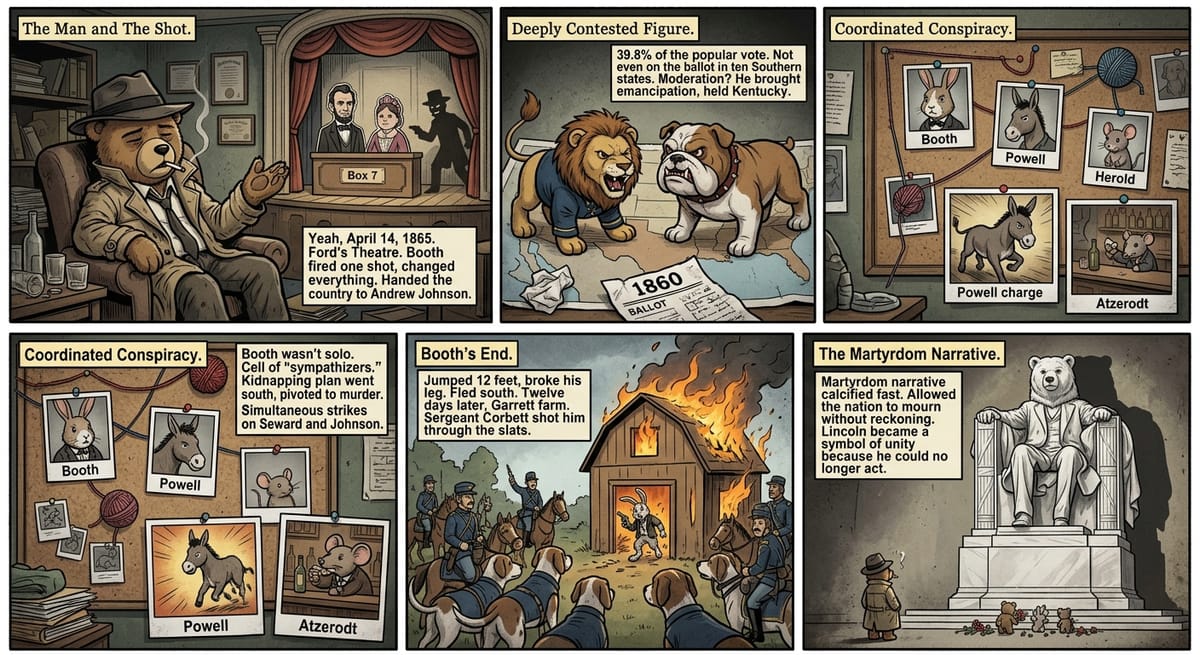
On the night of April 14, 1865, Abraham Lincoln sat in a red upholstered rocking chair in Box 7 of Ford’s Theatre, watching a performance of Our American Cousin. Five days earlier, Robert E. Lee had surrendered at Appomattox Court House. The Civil War was functionally over. Lincoln had not slept well in weeks, and his wife Mary Todd had almost cancelled the outing. He went anyway.
At 10:15 p.m., John Wilkes Booth stepped into the presidential box and fired a single .44-caliber ball from a Philadelphia Deringer into the back of Lincoln’s skull, just behind his left ear. Lincoln never regained consciousness. He was carried across 10th Street to the Petersen House, a boarding house owned by William Petersen, where he died at 7:22 a.m. on April 15, 1865. He was 56 years old.
Lincoln Entered the Presidency as a Deeply Contested Figure
Lincoln had entered the presidency in March 1861 winning the 1860 election with 39.8% of the popular vote, not appearing on the ballot in ten Southern states. He was not a moderate on slavery. He was opposed to its expansion and, by 1862, had decided emancipation was both a moral necessity and a military strategy. The Emancipation Proclamation took effect January 1, 1863, freeing enslaved people in Confederate-held territory. It did not free those in Union-held border states — a political calculation Lincoln made deliberately, keeping Kentucky and Missouri in the Union.
By the time of his second inauguration on March 4, 1865, Lincoln had shepherded the 13th Amendment through Congress. It was ratified in December 1865, eight months after his death. The amendment he worked for, he did not live to see finalized.
Booth Was Running a Coordinated Conspiracy, Not a Solo Operation
Booth led a cell of Confederate sympathizers that originally plotted to kidnap Lincoln in March 1865 and hold him ransom for Confederate prisoners. When the war’s end made that plan obsolete, Booth pivoted to assassination. The original scheme included simultaneous strikes on Vice President Andrew Johnson and Secretary of State William Seward on the same night.
Lewis Powell carried out the attack on Seward at his home on Lafayette Square, stabbing him repeatedly in the face and neck. Seward survived, though he bore scars for the rest of his life. George Atzerodt, assigned to kill Johnson, lost his nerve and got drunk at a bar near the Kirkwood House hotel instead. Johnson was unharmed.
Booth fled Ford’s Theatre, broke his leg jumping from the presidential box to the stage — a drop of about 12 feet — and escaped south into Maryland with co-conspirator David Herold. Twelve days later, on April 26, 1865, Union cavalry surrounded the Garrett farm near Port Royal, Virginia. Herold surrendered. Booth refused to come out. Sergeant Boston Corbett shot him through a gap in the barn slats. Booth died approximately two hours later.^1^
Did Lincoln’s Death Actually Make Reconstruction Fail?
The question has a concrete answer grounded in what actually happened after he died. Andrew Johnson, who became the 17th president, immediately began dismantling Reconstruction. Johnson vetoed the Civil Rights Act of 1866 (Congress overrode him), opposed the 14th Amendment, and restored former Confederate officials to power across the South. By 1877, the Compromise of 1877 ended Reconstruction entirely, withdrawing federal troops from the South and leaving formerly enslaved Black Americans to face the Black Codes, convict leasing, and ultimately the Jim Crow system that would hold for nearly a century.
Lincoln had a different vision, articulated in his second inaugural: “with malice toward none, with charity for all.” Whether that vision would have been strong enough to hold against Southern resistance is unknowable. What is known is that his absence made things measurably worse, and measurably faster.
The Martyrdom Narrative Calcified Fast Enough to Prevent Reckoning
Within 24 hours of Lincoln’s death, Secretary of War Edwin Stanton reportedly said, “Now he belongs to the ages.” The phrase — disputed by historians, possibly misquoted — became the cornerstone of a martyrdom narrative that made Lincoln essentially untouchable in American memory. Statues went up within a decade. The Lincoln Memorial, completed in 1922 on the National Mall, presents him seated in judgment, the size of a god.
The mythology was useful. It allowed the nation to mourn without fully reckoning with what his death made possible — the rapid political collapse of Reconstruction and the long catastrophe that followed. Lincoln became a symbol of national unity precisely because he could no longer be a political actor.^1^^2^
Lincoln Was Shot at Point-Blank Range and Still Lived Nine Hours
Dr. Charles Leale, a 23-year-old army surgeon who happened to be in the audience, reached the presidential box within minutes and cleared the wound passage with his finger to relieve pressure. Lincoln’s breathing stabilized temporarily. Leale’s instinct — that the president had to be moved to a horizontal surface — may have prolonged his life by hours, if not longer.^3^
The bullet, a lead ball, lodged behind Lincoln’s right eye and was never successfully extracted. Modern forensic analysis, including a 2023 review of surviving tissue samples at the National Museum of Health and Medicine, has confirmed the trajectory and terminal location of the projectile. Lincoln’s top hat, on display at the Smithsonian’s National Museum of American History, still carries the mourning band he added after the death of his son Willie in 1862.
Lincoln was the first American president assassinated — a threshold, not an anomaly. Three more followed: Garfield in 1881, McKinley in 1901, Kennedy in 1963. The pattern is real, and it says something about the violence that runs close to the surface of American political life. But four assassinated presidents out of 46 is also a number with a floor. The institution survived. The men did not, but the office did — and understanding the difference between those two facts is the starting place for thinking clearly about what happened in Ford’s Theatre on April 14, 1865.
─────────
Part of Presidential Assassinations — ← Back to series hub
Sources:
- Goodwin, Doris Kearns. Team of Rivals: The Political Genius of Abraham Lincoln. Simon & Schuster, 2005.
- Hodes, Martha. Mourning Lincoln. Yale University Press, 2015.
- Leale, Charles A. Lincoln’s Last Hours. Address delivered to the U.S. Soldiers’ Home, 1909.
- Swanson, James L. Manhunt: The 12-Day Chase for Lincoln’s Killer. William Morrow, 2006.
- National Museum of Health and Medicine. Lincoln Assassination Tissue Sample Analysis. Armed Forces Institute of Pathology, 2023.