The Ones Who Survived: Reagan Ford Teddy Roosevelt and the Near-Misses
At least seven presidents survived assassination attempts — including Reagan shot within an inch of his heart and Ford targeted twice in 17 days in 1975.
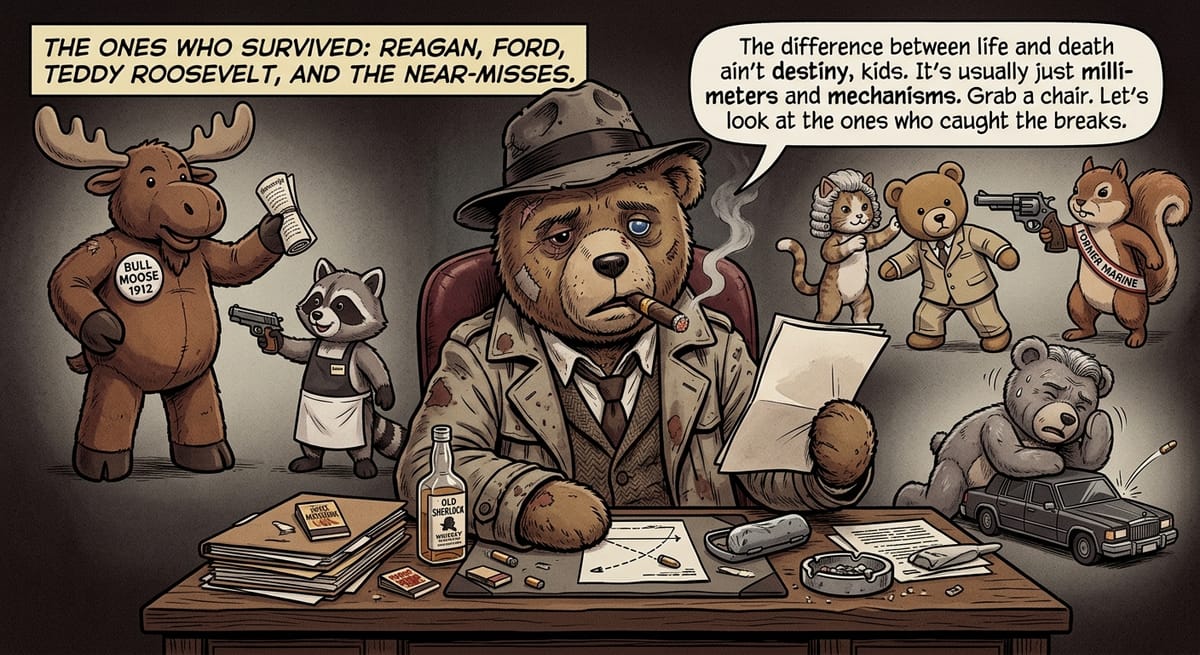
The Ones Who Survived: Reagan, Ford, Teddy Roosevelt, and the Near-Misses
At least seven American presidents survived assassination attempts. The survival column includes a sitting president shot through the chest who finished his campaign speech before seeking medical attention, two attempts on the same president within 17 days, and a president whose life was saved by a briefcase. The gap between the assassinated and the survivors is often not ideology or security or luck — it’s inches and circumstance.
Four American presidents were assassinated. At least seven more survived attempts. The survival column includes a sitting president shot through the chest who finished his campaign speech before seeking medical attention, two attempts on the same president within 17 days, and a president whose life was saved by a briefcase. The gap between the assassinated and the survivors is often not ideology or security or luck — it’s inches and circumstance.
Theodore Roosevelt Finished a 90-Minute Speech With a Bullet in His Chest
On October 14, 1912, Theodore Roosevelt was not president. He had served two terms, left office in 1909, handed the presidency to William Howard Taft, gone on safari in Africa, and decided in 1912 that Taft had betrayed progressive Republican principles badly enough to warrant a challenge. Roosevelt ran as the Progressive Party candidate — the Bull Moose ticket — against both Taft and Democrat Woodrow Wilson.
He was about to deliver a speech in Milwaukee, Wisconsin, when John Flammang Schrank, a 36-year-old New York saloonkeeper, shot him from about 6 feet away with a .38 caliber Colt revolver. The bullet passed through a steel eyeglass case and the folded 50-page manuscript of Roosevelt’s speech before entering his chest. It lodged approximately three inches deep in his chest wall, short of his lung.
Roosevelt reached inside his coat, examined his hand for frothy blood (he knew from hunting that pink, frothy blood meant a punctured lung), found none, and proceeded to give a 90-minute speech with a bullet in his chest. He opened by saying: “Ladies and gentlemen, I don’t know whether you fully understand that I have just been shot; but it takes more than that to kill a Bull Moose.” He was taken to Mercy Hospital in Milwaukee after the speech. The bullet was never removed and remained in his body until his death in 1919.^1^
Schrank was found not guilty by reason of insanity and spent 30 years in Wisconsin mental institutions before dying there in 1943. He claimed the ghost of William McKinley had instructed him to prevent Roosevelt from seeking a third term.
Gerald Ford Was Targeted Twice in Seventeen Days — a Record in American History
In September 1975, Gerald Ford survived two assassination attempts within 17 days — a record in American history, and one that seems almost impossible in retrospect.
On September 5, 1975, Lynette “Squeaky” Fromme, a follower of Charles Manson, approached Ford in Capitol Park in Sacramento, California, pointing a Colt .45 semi-automatic pistol. She had loaded four rounds into the magazine but there was no round in the chamber. Secret Service agent Larry Buendorf grabbed the weapon before it could be fired. Fromme was tackled to the ground. She later said she had pointed the gun at Ford to get a meeting for Manson with the president to discuss environmental issues. She was convicted of attempted assassination and sentenced to life imprisonment; she was released in 2009 after serving 34 years.^2^
On September 22, 1975, Sara Jane Moore, a political activist and FBI informant, fired a .38 caliber revolver at Ford outside the St. Francis Hotel in San Francisco. The shot was partially deflected by a former Marine named Oliver Sipple, who grabbed Moore’s arm. The bullet missed Ford by approximately 6 inches. Moore was convicted of attempted assassination and sentenced to life imprisonment; she was released in 2007, after 32 years.
Ford, who had never been elected to either the presidency or the vice presidency — he was appointed VP after Spiro Agnew’s resignation in 1973 and assumed the presidency after Nixon’s resignation in August 1974 — thus survived two assassination attempts in his single unelected term. He died of natural causes in December 2006, at age 93.
Reagan Was Shot Within an Inch of His Heart and Still Walked Into the Hospital
On March 30, 1981, John W. Hinckley Jr., a 25-year-old from Evergreen, Colorado, fired six shots from a Röhm RG-14 .22 caliber revolver at Reagan and his staff outside the Washington Hilton Hotel. Reagan was struck by a single bullet that ricocheted off the presidential limousine and entered his body under his left arm. The bullet traveled to within an inch of his heart.
Reagan was 70 years old — the oldest president in American history at that point — and arrived at George Washington University Hospital in critical condition. His systolic blood pressure had dropped to 78. Surgeons removed the “devastator” bullet (designed to fragment on impact, which it had not done) from his left lung. Reagan lost more than half his blood volume before it was stabilized.^3^ Modern trauma care is a big part of why Reagan's story ended differently from that of James Garfield, who survived the bullet in 1881 and then spent 79 days dying of infection; read how Garfield's doctors finished what Guiteau started.
Reagan’s press secretary James Brady was also shot, struck by a bullet that destroyed part of his frontal lobe. Brady survived but lived with severe disabilities for the rest of his life. He died in 2014 at age 73, and a medical examiner ruled his death a homicide caused by the 1981 shooting. Brady’s injuries, and his and his wife Sarah’s subsequent advocacy, led directly to the Brady Handgun Violence Prevention Act of 1993, which mandated federal background checks for gun purchases.
Hinckley was found not guilty by reason of insanity on June 21, 1982. He had been motivated by an obsession with the 1976 film Taxi Driver and its protagonist’s plan to assassinate a presidential candidate, and by his fixation on actress Jodie Foster, who had starred in the film. He spent 35 years in a psychiatric facility. In 2022, he was granted unconditional release.
Andrew Jackson’s Would-Be Killer Fired Two Pistols — Both Misfired
The earliest surviving attempt on a sitting American president occurred on January 30, 1835, when Richard Lawrence, a house painter who believed he was the rightful King of England owed a large inheritance by the U.S. government, approached Andrew Jackson on the steps of the Capitol building and fired two single-shot pistols at him. Both misfired — a malfunction so improbable that the odds were later calculated at approximately 1 in 125,000. Jackson, then 67, attacked Lawrence with his cane before bystanders intervened. Lawrence was found not guilty by reason of insanity; the jury deliberated for five minutes. He spent the rest of his life in institutions.^4^
Giuseppe Zangara Missed Roosevelt and Killed the Mayor of Chicago Instead
On February 15, 1933, Giuseppe Zangara fired five shots from a .32 caliber revolver at president-elect Franklin D. Roosevelt at Bayfront Park in Miami, Florida. Roosevelt was unharmed. Anton Cermak, the mayor of Chicago, who was standing nearby, was struck and died 19 days later. Three other bystanders were also wounded. Zangara, who said he hated all rich and powerful people and felt no specific grievance against Roosevelt in particular, was convicted of murder, sentenced to death, and executed in the Florida electric chair on March 20, 1933 — 33 days after the shooting.
What the Survival Record Actually Shows About Presidential Violence
The seven-plus attempted assassinations span nearly 190 years, from Jackson in 1835 to the present. They share no consistent ideological profile among the attackers: delusional individuals with no political coherence (Lawrence, Schrank, Zangara, Hinckley), political radicals (Fromme), political activists (Moore), and, in the case of other attempts not covered here, organized actors. The targets share no consistent political profile either: Jackson, Roosevelt, Ford, and Reagan were spread across the full range of American political ideology.
What they share is that violence against American political leaders has been attempted repeatedly across two centuries and has succeeded roughly half the time. The security apparatus that surrounds presidents today — the Secret Service, armored vehicles, advance teams, counter-sniper units, magnetometers — is the cumulative product of every successful attempt and every near-miss.^5^
The near-misses are in some ways more instructive than the successes. They make clear that the assassinations were not inevitable — that the difference between Lincoln’s death and Jackson’s survival, between Reagan’s recovery and Kennedy’s death, was not destiny or political meaning but millimeters and mechanisms. The attempts are numerous enough to form a pattern and random enough in their outcomes to resist a clean narrative. That discomfort is the honest place to sit with this history.
─────────
Part of Presidential Assassinations — ← Back to series hub
Sources:
- Millard, Candice. The River of Doubt: Theodore Roosevelt’s Darkest Journey. Doubleday, 2005.
- Bugliosi, Vincent. Helter Skelter: The True Story of the Manson Murders. W.W. Norton, 1974.
- Cannon, Lou. President Reagan: The Role of a Lifetime. PublicAffairs, 2000.
- Brands, H.W. Andrew Jackson: His Life and Times. Doubleday, 2005.
- Kaiser, Frederick M. “Presidential Protection: The Historical Record.” Congressional Research Service, Library of Congress, 2011.