RFK: The Second Kennedy to Die by Assassination
Robert Kennedy was shot in the Ambassador Hotel kitchen in Los Angeles on June 5 1968 minutes after winning the California primary — and died the next morning.
RFK: The Second Kennedy to Die by Assassination
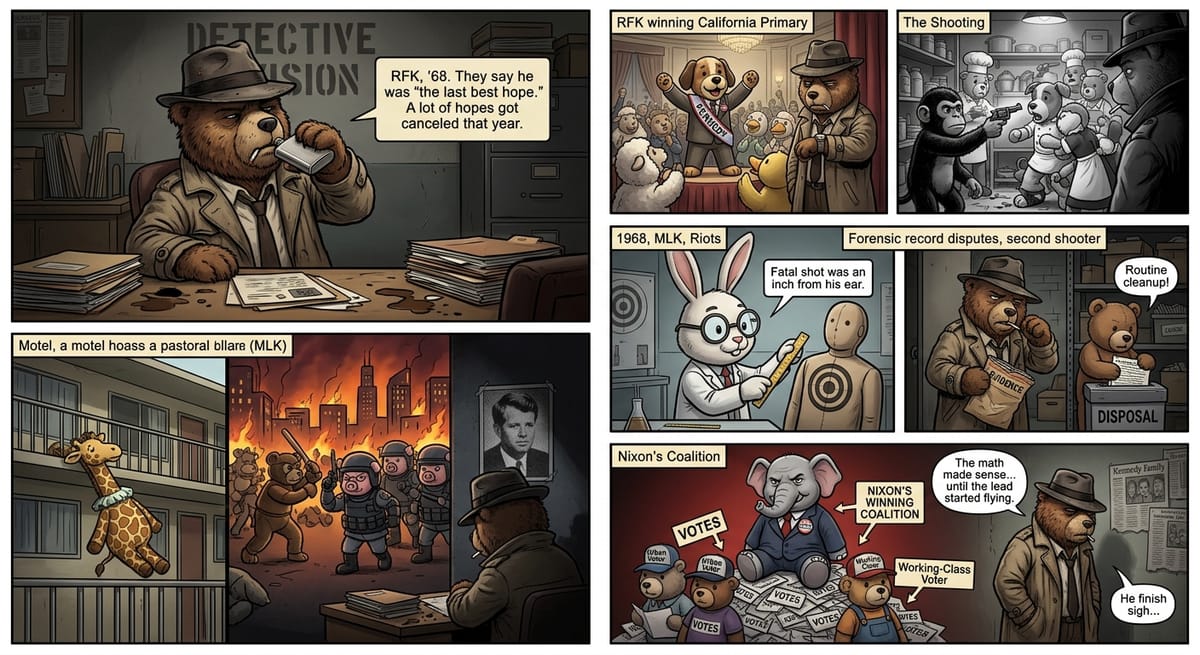
Robert F. Kennedy was shot on June 5, 1968, in Los Angeles, minutes after winning the California Democratic primary. He died the next morning. The shooting removed the one candidate who had demonstrated crossover appeal between Black urban voters and white working-class voters — a coalition Richard Nixon won the presidency without.
Robert F. Kennedy was shot shortly after midnight on June 5, 1968, in the kitchen pantry of the Ambassador Hotel in Los Angeles, California, minutes after he had won the California Democratic presidential primary. He had just delivered his victory speech to supporters in the Embassy Ballroom and was moving through a back corridor toward a press conference. Sirhan Bishara Sirhan, a 24-year-old Palestinian-born Jordanian citizen, stepped forward and fired a .22 caliber Iver Johnson Cadet revolver at close range.
Kennedy was struck three times. One bullet entered behind his right ear and lodged in his brain stem. Two others struck his back and armpit. Four bystanders were also wounded. Kennedy died at 1:44 a.m. on June 6, 1968, at Good Samaritan Hospital. He was 42 years old. The date of his death was the fifth anniversary of the Six-Day War, a detail Sirhan later cited as significant.^1^
By 1968, RFK Had Moved Significantly Left of Where He Started
Robert Kennedy had spent the first years of his political career as a committed anti-communist operative — counsel to Joseph McCarthy’s Senate subcommittee in 1953, then chief counsel for the Senate Rackets Committee starting in 1957, where he developed a consuming obsession with the Teamsters Union and its president, Jimmy Hoffa. The pursuit of Hoffa defined Kennedy’s tenure as Attorney General under his brother from 1961 to 1964, and Hoffa’s lawyers would later argue that Kennedy’s aggressive tactics had crossed legal and ethical lines.
By 1968, Kennedy had changed. The assassination of his brother in 1963 had quieted something in him and deepened something else. He had spent time in the poorest parts of Mississippi and Appalachia, visited the Pine Ridge Reservation, and testified before Congress about childhood hunger in America. He had become one of the earliest and most prominent Democratic critics of the Vietnam War, breaking with Lyndon Johnson over a conflict in which more than 30,000 Americans had already died by the start of 1968. When the Tet Offensive in January 1968 demonstrated the gap between official optimism and battlefield reality, Kennedy announced his candidacy on March 16, 1968.
The 1968 Democratic primary was a three-way race between Eugene McCarthy, who had entered first and helped drive Johnson from the race, Hubert Humphrey, who had the backing of the party establishment, and Kennedy. Kennedy won the Indiana primary on May 7 and the Nebraska primary on May 14. McCarthy won Oregon on May 28 — the first time a Kennedy had ever lost a primary election. California, on June 4, was decisive.^2^
What Did Sirhan Sirhan Actually Do — and What Does the Forensic Record Say?
Sirhan’s stated motive was Kennedy’s support for Israel and his pledge, two days before the shooting, to send 50 Phantom jet aircraft to Israel. Sirhan had written in his notebook, repeatedly, “RFK must die.” He told police and investigators that he had acted alone out of political grievance. He was convicted of first-degree murder in April 1969 and sentenced to death. California abolished the death penalty in 1972; his sentence was commuted to life imprisonment. He has been denied parole 16 times. As of 2024, Sirhan Sirhan remains incarcerated at RJ Donovan Correctional Facility in San Diego.
The forensic record has been disputed for decades. The coroner’s report, prepared by Dr. Thomas Noguchi, concluded that the fatal shot was fired from a distance of approximately one inch behind Kennedy’s right ear — a shot Sirhan, who was facing Kennedy several feet in front of him, could not have fired. Witnesses reported that a security guard, Thane Eugene Cesar, was directly behind Kennedy and was seen drawing his weapon. Cesar was never called as a witness at trial. Los Angeles Police Department destroyed physical evidence — wire transfers, notes, photographs — before any independent examination was possible.^3^
Whether these facts constitute evidence of a second shooter or simply evidence of poor investigative practice in 1968 is genuinely contested. A 2018 acoustic analysis by the California State Archives retrieved audio recordings from the scene. Independent forensic experts identified up to 13 distinct impulses on one recording from a handgun that held 8 rounds. The LAPD has contested this interpretation.
1968 Was Already the Bloodiest Year in American Political Life Since the Civil War
Kennedy’s assassination was the fourth major political killing of the decade, and the second in that calendar year. Martin Luther King Jr. had been shot on April 4, 1968, in Memphis, Tennessee, at the Lorraine Motel. Kennedy had been in Indianapolis the night of King’s death and had delivered an impromptu speech to a Black neighborhood crowd that had not yet heard the news — a speech widely credited with preventing riots in Indianapolis even as more than 100 other cities burned.
Two months later, Kennedy was dead in Los Angeles.
The Democratic National Convention in Chicago in August 1968 became one of the most violent and chaotic in American history. Mayor Richard J. Daley authorized the Chicago Police Department to use force against protesters outside the convention hall; 589 protesters were arrested and hundreds were beaten. Hubert Humphrey secured the Democratic nomination and lost the general election to Richard Nixon, who had promised a “secret plan” to end the Vietnam War. The war continued for seven more years.^4^
Kennedy’s Death Handed Nixon a Coalition He Couldn’t Have Won Any Other Way
Kennedy’s death removed from the 1968 race the candidate who had the most credibility with both urban Black voters and white working-class voters — a coalition that, combined, was unlikely to vote for Richard Nixon and that subsequent Democratic candidates have struggled to reassemble. Nixon won in 1968 with 43.4% of the popular vote, to Humphrey’s 42.7% and George Wallace’s 13.5%. A margin of approximately 500,000 votes out of 73 million cast.
Whether Kennedy would have won the nomination against the party establishment’s commitment to Humphrey — let alone the general election — is unknowable. But the demographic math of his coalition was real, and its dissolution after his death was real, and the structural consequences for the Democratic Party over the following decade were observable.
The Kennedy family had already buried a son in 1944 (Joseph Jr., killed in a WWII plane explosion), a daughter in 1948 (Kathleen, in a plane crash), a president in 1963, and an infant in 1963 (Patrick, who lived two days). Robert was the second brother killed. Edward Kennedy, the youngest, survived until 2009, dying of brain cancer. He did not run for president after Chappaquiddick in 1969. The RFK assassination sits inside a broader pattern of presidential-era political violence — from the Lincoln assassination through JFK to the cluster of attempted assassinations of the 1970s and 1980s — and the history of the Kennedy family in American political life is too dense with violent death to be accidental in its weight, and too clearly the product of specific political conditions to be dismissed as mere fate.
─────────
Part of Presidential Assassinations — ← Back to series hub
Sources:
- Clarke, Thurston. The Last Campaign: Robert F. Kennedy and 82 Days That Inspired America. Henry Holt, 2008.
- Schlesinger, Arthur M. Robert Kennedy and His Times. Houghton Mifflin, 1978.
- Noguchi, Thomas T. Coroner. Simon & Schuster, 1983.
- Dallek, Robert. Nixon and Kissinger: Partners in Power. HarperCollins, 2007.