William McKinley: The Anarchist's Bullet
McKinley was shot September 6 1901 at the Pan-American Exposition in Buffalo by anarchist Leon Czolgosz — and died eight days later from gangrene.
William McKinley: The Anarchist’s Bullet
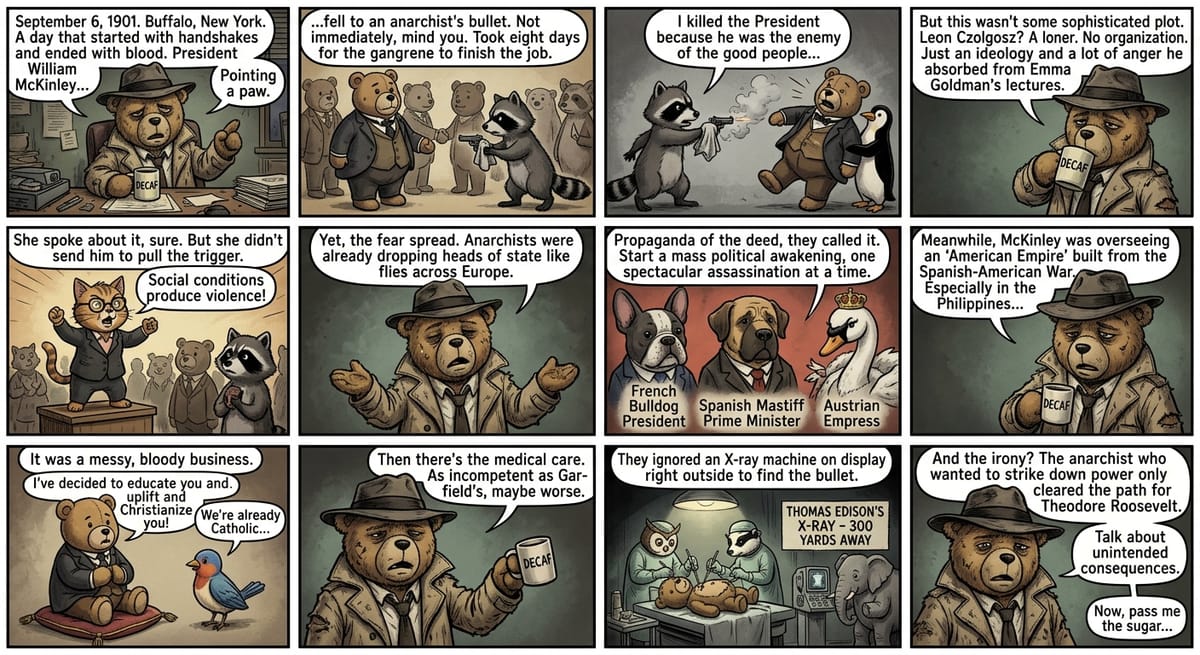
William McKinley was shot on September 6, 1901, at a public handshaking event in Buffalo, New York, by a self-radicalized anarchist named Leon Czolgosz. He died eight days later — not immediately from the bullet, but from gangrene along the wound track that surgeons failed to clean or properly drain. His death put Theodore Roosevelt in the White House.
On September 6, 1901, Leon Czolgosz stood in a receiving line at the Temple of Music on the grounds of the Pan-American Exposition in Buffalo, New York. He had wrapped his right hand in a white handkerchief to conceal a .32 caliber Iver Johnson revolver. At 4:07 p.m., he reached President William McKinley, who was shaking hands with members of the public, and fired twice at point-blank range.
One bullet was deflected by a button. The second entered McKinley’s abdomen, passed through his stomach, and lodged somewhere in the muscles of his back. McKinley, 58 years old, fell backward and was caught by his secretary, George Cortelyou. The crowd immediately grabbed Czolgosz. McKinley, bleeding into a white vest, reportedly said: “Don’t let them hurt him.”
He died eight days later, on September 14, 1901. He was the third American president assassinated in 36 years.
Czolgosz Was a Self-Radicalized Loner — Not an Organized Operative
Leon Czolgosz was 28 years old, born in Alpena, Michigan, to Polish immigrant parents. He had worked in a wire mill in Cleveland and had been radicalized by economic depression, labor violence, and the writings of Emma Goldman, the anarchist speaker and organizer whose 1901 lectures on political violence Czolgosz had attended. Goldman had spoken explicitly about the social conditions that produced violence. She did not instruct anyone to kill a president, but Czolgosz cited her as an influence when questioned after the shooting.
He had tried to make contact with anarchist organizations in Cleveland and Chicago and had been rebuffed — Emma Goldman’s circle was suspicious of him, worried he was a government informer. He was not. He was simply a man who had absorbed a particular ideology and acted on it without organizational support or coordination. The assassination was self-directed.
At trial, which lasted eight hours and included almost no genuine legal defense, Czolgosz was convicted on September 24, 1901 — eighteen days after the shooting. He was executed by electric chair at Auburn Prison in New York on October 29, 1901. His last words were reported as: “I killed the President because he was the enemy of the good people — the good working people. I am not sorry for my crime.”^1^
The Anarchist Movement of 1901 Had Already Killed Multiple Heads of State
Czolgosz’s act did not happen in a vacuum. The late 19th century had seen a wave of political assassinations across Europe by anarchists and radical socialists: French President Sadi Carnot in 1894, Spanish Prime Minister Antonio Cánovas del Castillo in 1897, Empress Elisabeth of Austria in 1898, Italian King Umberto I in 1900. The killings followed a strategic logic known as “propaganda of the deed” — the idea that a single spectacular act of violence against a head of state could spark mass political awakening.
American authorities had been watching the movement. The Bureau of Immigration, with essentially no statutory authority at the time, had been tracking radical organizers entering the country. McKinley’s assassination accelerated what became the Immigration Act of 1903, which explicitly barred anarchists from entering the United States — the first time political belief was used as a basis for immigration exclusion.
Emma Goldman was arrested in Chicago on the day of the shooting, held for six weeks, and released when investigators found no evidence connecting her to Czolgosz beyond his attendance at her lectures. She spent the rest of her life arguing that holding her responsible for the assassination was as logical as holding a teacher responsible for what a student did with knowledge.^2^
McKinley Was Managing an American Empire Built on the Spanish-American War
William McKinley had been president since March 1897 and was, at the time of his death, overseeing the aftermath of the Spanish-American War of 1898 — a conflict that had delivered Cuba, Puerto Rico, Guam, and the Philippines to American control or influence. The Philippines in particular was a live conflict: the Philippine-American War, begun in 1899, would continue until 1902 and result in an estimated 200,000 to 600,000 Filipino civilian deaths from combat, famine, and disease.
McKinley had initially opposed annexation of the Philippines. He changed his position after reportedly praying about it and deciding that the United States had an obligation to “educate the Filipinos, and uplift and civilize and Christianize them.” The Filipinos — who had been Catholic since the 16th century under Spanish colonization — had their own views on the matter, which produced the Philippine-American War.^3^
McKinley’s assassination elevated Theodore Roosevelt to the presidency at age 42, making him the youngest president in American history. Roosevelt had been placed on the ticket as vice president partly to neutralize him — Republican bosses considered him dangerously progressive and thought the vice presidency would contain him. The assassination ended that calculation completely.
An X-Ray Machine Was on Display 300 Yards Away — Nobody Used It
As with Garfield twenty years earlier, McKinley’s medical care contributed to his death. The bullet was not located and removed during surgery. Dr. Matthew Mann, the surgeon on site, operated under poor light at the Exposition’s emergency hospital rather than transferring McKinley to a better-equipped facility. The wound was sutured but inadequately drained. McKinley appeared to recover initially — he was eating solid food by September 10 — and then collapsed rapidly. The cause of death was gangrene of both walls of the stomach and the pancreas along the bullet track.
Thomas Edison had developed a primitive X-ray machine that was on display at the Pan-American Exposition grounds, approximately 300 yards from the Temple of Music. No one thought to use it to locate the bullet.^4^
McKinley is the most forgotten of the four assassinated presidents, which is an odd fate for a man who governed during the beginning of American empire. His death mattered most for what it produced: Theodore Roosevelt, the Sherman Antitrust Act’s aggressive enforcement, the conservation movement, and the trust-busting era. Compare this to the pattern with Lincoln, whose death also delivered unintended consequences — except in the opposite direction, handing the presidency to Andrew Johnson and accelerating the collapse of Reconstruction. The anarchist who killed McKinley hoping to strike at power helped install in power one of the most energetic and transformative presidents of the 20th century. Political violence is bad at predicting consequences. See also the full pattern of attempts and near-misses.
─────────
Part of Presidential Assassinations — ← Back to series hub
Sources:
- Rauchway, Eric. Murdering McKinley: The Making of Theodore Roosevelt’s America. Hill and Wang, 2003.
- Goldman, Emma. Living My Life. Alfred A. Knopf, 1931.
- Miller, Stuart Creighton. “Benevolent Assimilation”: The American Conquest of the Philippines, 1899–1903. Yale University Press, 1982.
- Leech, Margaret. In the Days of McKinley. Harper & Brothers, 1959.