The Tulsa Race Massacre: How White Mobs Destroyed Black Wall Street
On June 1 1921 a white mob deputized by Tulsa's city government burned 35 blocks of the Greenwood District — destroying 1256 homes 191 businesses and killing an estimated 100 to 300 people. No one was ever convicted.
The Tulsa Race Massacre: How White Mobs Destroyed Black Wall Street
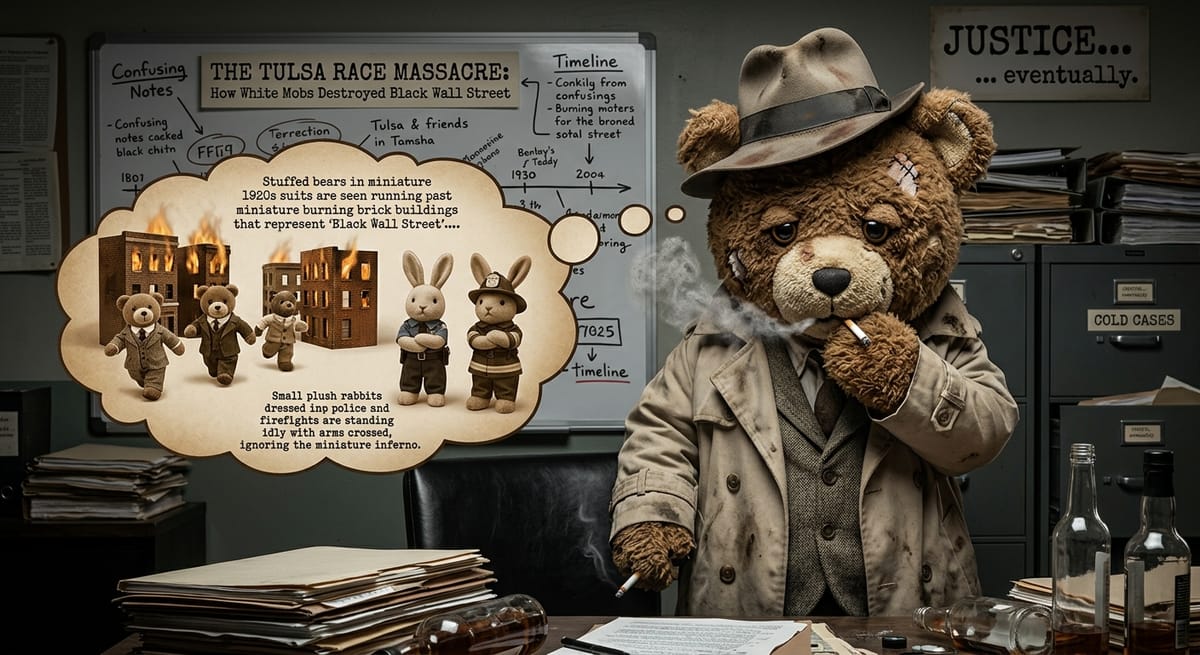
On the morning of June 1, 1921, a white mob — some of them deputized by the city government of Tulsa, Oklahoma — burned 35 blocks of the Greenwood District to the ground. They destroyed approximately 1,256 homes, 191 businesses, a hospital, a library, several churches, and a school. The death toll remains disputed: the Oklahoma Commission to Study the Tulsa Race Riot estimated between 100 and 300 people killed, the majority of them Black residents of Greenwood. No one was ever convicted of any crime related to the massacre. For most of the twentieth century, it was not taught in Oklahoma schools.
Part of American Race Massacres — ← Back to series hub
Greenwood Was the Wealthiest Black Community in the United States
The Greenwood District of Tulsa was one of the wealthiest Black communities in the United States. By 1921, it held more than 300 businesses on a commercial strip along Greenwood Avenue that newspapers had nicknamed “Black Wall Street” — banks, hotels, jewelry stores, law offices, a bus line, two newspapers, and dozens of smaller enterprises. It also had a hospital, the Frissell Memorial Hospital, and several schools.
Greenwood existed because segregation made it exist. Excluded from white Tulsa’s commercial districts, Black residents of the city built their own economy. Oil money was flowing through Oklahoma in the 1910s and 1920s, and Black Tulsans had access to enough of it, through domestic work, service industries, and small business, to build something substantial. The neighborhood was not utopian — it had poverty, it had crime, it had the grinding inequalities of a segregated city. But it was also a functioning, thriving community that had been built deliberately by people who had no other options.^2^
What Actually Happened in the Elevator on May 30, 1921
On May 30, 1921, Dick Rowland, a nineteen-year-old Black shoe shiner, entered an elevator operated by Sarah Page, a seventeen-year-old white woman, in the Drexel Building in downtown Tulsa. What happened inside the elevator is not known — no serious investigation was ever conducted, and Page later declined to press charges. The Tulsa Tribune reported on May 31 that Rowland had “attempted to assault” Page, using language that would have been understood by its readers as a rape accusation. By evening on May 31, a crowd of white men had gathered outside the courthouse where Rowland was being held.^3^
Black men from Greenwood, armed, arrived at the courthouse to protect Rowland. A confrontation ensued. A shot was fired — by whom is disputed. The white mob that had been gathering then went to Greenwood, and the massacre began.
The Mob Operated With City Government Backing
Over the night of May 31 and the morning of June 1, white Tulsans — organized into groups, many operating under the direction of law enforcement — moved through Greenwood systematically. They looted homes and businesses before burning them. They shot Black residents who were trying to flee. They detained and imprisoned thousands of Black Tulsans in the Convention Hall and the fairgrounds — more than 6,000 people at the peak — while the destruction continued.
Airplanes circled overhead. The Oklahoma National Guard, which had been mobilized, arrested Black residents rather than white attackers. The Tulsa police deputized white civilians and handed them weapons. Eyewitness accounts, collected decades later by researchers and journalists, described shots being fired from the planes, though this specific claim remains disputed.^4^
When it was over, Greenwood had been destroyed. Dick Rowland was released on June 1 without charges. He left Tulsa shortly after and never returned. Sarah Page did not press charges. No one was ever convicted of any crime related to the massacre.
Survivors Who Testified Decades Later
Damie Rowland, Dick’s mother, survived. So did A.J. Smitherman, editor of the Tulsa Star, who had organized armed Black men to go to the courthouse and later fled Oklahoma to avoid prosecution. Mabel Little, who with her husband Pressley had run a beauty shop and rental properties in Greenwood, survived. She was 103 years old when she testified before the Oklahoma commission in 1998. “I had the most beautiful shop,” she told the commission. “They burned it.”
In 2020 and 2021, as Tulsa prepared to mark the massacre’s centennial, researchers using ground-penetrating radar identified potential mass grave sites in Oaklawn Cemetery and other locations in Tulsa. Excavations have recovered remains. The state of Oklahoma has not yet formally determined the number of victims.^5^
A Century of Deliberate Erasure Followed the Destruction
The Tulsa massacre was covered in the immediate aftermath by newspapers across the country. Then it disappeared. The local newspapers did not discuss it. School curricula in Oklahoma did not teach it. The state of Oklahoma conducted no official investigation until 1997, when the legislature established the Oklahoma Commission to Study the Tulsa Race Riot. The commission’s 2001 report was the first official government acknowledgment of what had happened.
The suppression was not accidental. Property insurance companies refused to pay claims from Greenwood residents on the grounds that civil unrest was excluded from coverage. The city of Tulsa passed emergency zoning ordinances after the massacre that would have made it nearly impossible to rebuild Greenwood in the same location — ordinances that were eventually struck down in court. The mechanisms of erasure were legal, economic, and documentary.
A century of economic compounding followed the destruction of 1921. The homes and businesses that burned in Greenwood represented accumulated wealth — property equity, business assets, savings — that was gone overnight, with no legal recourse. The descendants of Greenwood’s residents have no court-ordered reparations, no settlement, no restoration.
The Tulsa massacre is the most documented case in the American race massacres series, but the pattern — economic success triggering organized destruction, state complicity, then erasure — appears in Rosewood, East St. Louis, Elaine, and Wilmington. The Colfax Massacre in 1873 established the legal framework for impunity that made all of them possible.
─────────
Sources:
- Oklahoma Commission to Study the Tulsa Race Riot of 1921. Tulsa Race Riot: A Report. Oklahoma Historical Society, 2001.
- Ellsworth, Scott. Death in a Promised Land: The Tulsa Race Riot of 1921. Louisiana State University Press, 1982.
- Gates, Eddie Faye. Riot on Greenwood: The Total Destruction of Black Wall Street. Sunbelt Eakin, 2003.
- Hirsch, James S. Riot and Remembrance: The Tulsa Race War and Its Legacy. Houghton Mifflin, 2002.
- State of Oklahoma, Office of the Attorney General. Tulsa Race Massacre — Potential Burial Sites Investigation. 2021.