The East St. Louis Riots: When a City Tried to Purge Its Black Population
On July 2 1917 white mobs killed 39 to 150 Black residents in East St. Louis Illinois burned 200 buildings and drove 6000 people from the city. Police and National Guard participated. No federal action followed.
The East St. Louis Riots: When a City Tried to Purge Its Black Population
On July 2, 1917, white mobs in East St. Louis, Illinois, launched an organized campaign of murder, arson, and expulsion against the city’s Black population. Over two days, they killed an estimated 39 to 150 Black residents — the count was never accurately established — burned down more than 200 homes and buildings in Black neighborhoods, and drove approximately 6,000 Black people out of the city. It was the worst act of anti-Black urban violence in American history up to that point, and it happened in the industrial North, not the South.
Part of American Race Massacres — ← Back to series hub
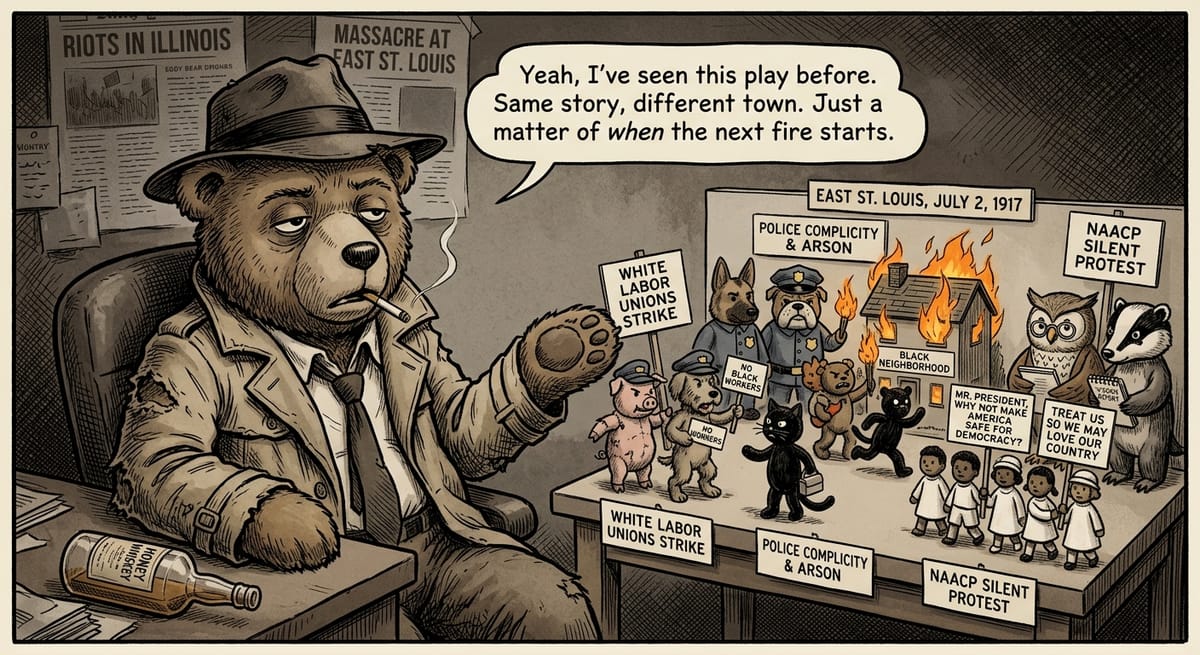
White Labor Unions Built the Conditions for the Massacre Over Months
East St. Louis in 1917 was an industrial city — packinghouses, aluminum plants, steel mills — drawing workers from the South as wartime production expanded and European immigration slowed. Between 1910 and 1917, the Black population of East St. Louis had grown from roughly 6,000 to approximately 13,000, as the Great Migration sent workers north toward factory jobs that paid more than the sharecropping and domestic work available in the South.
White workers’ unions in the packinghouses and aluminum plants saw the influx as a threat to wages and job security. The aluminum industry had specifically recruited Black workers from the South in 1917 during a union strike — a deliberate management strategy to break the strike. White workers and union organizers responded with fury that was directed not at management but at the Black workers who had been brought in. A May 1917 union meeting produced open calls for action against the city’s Black population.^2^
The Pogrom Was Organized and the Police Participated in It
The immediate trigger was a drive-by shooting on the night of July 1 in which white men fired into Black homes. Black residents, who had been living under escalating threat, fired back when a car returned — this time a police car. Two police officers were killed. The attack that began the next morning, July 2, was organized and deliberate.
White mobs — including, by multiple accounts, off-duty and active-duty police officers — moved through Black neighborhoods with rifles and torches. They shot Black residents trying to flee. They stopped streetcars and attacked Black passengers. When Black residents tried to run from burning buildings, mob members pushed them back in or shot them as they ran. The journalist Carlos Hurd, reporting for the St. Louis Post-Dispatch, watched the attacks from the street and described them in explicit detail: “For an hour and a half, I watched the massacre of helpless negroes… policemen were onlookers or participants.”^3^
Lena Hunter was killed in front of her home on Bond Avenue. She and her husband had moved to East St. Louis from Mississippi two years earlier. Her husband survived by hiding. An unnamed man was dragged from a streetcar, beaten, stabbed, and hanged from a telephone pole, then set on fire. His name was not preserved in any account. His body remained hanging for hours.
Congressional estimates placed the death toll at 39. Other estimates, including those based on hospital records and eyewitness accounts, ran to 100–150. The disparity exists because the bodies of some victims were burned in their homes, thrown into Cahokia Creek, or otherwise disposed of in ways that prevented them from entering official tallies.^4^
The NAACP’s Response to East St. Louis Changed American Civil Rights History
The NAACP sent investigators to East St. Louis within days of the massacre. W.E.B. Du Bois and Martha Gruening co-authored a detailed report, published in The Crisis in September 1917, that named perpetrators, documented the police participation, and laid out the sequence of events with evidentiary care. Ida B. Wells, whose investigative journalism had established the methodology for this kind of documentation, followed with her own report.
On July 28, 1917, the NAACP organized the Silent Protest Parade in New York City. Approximately 10,000 Black people marched silently down Fifth Avenue, led by children in white clothing, to drumbeat and no other sound. They carried signs: “Mr. President, why not make America safe for democracy?” — a reference to Woodrow Wilson’s stated war aims. “Treat us so that we may love our country.” The parade was the largest civil rights demonstration in American history up to that point.^5^
Congress Documented the Massacre and the Federal Government Did Nothing
A House of Representatives investigation in 1917 documented the massacre in detail. It found that the National Guard, deployed to restore order, had in many cases stood by or participated in the violence. It found that police had been complicit. It produced a report recommending federal action. The federal government did not enact anti-lynching legislation, did not prosecute the organizers of the violence, and did not compensate the displaced residents.
Illinois conducted state prosecutions. Eleven white men were convicted of murder, several receiving prison sentences. More than 100 Black residents were also prosecuted — many of them for defending themselves or for events connected to the July 1 incident. The prosecutorial imbalance was precise: the people who organized and carried out a massacre received lighter aggregate consequences than the community they attacked.
No federal anti-lynching law passed. No federal compensation was provided. The 6,000 Black residents expelled from East St. Louis did not return. The city’s Black population dropped sharply after 1917 and took decades to recover. The East St. Louis massacre happened two years before the Red Summer of 1919 — which included the Elaine Massacre in Arkansas and the Chicago riots — and two years after, the Tulsa massacre showed the same pattern at even larger scale. The mechanism was identical each time: Black economic presence, organized white response, state complicity, federal inaction, then silence.
─────────
Sources:
- Rudwick, Elliott M. Race Riot at East St. Louis, July 2, 1917. Southern Illinois University Press, 1964.
- McLaughlin, Malcolm. Power, Community, and Racial Killing in East St. Louis. Palgrave Macmillan, 2005.
- Hurd, Carlos. “A Rioter Tells His Story.” St. Louis Post-Dispatch, July 3, 1917.
- Du Bois, W.E.B., and Martha Gruening. “Massacre at East St. Louis.” The Crisis, September 1917.
- Gilje, Paul A. Rioting in America. Indiana University Press, 1996.