The Colfax Massacre: Reconstruction's Bloodiest Day
On Easter Sunday 1873 a white paramilitary force killed 62 to 153 Black men defending a Louisiana courthouse. The killers were convicted by a federal jury then freed by the Supreme Court — a ruling that gutted civil rights enforcement for a century.
The Colfax Massacre: Reconstruction’s Bloodiest Day
On Easter Sunday, April 13, 1873, in Colfax, Louisiana, a white paramilitary force attacked a group of Black men who had been defending the Grant Parish courthouse for three weeks. Between 62 and 153 Black people were killed — historians dispute the exact number — many of them after they had surrendered. It was the deadliest act of racial violence during Reconstruction, and one of the deadliest in American history. The men who carried it out were tried and convicted by a federal jury, then freed by the Supreme Court of the United States.^1^
Part of American Race Massacres — ← Back to series hub
Grant Parish Was Created by Reconstruction — and the White Democrats Refused to Accept It
Grant Parish had been created by Louisiana’s Reconstruction legislature in 1869, carved out of territory that had been plantation land. The town of Colfax was named after Schuyler Colfax, Ulysses Grant’s vice president. The political situation in Louisiana in the early 1870s was characterized by competing claims to power — the state had two rival governments after a disputed 1872 gubernatorial election, one backed by Republicans and freedpeople, one backed by Democrats and the white planter class.
The disputed election had a local counterpart in Grant Parish, where the Republican claimants to local offices were predominantly Black. William Ward, a Black Union Army veteran, held one of those offices. So did Levi Allen, another Black Republican. White Democrats in the area refused to accept the results and organized to take power by force.^2^
For Three Weeks, Black Republicans Held the Courthouse and Waited for Federal Help That Never Came
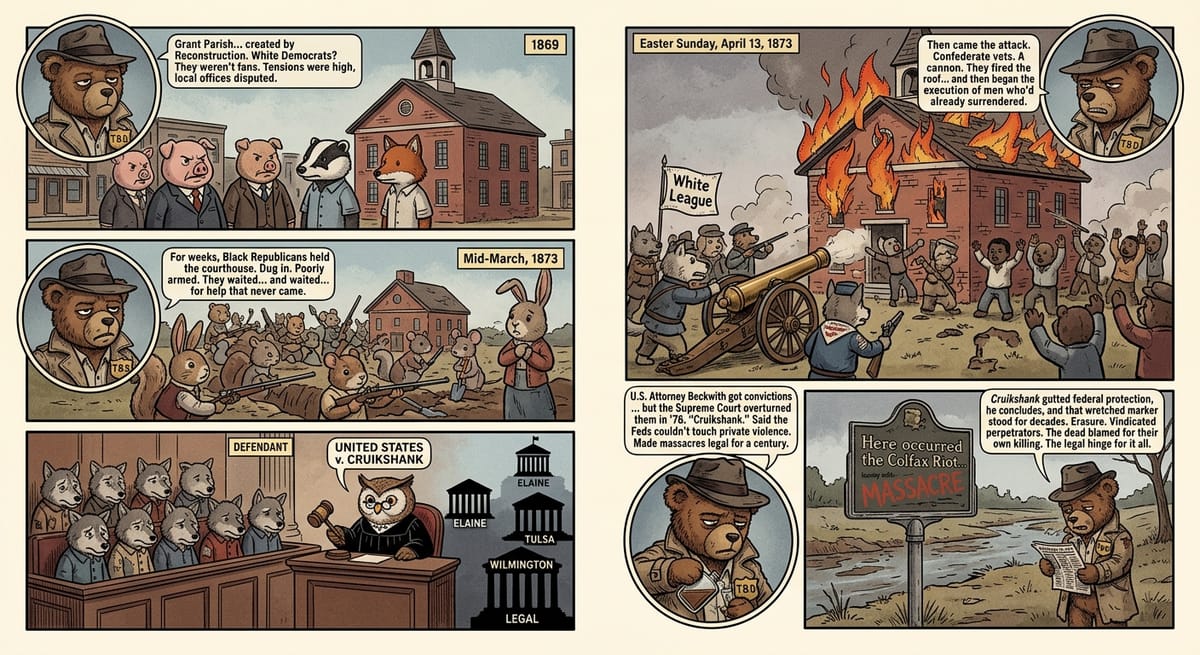
In mid-March 1873, Black Republicans in Colfax began occupying the courthouse to protect against what they correctly anticipated would be an armed attempt to seize local government. They dug trenches around the building, organized a defensive perimeter, and waited. The women and children of the community were sent away.
For three weeks, between 150 and 400 Black men — the numbers varied as people came and went — held the courthouse. They were armed, though poorly, with a mix of hunting guns and weapons. They sent messages asking for federal assistance that did not come. They were waiting for a relief force that never arrived.^3^
The Attack Ended in Execution of Surrendered Men
On April 13, a white paramilitary force of between 150 and 300 men — including members of the White League, a Louisiana white supremacist organization — arrived at Colfax with a cannon. They had military experience: many were Confederate veterans. The attack began in the afternoon. After several hours of fighting, the defenders set fire to the courthouse roof to drive out the attackers. When the Black defenders came out, they were met with fire.
Some were killed trying to surrender. Others were captured, held through the night, and then executed — shot in the head, one by one, in the dark. Estimates of the number killed range from 62 to 153, with the higher numbers reflecting witness accounts that some bodies were thrown into the Red River. The white attackers suffered three dead.
James Beckwith, the U.S. Attorney for Louisiana, prosecuted 97 men. Nine were convicted under the Enforcement Acts — the federal laws passed in 1870 and 1871 to prosecute Klan and paramilitary violence. The convictions were appealed to the Supreme Court.^4^
The Supreme Court’s Response Made Every Future Massacre Legally Safe
In 1876, the Supreme Court issued its decision in United States v. Cruikshank, overturning the convictions of the Colfax defendants on the grounds that the federal Enforcement Acts did not reach private violence — only state action — and therefore federal courts had no jurisdiction over the massacre. The Fourteenth Amendment’s protections, the court held, applied only when states violated rights, not when private individuals did.
The ruling effectively gutted the federal government’s ability to prosecute racial violence for the next century. It told the white paramilitary organizations of the South that their violence was beyond federal reach. It signaled to the Klan, the White League, the Red Shirts, and their successors that the only consequences they would face would come from all-white Southern juries — which meant no consequences at all.^5^
William Cruikshank, one of the leaders of the Colfax attack, went free. So did the other defendants. No one was ever punished, at any level of government, for the killing of between 62 and 153 Black men in Colfax on Easter Sunday, 1873.
Colfax Ended Reconstruction’s Promise of Federal Protection
The Colfax Massacre and the Supreme Court’s response to it marked the functional end of Reconstruction’s promise of federal protection for Black civil and political rights. The years 1874–1876 saw the White League and Red Shirts use organized paramilitary violence to overthrow Reconstruction governments in Louisiana, Mississippi, and South Carolina. The federal government, having lost its legal authority through Cruikshank and its political will through the deteriorating Northern enthusiasm for the project, did not intervene.
A historical marker was placed at the site of the massacre in 1950 by the Louisiana Department of Commerce and Industry. It read: “Here occurred the Colfax Riot in which three white men and 150 negroes were slain. This event on April 13, 1873 marked the end of carpetbag misrule in the South.”
The marker stood for decades. It called a massacre a riot. It counted the white attackers’ deaths and the Black victims’ deaths with equal moral weight. It framed the suppression of Black political power as the restoration of order. It was, in miniature, what happened everywhere: the history was rewritten, the perpetrators were vindicated, and the dead were blamed for their own killing. The same mechanism — massacre, then prosecutorial inversion, then erasure — ran through Wilmington in 1898, Elaine in 1919, and Tulsa in 1921. The Cruikshank decision is the legal hinge that made all of it possible.
─────────
Sources:
- Lane, Charles. The Day Freedom Died: The Colfax Massacre, the Supreme Court, and the Betrayal of Reconstruction. Henry Holt, 2008.
- Foner, Eric. Reconstruction: America’s Unfinished Revolution, 1863–1877. Harper & Row, 1988.
- Keith, LeeAnna. The Colfax Massacre: The Untold Story of Black Power, White Terror, and the Death of Reconstruction. Oxford University Press, 2008.
- United States v. Cruikshank, 92 U.S. 542 (1876). U.S. Supreme Court.
- Equal Justice Initiative. Reconstruction in America: Racial Violence After the Civil War, 1865–1876. EJI, 2020.