The Elaine Massacre: Arkansas's Forgotten Bloodbath
In October 1919 federal soldiers and white posses killed an estimated 100 to 856 Black sharecroppers in Elaine Arkansas. Their crime was forming a union. Twelve survivors were sentenced to death after trials lasting under an hour.
The Elaine Massacre: Arkansas’s Forgotten Bloodbath
In the last days of September and first days of October 1919, white men — including federal soldiers — swept through the farmland around Elaine, Arkansas, killing Black sharecroppers and their families over the course of four days. The victims had done one thing to earn their deaths: they had organized a union to negotiate fairer prices for their cotton. The number of Black people killed has never been established. Estimates range from 100 to 856. The twelve Black men convicted of murder in trials that lasted less than an hour each were sentenced to death and spent years on death row before the Supreme Court intervened — not because their innocence was clear, but because their trials were a fraud.^1^
Part of American Race Massacres — ← Back to series hub
The Union Was Legal. The Organizing Was the Offense.
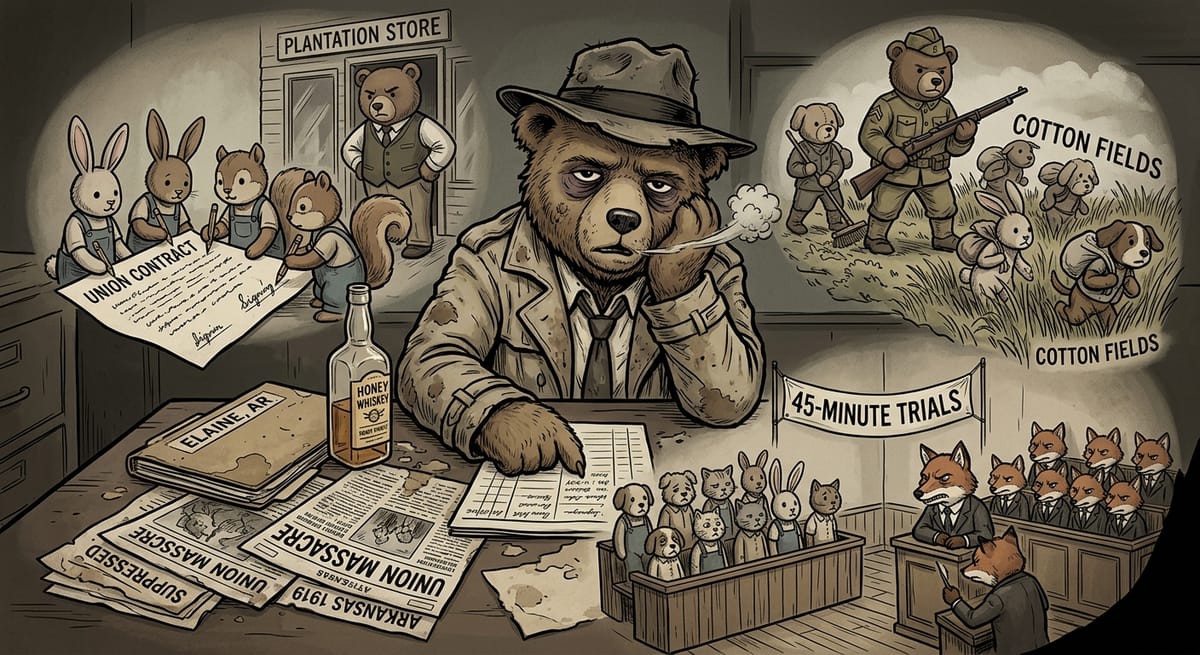
The Progressive Farmers and Household Union of America had been organizing Black sharecroppers in Phillips County, Arkansas, through 1919. The union’s objective was straightforward: sharecroppers in the Delta worked under contracts that gave planters enormous discretion over cotton pricing, debt accounting, and the goods sold to workers at inflated prices at plantation stores. Black sharecroppers were routinely cheated — accounts were kept by the planter, audited by no one, and the sharecropper who complained faced violence or eviction. The union intended to hire lawyers to negotiate collective contracts.^2^
On the night of September 30, 1919, union members gathered at a church in Hoop Spur, about five miles north of Elaine, with guards posted outside. The meeting was not secret — union organizing was not illegal. Shooting erupted when law enforcement officers arrived. One white deputy was killed.
The Federal Army Deployed Against the Victims, Not the Killers
The death of the deputy triggered a response that bore no relationship to the initial incident. Word went out across the county and surrounding areas. White men from as far as Tennessee arrived, some deputized by local authorities, others operating on their own. The 583rd Engineers of the U.S. Army, stationed nearby, were deployed on October 1 under the command of Colonel Isaac Jenks, with orders to “suppress the negro insurrection” — a phrase that described a labor organizing meeting as a military uprising.
Over four days, the posse and federal soldiers moved through the Black community of Elaine and the surrounding farmland. Black men, women, and children were shot in their fields, their homes, and the roads between them. The dead were not counted in any official sense. The bodies were not preserved. No government agency conducted a systematic investigation of Black deaths. The only death toll that has ever been subject to official inquiry is the five white deaths that occurred during the violence.^3^
The NAACP’s Walter White traveled to Elaine in the aftermath disguised as a white reporter — his light skin permitted it — and documented what he found. Survivors described a killing that was indiscriminate: people who had nothing to do with the union were shot because they were Black and present. White wrote that he was identified before leaving and told he would be killed if he didn’t get out of town. He got out.
The Trials Lasted Forty-Five Minutes and Produced Death Sentences
In the weeks following the massacre, 122 Black people were indicted by Phillips County grand juries. Twelve were sentenced to death for murder. Sixty-seven received prison sentences. The trials for the twelve condemned men, held in November 1919, lasted forty-five minutes or less each. The juries were all white. The defendants had no meaningful access to counsel. No defense witnesses were called. No cross-examination occurred. The verdicts were returned in minutes.^4^
The men on death row included Frank and Ed Hicks, both sharecroppers, and Frank Moore, another union member. They appealed through the Arkansas courts without success, then reached the U.S. Supreme Court in Moore v. Dempsey (1923). The Supreme Court ruled in their favor — not on the grounds of innocence, but on the grounds that trials conducted in an atmosphere of mob domination, where the forms of legal procedure were observed but any acquittal would have meant mob violence, did not constitute due process. The decision was significant in constitutional law. It came four years after men had been put on death row for organizing a union.^5^
Why the Elaine Massacre Stayed Buried
The Elaine massacre is less known than Tulsa, less documented than the Chicago riots of the same Red Summer, less remembered than Rosewood — partly because it happened in a rural area with limited press access, partly because the framing of the event as a “negro insurrection” persisted in the historical record for decades, and partly because no one who participated in the killing was ever charged with anything.
Robert Hill, the founder of the Progressive Farmers and Household Union, fled Arkansas and was eventually arrested in Kansas. He was extradited back to Arkansas, then released — he was too prominent, too connected to outside journalists and investigators, to disappear quietly into the prison system. The union dissolved. The sharecroppers who survived went back to the same contracts, the same accounts, the same plantation stores. The economic conditions that had prompted the organizing in September 1919 were unchanged.
History’s silence about Elaine is not an accident. It reflects the same mechanism that operated on the ground in Phillips County in October 1919: the people with the power to make the record decided what the record would say. The same suppression pattern — framing massacre as insurrection, prosecuting victims, sealing the record — appears in Wilmington and in the Colfax Massacre. The historical marker at Colfax, placed in 1950, still calls a massacre a “riot.”
─────────
Sources:
- Stockley, Grif. Blood in Their Eyes: The Elaine Race Massacres of 1919. University of Arkansas Press, 2001.
- Whitaker, Robert. On the Laps of Gods: The Red Summer of 1919 and the Struggle for Justice That Remade a Nation. Crown, 2008.
- McWhirter, Cameron. Red Summer: The Summer of 1919 and the Awakening of Black America. Henry Holt, 2011.
- Moore v. Dempsey, 261 U.S. 86 (1923). U.S. Supreme Court.
- Equal Justice Initiative. Lynching in America: Confronting the Legacy of Racial Terror. 3rd ed. EJI, 2017.