The Wilmington Coup of 1898: America's Only Successful Coup d'Etat
On November 10 1898 a white supremacist mob in Wilmington NC overthrew the elected city government at gunpoint killed up to 60 Black residents and expelled Republican officials. The coup's leaders became governor and US senator.
The Wilmington Coup of 1898: America’s Only Successful Coup d’Etat
On November 10, 1898, two days after an election, a white supremacist mob in Wilmington, North Carolina, overthrew the city’s democratically elected government, murdered an unknown number of Black residents, expelled Black and white Republican officials from the city, and installed a new city government by force. The coup succeeded completely. No federal intervention occurred. The men who led it went on to become governor and U.S. senator. American historians largely forgot about it for almost a century — the North Carolina state legislature’s own commission didn’t formally call it a coup until 2006.^1^
Part of American Race Massacres — ← Back to series hub
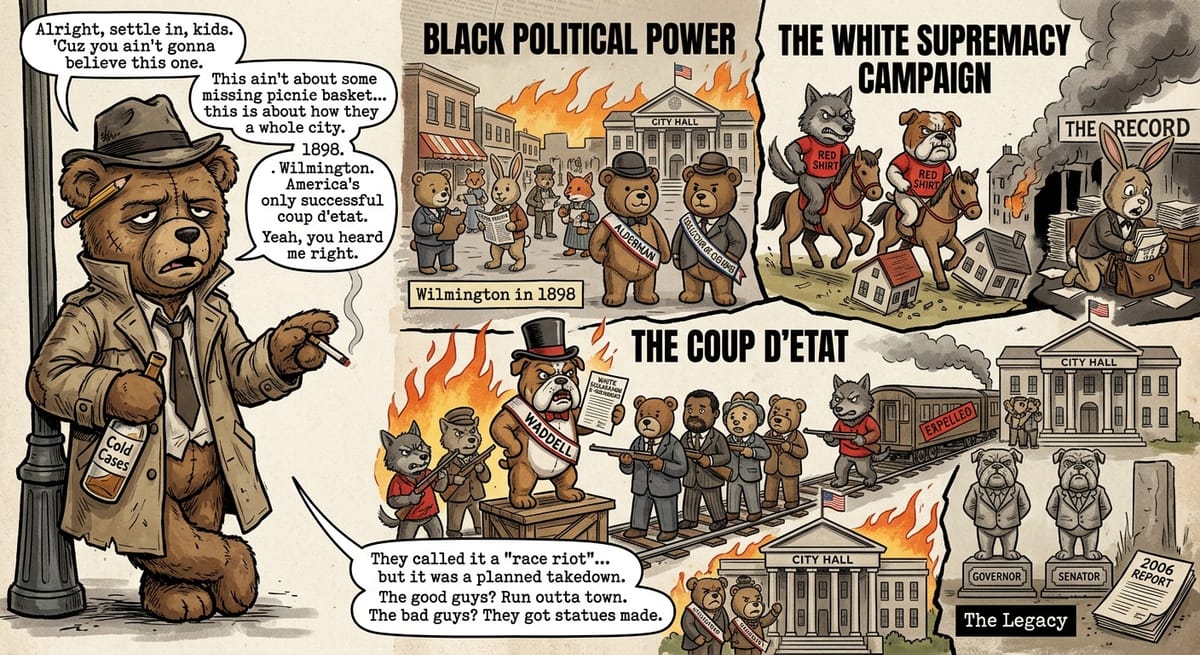
Wilmington in 1898 Was What Black Political Power Looked Like When Enforced
Wilmington in the 1890s was a majority-Black city with a functioning Black middle class, Black-owned businesses, Black elected officials, and a Black newspaper. The city had a fusionist government — a coalition of Black Republicans and white Populists — that had been winning elections throughout the decade. Black men in Wilmington held positions as aldermen, magistrates, and a deputy sheriff. The collector of customs for the Port of Wilmington was a Black man named John Campbell Dancy.^2^
This was not anomalous for the Reconstruction and post-Reconstruction South — it was what political participation looked like when the federal government enforced voting rights. What was anomalous, by 1898, was that Wilmington still had it. In most of the South, the combination of disenfranchisement, violence, and Supreme Court decisions — particularly the Colfax Massacre’s legal aftermath — had already ended Black political participation. Wilmington was a holdout. The Democratic Party of North Carolina, led by Alfred Moore Waddell, had decided to end it.
The 1898 Campaign Was Explicitly and Deliberately a White Supremacy Campaign
The 1898 North Carolina Democratic campaign was openly and explicitly a white supremacy campaign — the party used those words in its literature, its rallies, and its newspaper coverage. Josephus Daniels, editor of the Raleigh News and Observer and later Woodrow Wilson’s Secretary of the Navy, ran cartoons depicting Black men as sexual predators threatening white women. The Red Shirts, a white paramilitary organization based in South Carolina, deployed into North Carolina to intimidate Black voters.^3^
Alexander Manly, editor of the Wilmington Record, published an editorial in August 1898 responding to the Democratic campaign’s sexual-threat rhetoric. Manly argued that white women sometimes sought relationships with Black men willingly, and that rape accusations were routinely used to cover consensual affairs. The editorial was accurate — Ida B. Wells had documented the same pattern for years. It was used as a pretext. In the weeks leading up to the November 8 election, the Red Shirts rode through Black neighborhoods at night, shooting, intimidating, and conducting terror campaigns against Black voters and Republicans. The election itself involved widespread suppression of Black votes.
The Coup Happened Two Days After the Election — Because It Was Never About the Election
The Democrats had won the election. What happened on November 10 was not about the election. It was about destroying what remained of Black Wilmington’s political and economic power.
Alfred Waddell read a “White Declaration of Independence” to a crowd of 500 white men on the morning of November 10, demanding the resignation of all Black officials and the expulsion of Alexander Manly. When the demanded responses did not come fast enough, the mob marched to the office of the Wilmington Record and burned it to the ground. They then began moving through the city.^4^
The elected mayor and Board of Aldermen were forced to resign at gunpoint. New officials, selected by Waddell and his associates, were immediately installed. The coup government then issued orders expelling key Black and white Republican figures from the city. Men were put on trains at gunpoint and told not to return.
The killing during and after the coup is documented in the record but not enumerated. Estimates of Black deaths range from 14 to more than 60; the 2006 North Carolina 1898 Wilmington Race Riot Commission report declined to establish a definitive count because bodies were disposed of in ways that prevented tallying. The white Wilmington coup leaders reported to federal authorities that they had restored order following a “race riot” — a framing that inverted the actual sequence of events.^5^
The Coup’s Leaders Were Rewarded with Governorships and Senate Seats
Alfred Waddell became mayor of Wilmington. Charles Aycock, who had helped orchestrate the white supremacy campaign statewide, became governor of North Carolina in 1900. In the legislature elected in 1898, Democrats passed a constitutional amendment requiring a literacy test for voting — designed by people who had denied Black people access to education for thirty years to disqualify the people they had denied education to. The amendment passed in 1900. Black political participation in North Carolina effectively ended.
The North Carolina 1898 Wilmington Race Riot Commission, created by the legislature in 2000, published its report in 2006. It called what happened a coup, not a riot. It documented the organized nature of the violence, the premeditation, and the complete inversion of the democratic order. It recommended reparations. The legislature did not act on the reparations recommendation.
The coup’s architects were celebrated for generations. Aycock’s name was on schools across North Carolina until 2015 and 2020, when pressure from activists and the legislature’s own 2006 report led to some renamings. Waddell’s statue stood in Wilmington. The story of what actually happened — a planned, organized overthrow of an elected government — was not part of the civic memory the statues were meant to preserve.
The Wilmington coup was the organized political version of what Colfax accomplished through paramilitary violence in 1873: the destruction of Black political power at the moment it had become functional. Both cases produced impunity for the perpetrators. The Elaine Massacre in 1919 showed the same pattern — organized violence against Black economic organizing, followed by prosecution of the victims and erasure of the record.
─────────
Sources:
- Cecelski, David S., and Timothy B. Tyson, eds. Democracy Betrayed: The Wilmington Race Riot of 1898 and Its Legacy. University of North Carolina Press, 1998.
- Prather, H. Leon. We Have Taken a City: The Wilmington Racial Massacre and Coup of 1898. Africa World Press, 2006.
- Daniels, Josephus. Editor in Politics. University of North Carolina Press, 1941.
- North Carolina 1898 Wilmington Race Riot Commission. 1898 Wilmington Race Riot Report. North Carolina Office of Archives and History, 2006.
- Zucchino, David. Wilmington’s Lie: The Murderous Coup of 1898 and the Rise of White Supremacy. Atlantic Monthly Press, 2020.