The Rosewood Massacre: A Florida Town Wiped Off the Map
In January 1923 a white mob burned every building in Rosewood Florida killed at least six Black residents and drove 150 survivors into the swamps. Florida paid reparations to nine survivors in 1994 — the only state ever to do so.
The Rosewood Massacre: A Florida Town Wiped Off the Map
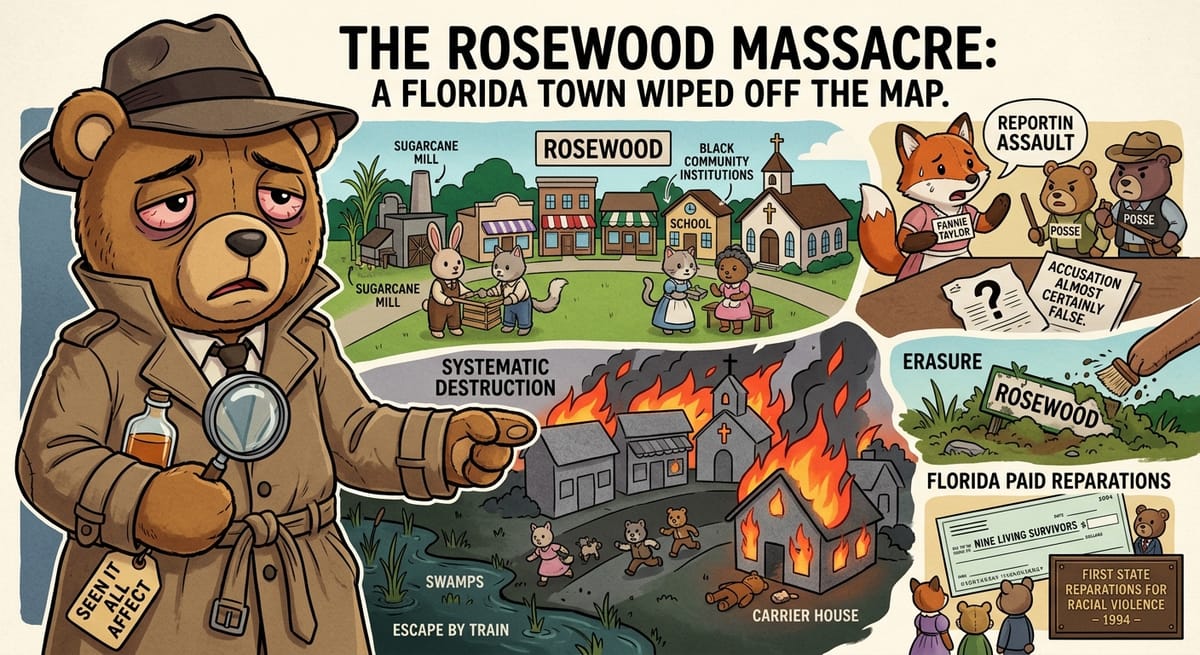
Rosewood, Florida, was a small, predominantly Black town in Levy County with a population of around 150 people. By the end of the first week of January 1923, it no longer existed. White mobs from surrounding communities had killed at least six Black residents — likely more — burned every building in town, and driven the survivors into the swamps. Florida paid reparations to nine living survivors or their direct heirs in 1994 — the only time a U.S. state has paid compensation for a racial massacre. The town was never rebuilt.
Part of American Race Massacres — ← Back to series hub
Rosewood Had Land, a Church, and Enough Stability to Be a Target
Rosewood sat about 40 miles south of Gainesville in the flat piney woods of north-central Florida. Its Black residents owned land and ran small enterprises — a church, a school, a masonic lodge, a sugarcane mill. A number of families had been in the area for generations, having acquired property during and after Reconstruction. The Carrier family and the Carter family were among the established names; Sarah Carrier was a respected community figure who worked as a domestic for a white family in neighboring Sumner.^1^
The town’s name came from cedar pencil manufacturing that had once operated there, using local red cedar. By 1923, the cedar had been logged out and the manufacturing gone, but the community remained. What it had — land, church, community institutions — was enough to make it a target.
The Accusation That Started It Was Almost Certainly False
On the morning of January 1, 1923, Fannie Taylor, a white woman in Sumner, reported that she had been assaulted by a Black man. Her husband, James Taylor, and other white men in Sumner organized a search. They were looking for Jesse Hunter, a Black convict who had recently escaped from a chain gang in the area. The posse followed what they said were tracks leading toward Rosewood.^2^
Later investigations, including testimony collected decades after the massacre and a 1994 Florida Board of Regents special report, found substantial evidence that Fannie Taylor’s attacker was a white man with whom she had been having an affair, and that Taylor herself knew no Black man had been involved. Whether the men who organized the posse knew the accusation was false, or whether they simply did not care, shaped what happened next.
The Killing Was Systematic, Not Spontaneous
On January 1 and 2, the posse arrived in Rosewood and began interrogating residents. On January 4, they came to the home of Sarah Carrier, believing Jesse Hunter was hiding there. What happened next is disputed in detail but not in result: a firefight broke out at the Carrier house. Sarah Carrier and her son Sylvester Carrier were killed. Two white posse members were also killed. The retaliatory violence that followed targeted not specific individuals but the entire community.^3^
Over the next several days, white mobs — which grew to include men from across Levy and surrounding counties — burned Rosewood systematically. The Carrier house was burned. The church was burned. The masonic lodge was burned. Every structure in the town was destroyed. The surviving Black residents fled into the swamps, where a white cedar manufacturer named John Wright helped organize their escape by train. Several children and adults were smuggled out on the train in the dark; Wright was one of the few white people in the area who helped rather than participated in the killing.
James Carrier, a young man, was captured by the mob on January 5 and murdered. Aaron Carrier survived being dragged behind a car by the intervention of a white sheriff who locked him in jail for protection. The total number killed remains disputed: the 1994 Florida report identified eight deaths — six Black and two white — but survivor accounts and circumstantial evidence suggest the number of Black victims was higher, with additional bodies disposed of in the swamps.^4^
How Did Rosewood Stay Hidden for Sixty Years?
What followed the destruction of Rosewood was not investigation. It was erasure. Local newspapers covered the initial confrontation but quickly moved on. No one was arrested for the burning of Rosewood. No one was charged with murder for any of the Black victims. The state of Florida did nothing.
The survivors scattered. Many went to Gainesville, Jacksonville, and other Florida cities. They did not talk about Rosewood publicly for decades — in some cases, not within their families. The shame and the fear were both real. Minnie Lee Langley was ten years old when her family fled Rosewood in 1923. She was in her 60s before she began talking about it, and in her 80s when she testified before the Florida legislature.
For sixty years, Rosewood barely existed in the public record. It was not taught in Florida schools. It appeared in no state histories. The physical site was overgrown.^5^
Florida Paid Reparations — the Only State That Ever Has
The story resurfaced in the early 1980s when journalist Gary Moore found surviving witnesses and began publishing accounts. The coverage led eventually to a 1993 documentary and in 1994 to a formal Florida Senate Special Master’s report, which found that the state of Florida had failed to protect Black residents and had an obligation to provide compensation.
In 1994, the Florida legislature passed the Rosewood Claims Bill, which authorized payments of up to $150,000 to direct survivors and scholarships for their descendants — the first time a U.S. state had paid reparations for racial violence. Nine living survivors or their direct heirs received payments. Minnie Lee Langley received compensation. So did Arnett Doctor, whose grandmother had survived the massacre, and who had spent years pushing for recognition.
The money did not rebuild what had been destroyed. It acknowledged that something had been destroyed, which was not nothing — but it was also not the land, not the community, not the two generations of accumulated wealth that burned in January 1923.
The false accusation used to trigger the Rosewood massacre follows the same pattern Ida B. Wells documented across hundreds of cases in the 1890s. The community destruction mirrors what happened in Tulsa and in Forsyth County, Georgia — organized violence that converted a functioning Black community into an absence. Rosewood’s reparations remain the only case in which a U.S. government has paid compensation; the Tulsa massacre commission recommended reparations in 2001 and the Oklahoma legislature did not act.
─────────
Sources:
- Dye, R. Thomas. The Rosewood Massacre: Rethinking Racial Violence. Florida Historical Quarterly, 1997.
- Dunn, Marvin. The Beast in Florida: A History of Anti-Black Violence. University Press of Florida, 2013.
- Jones, Maxine D., et al. A Documented History of the Incident Which Occurred at Rosewood, Florida, in January 1923. Florida Board of Regents, 1994.
- d’Orso, Michael. Like Judgment Day: The Ruin and Redemption of a Town Called Rosewood. Boulevard Books, 1996.
- Florida Senate Special Master’s Report on the Rosewood Claims Bill, 1994.