Alcatraz: The Rock That America Built to Hold Its Worst
Alcatraz held Al Capone and Robert Stroud for 29 years at three times the cost of any other federal prison — then closed in 1963 because the economics no longer made sense.
Alcatraz: The Rock That America Built to Hold Its Worst
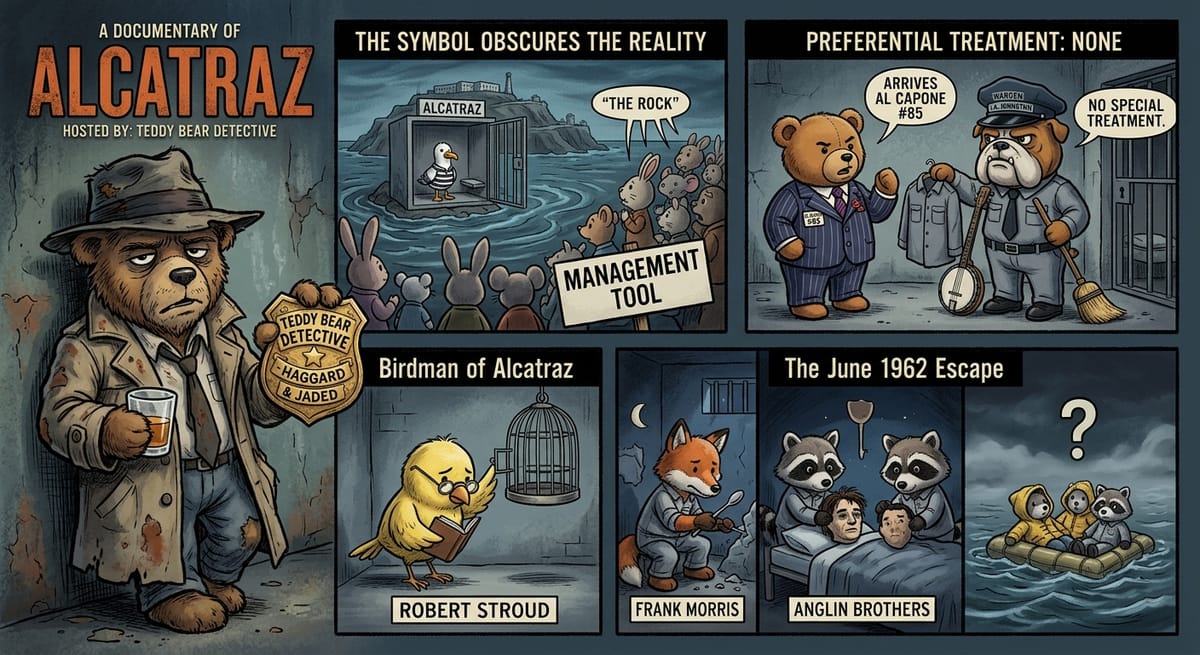
Alcatraz was built to be inescapable — twelve acres of rock in San Francisco Bay, surrounded by water cold enough to kill and currents strong enough to drag a swimmer under. For 29 years, from 1934 to 1963, it held the people the federal government had decided deserved no second chances. Al Capone did time there. Robert Stroud, the “Birdman,” spent 17 years in its isolation block. The place became a symbol so complete that the name alone still carries weight. But the symbol obscures the reality: Alcatraz was a management tool, not a punishment innovation, and it worked about as well as most federal management tools do.
The Army Left a Ready-Made Prison
The Spanish named it Isla de los Alcatraces — Island of the Pelicans — when they sailed the bay in 1775. The U.S. Army took it over in 1850, built a military fort and then a military prison, and kept it for decades before the federal Bureau of Prisons assumed control in 1934. The army’s long tenure left behind a fortified structure already designed to hold people who weren’t supposed to leave. The Bureau of Prisons didn’t build Alcatraz from scratch; it inherited a facility and turned it into a federal penitentiary at a moment when high-profile gangster violence was dominating the news and the government wanted somewhere to put people like Al Capone that would signal severity.
The island’s first warden was James A. Johnston, appointed in 1934. Johnston had a reputation as a reformer from his time running San Quentin and Folsom — which made him a counterintuitive choice to run what the press was already calling “the toughest prison in America.” He ran it from 1934 to 1948, and the conditions he established — strict silence rules, limited privileges, near-total control over the daily environment — defined the Alcatraz experience for most of its federal life.
Why Did Alcatraz Cost Three Times More Than Any Other Federal Prison?
Alcatraz was never meant for everyday criminals. The federal Bureau of Prisons designed it as a last-resort transfer destination for inmates at other federal facilities who were too disruptive, too dangerous, or too famous to manage elsewhere. At its peak population, Alcatraz held around 300 men — a tiny fraction of the federal prison population — in a facility that cost the government nearly three times more per inmate than any other federal prison to operate.^1^
Al Capone arrived in August 1934, inmate #85, already suffering the early stages of the neurosyphilis that would eventually kill him. He expected the kind of preferential treatment he’d received at Atlanta Federal Penitentiary. Alcatraz gave him none of it. By 1938, he was playing banjo in the prison’s inmate band — a detail that’s become shorthand for the surreal quality of the place — and by 1939 he was transferred out, too sick to be a management problem anymore.
Robert Stroud, known as the Birdman of Alcatraz, arrived in 1942 after spending years at Leavenworth, where he’d genuinely become an expert ornithologist. The Birdman name was a Leavenworth story; Alcatraz never let him keep birds. He spent 17 years there, largely in isolation, before being transferred to the Medical Center for Federal Prisoners in Springfield, Missouri in 1959. He died in 1963, the same year Alcatraz closed. The 1962 Burt Lancaster film cemented the Birdman mythology while significantly distorting the facts.
George “Machine Gun” Kelly arrived in 1934 and stayed until 1951. Alvin Karpis, the last member of the Ma Barker gang, did 26 years on the island — longer than any other inmate — arriving in 1936 and leaving when Alcatraz closed in 1963.
The Escapes That Made It Famous Exposed What It Couldn’t Control
Thirty-six men attempted escape across 14 separate escape attempts during Alcatraz’s 29 years as a federal penitentiary. Twenty-three were recaptured. Six were shot and killed during attempts. Two drowned. Five remain listed as “missing and presumed drowned” — a category that has generated more mythology than any other aspect of the prison’s history.^2^
The June 1962 escape by Frank Morris and John and Clarence Anglin is the one that won’t die. Morris, a career criminal with an IQ measured at 133, had escaped from other facilities before. He and the Anglin brothers spent months digging through the deteriorating concrete around the ventilation grates in their cells using spoons sharpened into tools, hiding the work with cardboard and paint. They fabricated papier-mâché dummy heads, covered in real hair collected from the prison barbershop, and placed them in their beds. On the night of June 11, all three went through the vents, climbed to the roof, and made it to the water.
They were never found. The FBI investigated for 17 years before closing the case in 1979, listing all three as presumed drowned. The U.S. Marshals Service kept the case open for decades longer. In 2013, a letter surfaced allegedly from John Anglin claiming all three had survived; handwriting analysis was inconclusive. The cold water, the currents, and the improvised flotation devices they’d built from raincoats make survival unlikely but not impossible. The case remains officially open.
The 1946 “Battle of Alcatraz” was more brutal and less celebrated. On May 2, six inmates seized guns from a gun gallery and took control of a cell house. Two guards were killed and eighteen others wounded. The U.S. Marines were called in. After two days, the revolt collapsed. Inmates Bernard Coy, Joseph Cretzer, and Marvin Hubbard were found dead in a utility corridor. Miran Thompson and Sam Shockley were later executed in the San Quentin gas chamber for the killings.^3^
The Rock Closed Because the Economics Failed, Not Because It Succeeded
The reason Alcatraz closed in 1963 was mundane: it was too expensive and the infrastructure was failing. Attorney General Robert Kennedy ordered the closure after a Bureau of Prisons report calculated that it cost $10.10 per day to house an inmate at Alcatraz compared to $3 per day at other federal facilities. The buildings were deteriorating. The salt air was destroying the plumbing and concrete faster than the government could repair it. The prison had served its symbolic purpose, and the economics no longer made sense.
Warden Olin Blackwell oversaw the final transfers on March 21, 1963. The last prisoner to leave was Frank Weatherman. The island sat vacant until 1969, when a group of Native American activists occupied it for 19 months under the banner of the Indians of All Nations, citing the Fort Laramie Treaty of 1868, which granted Native peoples rights to unused federal land. The occupation ended in June 1971 when federal marshals removed the remaining 15 occupants. The island was incorporated into the Golden Gate National Recreation Area in 1972 and has been one of San Francisco’s most-visited tourist attractions since.
The Symbol Was Always More Useful Than the Prison
The mythology around Alcatraz — impenetrable, inescapable, the final answer — was always partly a federal government press campaign. The Bureau of Prisons used the island’s reputation deliberately to manage behavior at other facilities: behave, or you’ll end up at the Rock. Whether that threat worked is debatable. What’s clear is that Alcatraz held a few hundred men at enormous expense for three decades, and the problems that made those men difficult to manage at other facilities did not disappear when they arrived on the island.
The prison closed because it was inefficient, not because it succeeded. The men who did time there — whether famous gangsters or anonymous lifers — spent years in cells barely larger than a parking space, under rules designed to minimize every variable, in a building the ocean was slowly destroying. Some of them cracked. Some of them did their time and got transferred back to the system they came from. A few tried to swim away. The story of Alcatraz is less about the worst that America had to offer and more about what America decided to do with people it had given up on — and what that decision cost.
For the full picture of how American prisons were built to manage and contain, see the Attica uprising, where the costs of that model came due all at once, and Angola, where the same logic runs on plantation land to this day. The Historic American Prisons series hub maps the pattern across all five institutions.
─────────
Sources:
- Ward, David A. Alcatraz: The Gangster Years. University of California Press, 2009.
- Federal Bureau of Investigation. Alcatraz Escape Attempts Case Files. FOIA Release, 1979.
- Johnston, James A. Alcatraz Island Prison and the Men Who Live There. Scribner, 1949.
Part of Historic American Prisons — ← Back to series hub