Native American Genocide in American History
The U.S. reduced the Native population from millions to 237,000 by 1900 through removal, massacres, boarding schools, and forced sterilization. Both series documented here.

Native American Genocide in American History
The word “genocide” carries legal weight. Under the 1948 United Nations Convention on the Prevention and Punishment of the Crime of Genocide — which the United States ratified in 1988 — genocide includes not only mass killing but also “causing serious bodily or mental harm to members of the group,” “deliberately inflicting conditions of life calculated to bring about its physical destruction,” and “imposing measures intended to prevent births within the group.” By those criteria, the history of U.S. federal policy toward Native nations fits the definition in multiple categories, simultaneously, across multiple centuries.
This section documents that history — not as a single catastrophic event but as a sustained project pursued through military force, legal architecture, institutional control, and demographic targeting — that reduced the Native population of the continental United States from an estimated 5 to 15 million people at the time of European contact to approximately 237,000 in the 1900 census, before slowly recovering to roughly 3.7 million in the 2020 census.^1^
In This Series
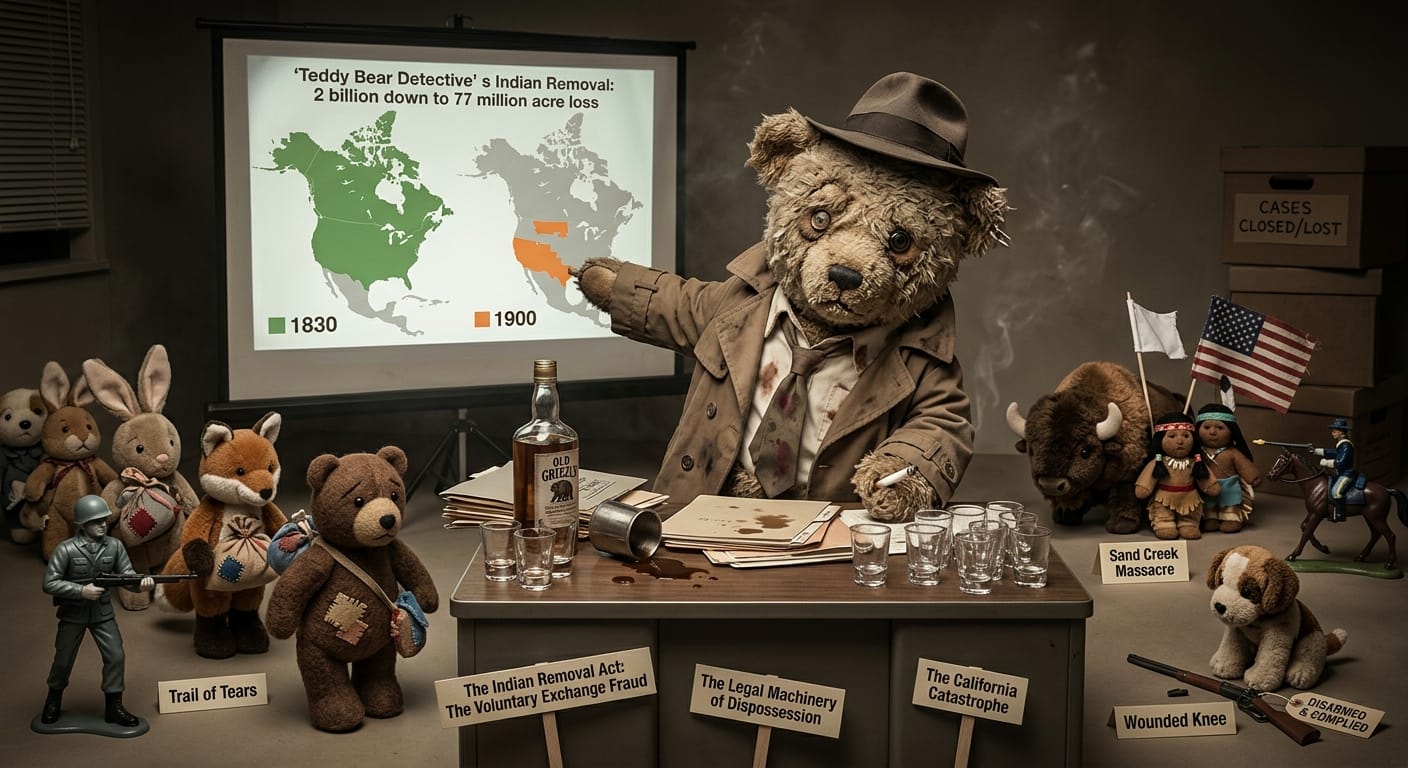
- Indian Removal: How America Emptied a Continent — The Trail of Tears, Sand Creek, and Wounded Knee
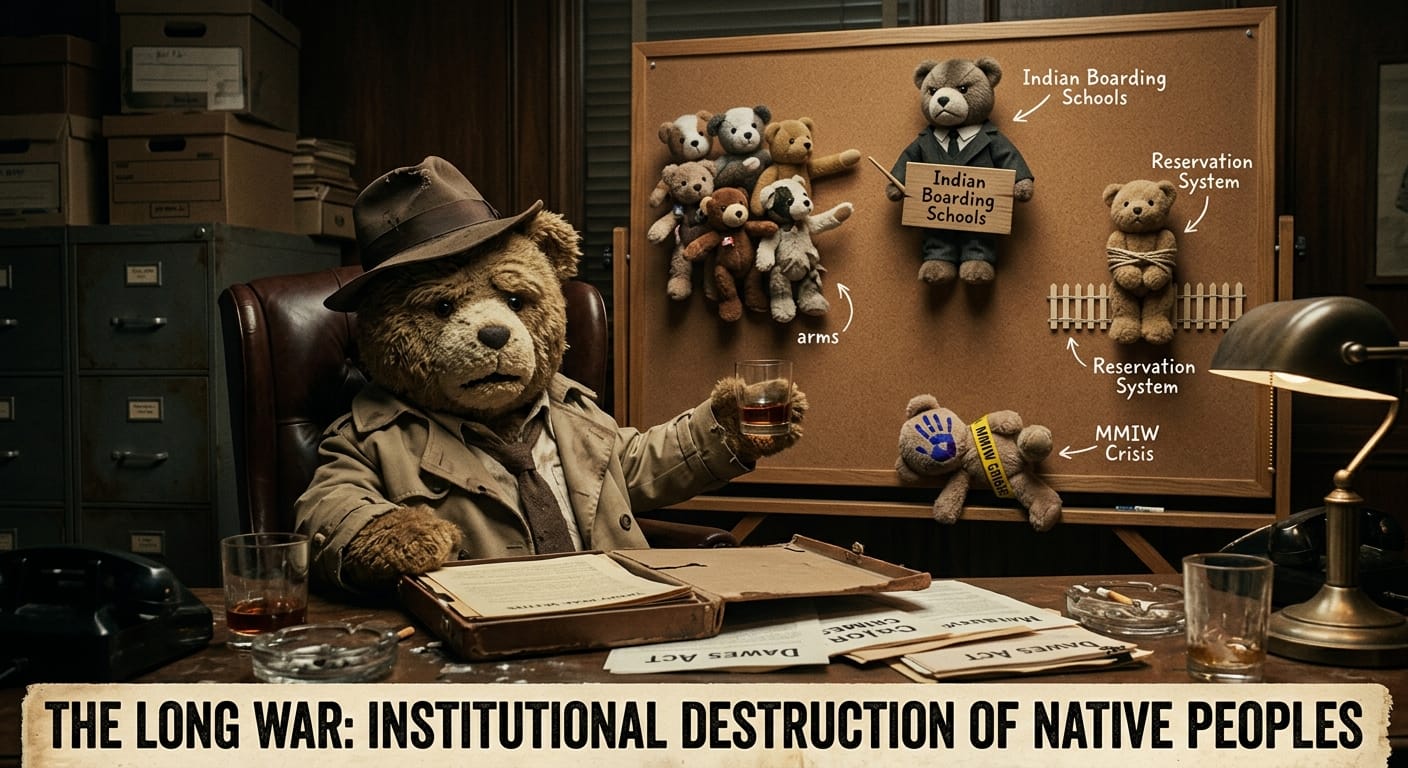
- The Long War: Institutional Destruction of Native Peoples — Boarding schools, broken treaties, the reservation system, forced sterilization, and MMIW
The Military Phase Displaced Entire Nations
The first series documents what happened when the United States decided, explicitly and as a matter of enacted federal law, that Native people needed to be relocated off their ancestral lands to make room for settlers. The Indian Removal Act of 1830 gave the policy its statutory form. The Trail of Tears gave it its human face — an estimated 4,000 Cherokee dead on the march to Indian Territory. Sand Creek in 1864 showed what the military implementation looked like when an officer with no intention of distinguishing between peaceful and hostile Natives arrived at a camp flying an American flag. Wounded Knee in 1890 showed the endpoint: a disarmament operation that killed at least 250 Lakota men, women, and children, and for which the Army awarded 20 Medals of Honor.
These events are the most legible because they generated documentation — congressional inquiries, eyewitness accounts, photographs. They do not represent the totality of removal-era violence. The California Indian catastrophe, in which the Native population of California declined from roughly 150,000 at the time of American acquisition to 16,000 by 1900, involved hundreds of individual massacres carried out by settlers and militias subsidized by the California state government — most of which have no entry in standard American history.^2^
The Institutional Phase Used Law to Continue What Bullets Started
The second series documents the phase that followed military conquest: the use of federal institutions — schools, courts, health services, land bureaucracies — to accomplish through law and bureaucracy what the Army had accomplished through force. The boarding school system took children. The Dawes Act took land. The Indian Health Service’s sterilization program took reproductive futures. The jurisdictional vacuum created by a century of federal court decisions takes, still, the lives of Native women who disappear into gaps between tribal, federal, and state authority.
The boarding school system operated for over a century — from the founding of the Carlisle Indian Industrial School in 1879 through the last schools of its type in the mid-20th century — and processed an estimated 150,000 children. The 2022 Interior Department report identified 53 burial sites at or near former schools. The Dawes Act of 1887 transferred approximately 90 million acres of tribal land to private ownership within five decades.^3^ The forced sterilization program, operating through the 1970s, sterilized an estimated 25 to 50 percent of Native women who came through Indian Health Service facilities during the program’s most active period. The MMIW crisis — still unfolding — results directly from the jurisdictional structures that this institutional war created.
These Chapters Are Not Closed
These are not closed chapters. The 574 federally recognized tribes today govern approximately 56.2 million acres, compared to an estimated 2 billion acres at the time of European contact.^4^ The Black Hills — guaranteed to the Lakota by the Fort Laramie Treaty of 1868, taken by congressional act in 1877, and awarded back in monetary compensation by the Supreme Court in 1980 — remain under federal and private ownership. The Sioux Nation has refused the approximately $1 billion that has accumulated in the federal trust account, because what they want is the land, not the payment. The land has not been returned.
The boarding school burial sites are still being identified. The MMIW database is still being built. The jurisdictional gaps that allow violence against Native women to go unprosecuted are still being partially closed by legislation passed in 2022, 150 years after the legal framework creating those gaps was first assembled. The IHS sterilization program produced no prosecutions. Sand Creek’s Chivington died defending what he called a battle. Wounded Knee’s Medals of Honor have not been rescinded despite multiple congressional attempts.
The history documented in these articles does not require a framework to understand it. It requires attention to what actually happened and to what the people it happened to actually said about it — in Luther Standing Bear’s account of being given an English name he didn’t understand, in John Ross’s petition signed by 15,000 Cherokee protesting an illegitimate treaty, in Marie Sanchez’s documentation of sterilizations on the Northern Cheyenne Reservation, in Sarah Deer’s legal scholarship on the jurisdictional roots of violence against Native women.
The specifics are the argument. The general claim — that the United States carried out a sustained campaign of dispossession, cultural destruction, and demographic reduction against Native nations — is documented in the federal government’s own records. The question that remains open is not historical. It is political: what a country does with that knowledge, and whether it chooses to.
─────────
Sources:
- Thornton, Russell. American Indian Holocaust and Survival: A Population History Since 1492. University of Oklahoma Press, 1987.
- Madley, Benjamin. An American Genocide: The United States and the California Indian Catastrophe. Yale University Press, 2016.
- Adams, David Wallace. Education for Extinction: American Indians and the Boarding School Experience, 1875–1928. University Press of Kansas, 1995.
- Wilkins, David E., and K. Tsianina Lomawaima. Uneven Ground: American Indian Sovereignty and Federal Law. University of Oklahoma Press, 2001.
In This Section