The Reservation System: America's Open-Air Prisons
The Dawes Act stripped 90 million acres of tribal land between 1887 and 1934. Reservation poverty today has a documented cause — it was the policy goal all along.
The Reservation System: America’s Open-Air Prisons
The reservation system was not a compromise. It was a containment strategy that evolved over roughly a century from military-enforced geographic restriction into a bureaucratic apparatus designed to manage — and in the view of many federal officials, eventually dissolve — Native nations as political and cultural entities. The poverty visible on reservations today is not an accident of geography. It is the accumulated result of deliberate policy that stripped approximately 90 million acres of tribal land between 1887 and 1934 alone.
Part of The Long War — ← Back to series hub
How the Federal Government Used Geography as a Weapon
The reservation concept predates the Indian Removal Act of 1830 — some colonial-era agreements had established designated territories for Native groups — but the system as a federal institution took shape after the Civil War, when the military campaigns across the Great Plains required a way to define where Native people could be without being classified as hostile. The solution was geographic: designate areas as reservations, require Native people to stay within them, and treat anyone outside as a legitimate military target.
The Fort Laramie Treaty of 1868, which ended Red Cloud’s War, assigned the Lakota a reservation encompassing all of present-day South Dakota west of the Missouri River — approximately 60 million acres. Within a decade, the Black Hills had been taken and the reservation had been fractured into multiple smaller units. This pattern — large initial reservation, repeated reduction — was not unique to the Lakota. It was standard operating procedure.
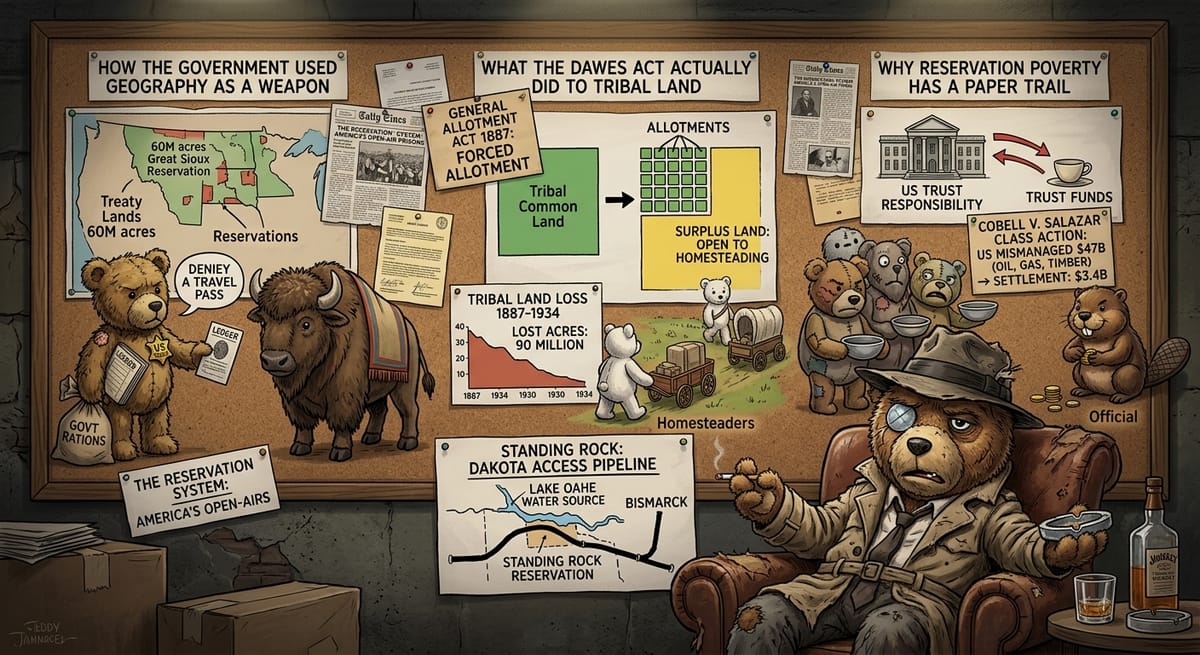
Confinement was enforced. The Bureau of Indian Affairs, established in 1824 under the War Department and transferred to the Interior Department in 1849, managed the reservation system through a network of Indian agents — political appointees with near-total authority over the people on their assigned reservations. Agents controlled rations, approved or denied travel passes, oversaw schools, and in many cases enriched themselves through the contracts they managed for supplying food and goods.^1^ The corruption was endemic enough that the 1869 Board of Indian Commissioners was created specifically to investigate it.
What the Dawes Act Actually Did to Tribal Land
The General Allotment Act of 1887 — the Dawes Act — transformed the reservation system’s mechanism of control. Before allotment, reservation land was held in common by the tribe, which meant it could not be sold to individual settlers. Allotment dissolved this communal ownership into individual parcels: 160 acres per family head, 80 acres per single adult. Land left over after allotment was declared “surplus” and opened to white homesteading.
Between 1887 and 1934, Native nations lost approximately 90 million of the roughly 138 million acres they held at the time the Dawes Act passed.^2^ On the Crow Reservation in Montana, the land base shrank from approximately 8 million acres to under 3 million. The Choctaw Nation in Oklahoma saw vast acreage transferred out of tribal ownership within a generation. Allotment achieved through law what wars had achieved through force: land transfer at scale.
The 1934 Indian Reorganization Act — the Wheeler-Howard Act — stopped allotment and attempted to restore some tribal self-governance, but by then the damage was largely done. The land that had been transferred out of tribal ownership in the allotment era could not be easily recovered. What remained was often checkerboarded: parcels of tribal land interspersed with private and state land, creating jurisdictional nightmares that persist today and complicate everything from law enforcement to resource development.
Why Reservation Poverty Has a Paper Trail
The material conditions that characterize many reservations in the present — high unemployment, inadequate housing, limited access to healthcare and clean water, elevated rates of poverty — are not inherent to the geography or the people. They are the product of a system designed to control rather than support. Federal trust responsibility — the legal obligation of the United States to manage resources held in trust for Native nations — has historically been managed with spectacular incompetence or outright corruption.
The Cobell v. Salazar class action lawsuit, settled in 2009 for $3.4 billion, established that the federal government had mismanaged individual Indian trust accounts since the allotment era, losing or misdirecting an estimated $47 billion in revenues from oil, gas, timber, and grazing on Native lands.^3^ The $3.4 billion settlement was a fraction of the actual amount owed. The individual accountholders — Native people whose land use revenues had been managed by the Bureau of Indian Affairs — received an average of a few thousand dollars each.
The Standing Rock Sioux Reservation in North and South Dakota, home to approximately 8,000 people, sits on land that was part of the original treaty-guaranteed Great Sioux Reservation. The Dakota Access Pipeline — the subject of massive protests in 2016 and 2017 — was routed under Lake Oahe, a primary water source for the reservation, after originally being rerouted away from Bismarck, North Dakota, because of concerns about water safety for that city’s predominantly white population.^4^
About 574 federally recognized tribes exist today. Approximately 56.2 million acres remain in tribal ownership or held in federal trust for tribes — compared to the roughly 2 billion acres that Native nations controlled before European contact. The broken treaties that created this system, the boarding schools that operated within it, and the forced sterilization programs that targeted Native women through IHS clinics on reservations are all features of the same structure — a system designed to control rather than support. The reservation system that was supposed to be a transitional arrangement became instead a permanent structure. It outlasted the policies that created it, outlasted the explicit assimilation agenda, and outlasted the federal termination era of the 1950s and 1960s, when the government tried to dissolve tribal governments altogether. What it has not produced, in most places and by most measures, is the material security and self-determination that federal trust responsibility nominally promised.
─────────
Sources:
- Hoxie, Frederick E. A Final Promise: The Campaign to Assimilate the Indians, 1880–1920. University of Nebraska Press, 1984.
- Wilkins, David E., and K. Tsianina Lomawaima. Uneven Ground: American Indian Sovereignty and Federal Law. University of Oklahoma Press, 2001.
- Cobell v. Salazar, Settlement Agreement, 2009. U.S. Department of Justice.
- Estes, Nick. Our History Is the Future: Standing Rock Versus the Dakota Access Pipeline. Verso, 2019.