The Sand Creek Massacre: When the Army Attacked a Peace Camp
In 1864 Colorado militia attacked a Cheyenne and Arapaho camp flying an American flag, killing 150 to 200 people. No one was ever prosecuted.
The Sand Creek Massacre: When the Army Attacked a Peace Camp
The Sand Creek Massacre happened on November 29, 1864, when Colonel John Chivington led 700 Colorado militia soldiers against a Cheyenne and Arapaho encampment that was flying an American flag and holding a U.S. Army protection letter. Between 150 and 200 people were killed — the majority of them women, children, and elderly men — while soldiers mutilated the bodies for trophies. No one was ever prosecuted. Chivington spent the rest of his life calling it a battle.
Part of Indian Removal: How America Emptied a Continent — ← Back to series hub
A “Peace” Policy That Left Compliant People Exposed
By the early 1860s, the Cheyenne and Arapaho nations had been steadily pushed off their treaty-guaranteed lands in Colorado Territory as gold rush settlers poured in after the 1858 Pikes Peak strike. The Treaty of Fort Wise in 1861 — signed by a minority of chiefs without full authority from their nations — compressed Cheyenne and Arapaho territory into a fraction of what the earlier Fort Laramie Treaty of 1851 had guaranteed.^1^
Tensions escalated through 1864 as raids and reprisals mounted on both sides. Colorado Territorial Governor John Evans, facing pressure from settlers and angling to accelerate statehood by demonstrating military necessity, issued a proclamation in August 1864 calling on “friendly” Cheyenne and Arapaho to report to Fort Lyon for protection, while declaring all others legitimate targets of warfare. The proclamation placed people in an impossible position: gather at the fort and trust the same government that had been eroding their lands for years, or stay on the plains and be designated enemies.
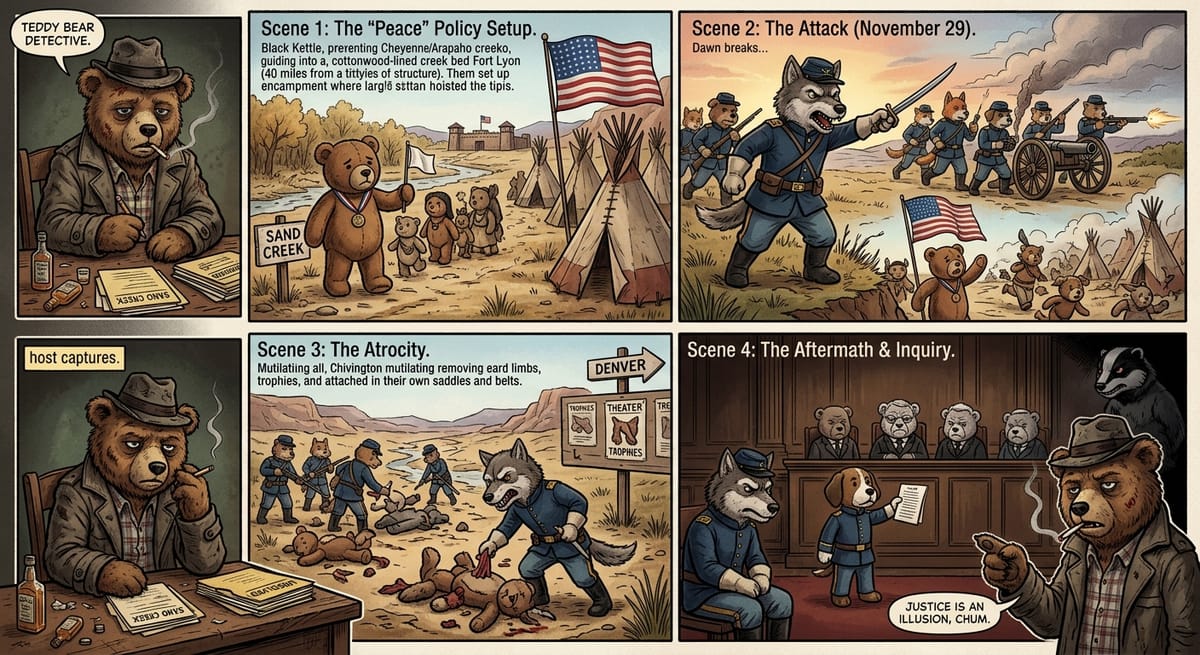
Black Kettle chose to comply. He led his band of Southern Cheyenne — along with a smaller Arapaho group led by Left Hand — to Sand Creek, approximately 40 miles northeast of Fort Lyon, in late November 1864. They had been told to camp there and await further orders. They had approximately 700 people, the majority of them women, children, and elderly men, since younger warriors were out hunting. They flew the American flag. Some accounts say Black Kettle also flew a white flag of truce.^2^
What Chivington’s Soldiers Actually Did on November 29
Colonel John Chivington and approximately 700 Colorado militia — the Third Colorado Cavalry, a 100-day unit whose enlistments were about to expire without having seen combat — arrived at Sand Creek before dawn on November 29, 1864. Chivington was a Methodist minister-turned-military officer who had earned genuine praise for his role in the Battle of Glorieta Pass in 1862. He was also explicitly not interested in taking prisoners.
His orders to his men, reported by multiple witnesses, were to kill and scalp everyone, adding that “nits make lice” — meaning children should not be spared because they would grow up to be warriors.
The attack began at approximately 7 a.m. Black Kettle raised the American flag higher and called his people to gather under it, believing it would signal their peaceful status. It did not. Soldiers opened fire with artillery and rifles. What followed lasted several hours. Many of the dead were killed while fleeing up the dry creek bed. Soldiers mutilated the bodies of the dead, taking scalps, fingers, and genitalia as trophies that were later displayed publicly at Denver’s Apollo Theater to crowds of cheering settlers.
An estimated 150 to 200 Cheyenne and Arapaho were killed, with some estimates running higher.^3^ Among them were White Antelope, a peace chief in his seventies who had visited Washington and met multiple presidents. He stood his ground with his arms folded, singing his death song, and was killed and mutilated. Left Hand, the Arapaho chief, was mortally wounded. Black Kettle survived — and would survive another four years before being killed in a separate attack, at the Washita Massacre of November 1868, led by George Armstrong Custer.
The Soldier Who Refused — and Was Murdered for Testifying
Not everyone in the militia participated willingly. Captain Silas Soule refused to order his company to fire and later wrote a letter to his commanding officer describing the massacre in detail. He testified against Chivington before a congressional inquiry. Soule was murdered on a Denver street in April 1865, two months after his testimony.
Chivington returned to Denver a hero. A congressional inquiry, a military commission, and a Joint Committee on the Conduct of the War all subsequently condemned the massacre. The military commission concluded that Chivington had “deliberately planned and executed a foul and dastardly massacre.” Chivington had already mustered out of volunteer service and could not be court-martialed.^4^ He faced no criminal charges. He spent the rest of his life defending what he called a battle, not a massacre.
Why Sand Creek Was a Policy Outcome, Not a Rogue Commander
Sand Creek was the product of a specific political ecosystem: a territorial governor who manufactured a crisis, a militia unit with something to prove, and a federal government that had created conditions where compliant Natives and hostile Natives were increasingly indistinguishable targets. The proclamation that told “friendly” Cheyenne and Arapaho to report to Fort Lyon simultaneously removed any incentive for soldiers to distinguish between them and anyone else.
The massacre accelerated rather than resolved the conflict. The survivors of Sand Creek spread across the plains, joining with Lakota and other Cheyenne bands. Raids intensified through 1865. The violence that Chivington’s attack was supposedly meant to end became substantially worse in the months that followed. The same dynamic — federal policy creating conditions for atrocity, then using the resulting violence to justify further military action — runs from the Trail of Tears through Wounded Knee and into the reservation system that followed. Sand Creek is not an exception to U.S. policy toward Native nations. It is an example of how that policy worked in practice.
In 2000, the U.S. government formally apologized for the Sand Creek Massacre through Public Law 106-465, which also established the Sand Creek Massacre National Historic Site in Colorado. The Cheyenne and Arapaho Tribes of Oklahoma and the Northern Cheyenne Tribe participated in the development of the site. Soule’s testimony, preserved in the congressional record, remains one of the most detailed firsthand accounts of what happened. His murder — likely by associates of one of the men he implicated — has never resulted in a prosecution. The site where 150 to 200 people were killed while flying an American flag is now federal land.
─────────
Sources:
- Hoig, Stan. The Sand Creek Massacre. University of Oklahoma Press, 1961.
- Halaas, David Fridtjof, and Andrew E. Masich. Halfbreed: The Remarkable True Story of George Bent. Da Capo Press, 2004.
- West, Elliott. The Contested Plains: Indians, Goldseekers, and the Rush to Colorado. University Press of Kansas, 1998.
- U.S. Congress, Joint Committee on the Conduct of the War. Massacre of Cheyenne Indians. 38th Congress, 2nd Session, 1865.