Forced Sterilization: The Program That Targeted Native Women
Between 1970 and 1976 the Indian Health Service sterilized an estimated 25 to 50 percent of Native women in its facilities. No one was prosecuted.
Forced Sterilization: The Program That Targeted Native Women
Between 1970 and 1976, the Indian Health Service sterilized an estimated 25 to 50 percent of Native American women who came through its facilities.^1^ The exact number remains contested because the federal government did not keep systematic records and because the procedures were often performed without meaningful informed consent — sometimes without any consent at all. What is documented is that a federally run health system used its position as the primary medical provider for Native communities to perform irreversible sterilizations on thousands of Native women, many of them teenagers.
Part of The Long War — ← Back to series hub
How Federal Sterilization Funding Reached IHS Clinics
Forced sterilization of people deemed “unfit” had a long history in the United States before it reached Native women specifically. By 1940, 30 states had enacted compulsory sterilization laws targeting people in state institutions who were classified as mentally ill, intellectually disabled, or otherwise genetically undesirable. The Supreme Court had upheld forced sterilization in Buck v. Bell in 1927, with Justice Oliver Wendell Holmes writing that “three generations of imbeciles are enough.” That decision has never been formally overturned.^2^
Federal funding for sterilization expanded dramatically in the early 1970s through Title X of the Public Health Service Act and through Medicaid, which began covering sterilization costs in 1972. The Indian Health Service, which operated as the primary healthcare provider for Native people on and near reservations, gained access to these federal funds and used them aggressively. Between 1973 and 1976 alone, the IHS sterilized approximately 3,406 Native women under federally funded contracts — a figure drawn from partial IHS records compiled by Dr. Connie Pinkerton-Uri, a Choctaw-Cherokee physician who investigated the program after patients at the Claremore, Oklahoma IHS clinic began reporting they had been sterilized without understanding the permanence of the procedure.^3^
The Specific Coercion Tactics the GAO Documented
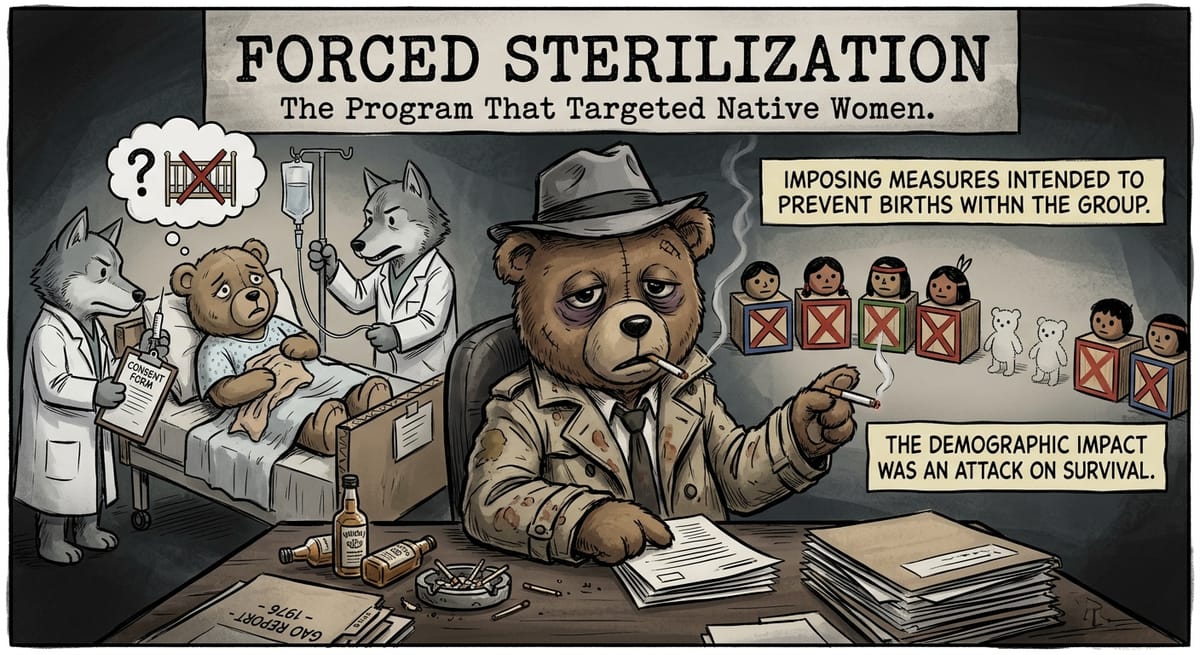
Pinkerton-Uri’s investigation, and later research by the Government Accountability Office, documented specific patterns of coercion. Women were approached during labor and delivery and asked to sign consent forms while in pain or medicated. Some were told that their welfare benefits would be terminated if they refused. Others were told the procedure was reversible when it was not. Teenagers — in some documented cases, girls as young as 15 — were sterilized without parental consent, which violated the IHS’s own regulations.
Marie Sanchez, a Northern Cheyenne tribal judge who investigated sterilizations within her own community in the mid-1970s, documented cases of women who had been sterilized following Caesarean sections without being informed that the procedure was happening alongside the delivery. She estimated that on the Northern Cheyenne Reservation alone, the birth rate had dropped by 60 percent over roughly a decade — a figure that aligned with the sterilization numbers she compiled.
Senator James Abourezk of South Dakota requested a Government Accountability Office investigation in 1976. The GAO report, released in November 1976, examined IHS sterilizations across four area offices — Albuquerque, Aberdeen, Oklahoma City, and Phoenix — and found that in a three-year period, 3,406 sterilizations had been performed, including 36 women under age 21 and at least 3 women under age 15. The report also found that IHS had not complied with its own informed consent regulations in a substantial number of cases.^4^
Why This Fits the Legal Definition of Genocide
The figures are hard to pin down precisely because IHS record-keeping was incomplete, because women in remote areas had no way to compare notes or access advocacy, and because the federal government did not treat the program as something requiring careful documentation. The 25 to 50 percent estimate for Native women sterilized during the 1970s comes from combining the partial GAO figures with Pinkerton-Uri’s research and the demographic work of scholars including Jane Lawrence, whose 2000 article in the American Indian Quarterly remains one of the most thorough analyses of the available data.
The demographic impact was not incidental. Native American birth rates declined significantly during the period when sterilizations were most common. For nations that had already lost most of their land through the reservation system and broken treaties, and much of their cultural infrastructure to the boarding school system, the loss of reproductive capacity at this scale was an attack on survival. The United Nations Convention on the Prevention and Punishment of the Crime of Genocide, which the U.S. ratified in 1988, includes “imposing measures intended to prevent births within the group” in its definition of genocide.
No one was prosecuted for the IHS sterilization program. The Indian Health Care Improvement Act of 1976 included enhanced consent protections specifically in response to the documented abuses, but it did not provide compensation to the women who had been sterilized or the communities that had lost future generations to the policy. The broader forced sterilization apparatus — applied to poor women, disabled people, incarcerated people, and immigrants across the country in the same period — was similarly addressed through new regulations rather than accountability.
The women who were sterilized at Claremore, at Pine Ridge, at Billings, at Gallup — they are not abstractions. Most of them are still alive or died in recent decades. The children who were not born because of those procedures are an absence in communities that are still counting the cost of a century of policies designed to reduce Native populations. That absence does not show up in any federal record.
─────────
Sources:
- Lawrence, Jane. “The Indian Health Service and the Sterilization of Native American Women.” American Indian Quarterly 24, no. 3 (2000): 400–419.
- Buck v. Bell, 274 U.S. 200 (1927).
- Pinkerton-Uri, Connie, cited in Torpy, Sally J. “Native American Women and Coerced Sterilization.” American Indian Culture and Research Journal 24, no. 2 (2000).
- U.S. Government Accountability Office. Investigation of Allegations Concerning Indian Health Service. November 1976.