Indian Boarding Schools: Kill the Indian Save the Man
The federal government ran 83 Native American boarding schools between 1869 and 1978. The 2022 Interior report found 53 burial sites at or near former schools.
Indian Boarding Schools: Kill the Indian, Save the Man
Between 1869 and 1978, the federal government operated an estimated 83 boarding schools where Native American children were taken from their families, forbidden from speaking their languages, and subjected to physical and sexual abuse — and where hundreds died and were buried without their families being notified. The phrase in the headline comes from Richard Henry Pratt, founder of the Carlisle Indian Industrial School, who meant it as a reform argument. The system he built produced cultural destruction at industrial scale.
Part of The Long War — ← Back to series hub
How a “Humane” Alternative Became a Century of Abuse
The boarding school model emerged from a specific moment in federal Indian policy: the late 1860s, when military campaigns against Native nations on the Great Plains were proving expensive, the public was divided on the methods being used, and reformers argued that assimilation was both cheaper and morally superior to extermination. The 1867 Indian Peace Commission report recommended that Native children be educated into American culture as the primary strategy for resolving the “Indian question.”
Pratt opened Carlisle in 1879 using 82 Lakota children, some of them the children of chiefs held as prisoners of war at Fort Marion, Florida. The experiment — isolating children from their communities and forcing immersion in English language, Christianity, and trades — was considered a success by federal standards, and Congress began funding additional schools.^1^ Between 1869 and 1978, an estimated 83 federally funded boarding schools operated across the country, with attendance often mandatory under threat of imprisonment for parents who refused to send their children.^2^
The 1891 Indian School Superintendent’s annual report stated plainly that children should be taken young, before attachments to Native culture became “fixed.” Agents were authorized to withhold rations from families who refused to comply.
What Children Experienced Inside the Schools
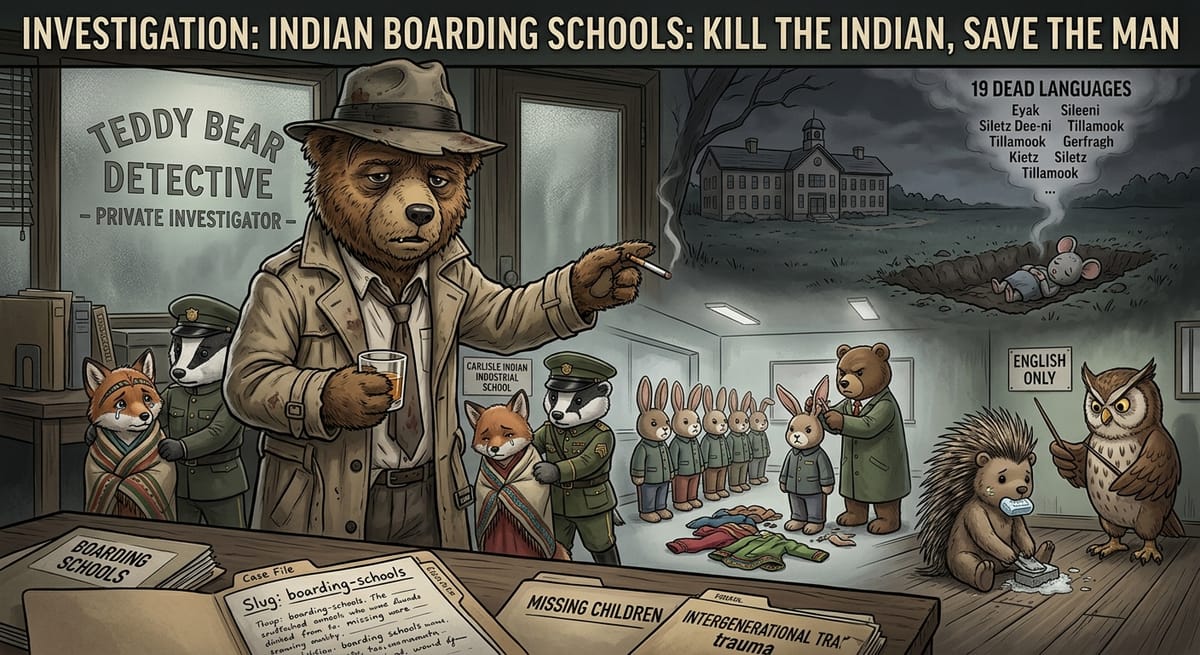
The suppression was systematic and documented. At Carlisle and schools modeled on it, children were given English names, forbidden from speaking their Native languages — punishments included beatings, having mouths washed out with soap, and solitary confinement — and required to dress in military-style uniforms. Traditional spiritual practices were prohibited. Letters home were censored or withheld. Visits from family were limited or denied.
Luther Standing Bear, a Lakota writer and activist who entered Carlisle in 1879 as part of the first class, later wrote that students were lined up in front of a list of names on a blackboard and told to pick one. He chose the name “Luther” because it was at the top of the list and he did not know what any of the names meant. His account, published in My People the Sioux in 1928, documents the systematic disorientation built into the school’s intake process.^3^
Physical and sexual abuse at the schools was widespread. The 2022 Federal Indian Boarding School Initiative Investigative Report, published by the U.S. Department of the Interior under Secretary Deb Haaland — the first Native American to serve as a cabinet secretary — identified 53 burial sites at or near former schools, representing hundreds of children who died in federal custody.^4^ The report acknowledged that the death toll is likely significantly higher than what official records captured, given incomplete record-keeping and the practice of burying children without notifying their families.
Zitkala-Ša — Gertrude Simmons Bonnin — a Yankton Dakota writer who entered White’s Indiana Manual Labor Institute at age eight in 1884, wrote in Atlantic Monthly in 1900 about the first night at school: “I was not washed or changed into white attire, but taken immediately to a large dormitory, where rows and rows of little iron beds were placed. I had never before slept in a bed; I cried myself to sleep.” Her essays are among the earliest published accounts by a Native woman of the boarding school experience.
The System Lasted Over a Century and Left 19 Languages Dead
The system did not end quickly. The 1934 Indian Reorganization Act shifted federal policy toward tribal self-governance, but boarding schools continued operating. The last federally funded boarding school under the original assimilation framework — the Mount Pleasant Indian School in Michigan — did not close until 1934. Others operated through the 1970s. The Indian Child Welfare Act of 1978, which established minimum protections for Native families in child custody proceedings, passed in part because the boarding school era had normalized the removal of Native children from their communities to such a degree that the practice had been absorbed into state child welfare systems.
By the time the system wound down, an estimated 150,000 Native children had passed through federal boarding schools. The 2022 investigative report identified at least 19 Native languages that died during the boarding school period — languages with no surviving speakers, no recordings, no way back.
The boarding school system did not operate in isolation. It drew from the reservation system that concentrated Native populations and the broken treaties that eliminated alternatives. The intergenerational effects are documented in Native communities across the country: disrupted language transmission, severed family structures, elevated rates of substance abuse and mental health crises traceable to historical trauma. The phrase “intergenerational trauma” appears frequently in public health literature on Native communities. What it describes is the compounding damage of a system that operated for over a century and whose effects were designed to be permanent. Some of them were.
The 2022 Federal Indian Boarding School Initiative report recommended a second phase of investigation to identify additional burial sites and the children buried in them. That work is ongoing. Several schools that are still operating — now under tribal or Bureau of Indian Education control and with radically different educational approaches — have been the site of community-led memorialization efforts. The MMIW crisis and the jurisdictional gaps it exposes are part of the same history: the boarding school era normalized the removal of Native children from their families, and the effects of that normalization are still being counted.
─────────
Sources:
- Adams, David Wallace. Education for Extinction: American Indians and the Boarding School Experience, 1875–1928. University Press of Kansas, 1995.
- U.S. Department of the Interior. Federal Indian Boarding School Initiative Investigative Report. May 2022.
- Standing Bear, Luther. My People the Sioux. University of Nebraska Press, 1928.
- Lomawaima, K. Tsianina. They Called It Prairie Light: The Story of Chilocco Indian School. University of Nebraska Press, 1994.