Indian Removal: How America Emptied a Continent
The Trail of Tears, Sand Creek, and Wounded Knee were not isolated events. This series documents the federal project that stripped Native nations of 2 billion acres.

Indian Removal: How America Emptied a Continent
The removal of Native peoples from their homelands was not a series of isolated tragedies. It was a sustained federal project, pursued across administrations, executed through military force and legal machinery alike, and aimed at a single consistent goal: clearing land for white settlement. The Trail of Tears, Sand Creek, and Wounded Knee are separated by decades and geography, but they share the same architecture of dispossession.
← Back to Native American History
In This Series
- The Trail of Tears: Andrew Jackson’s Forced March
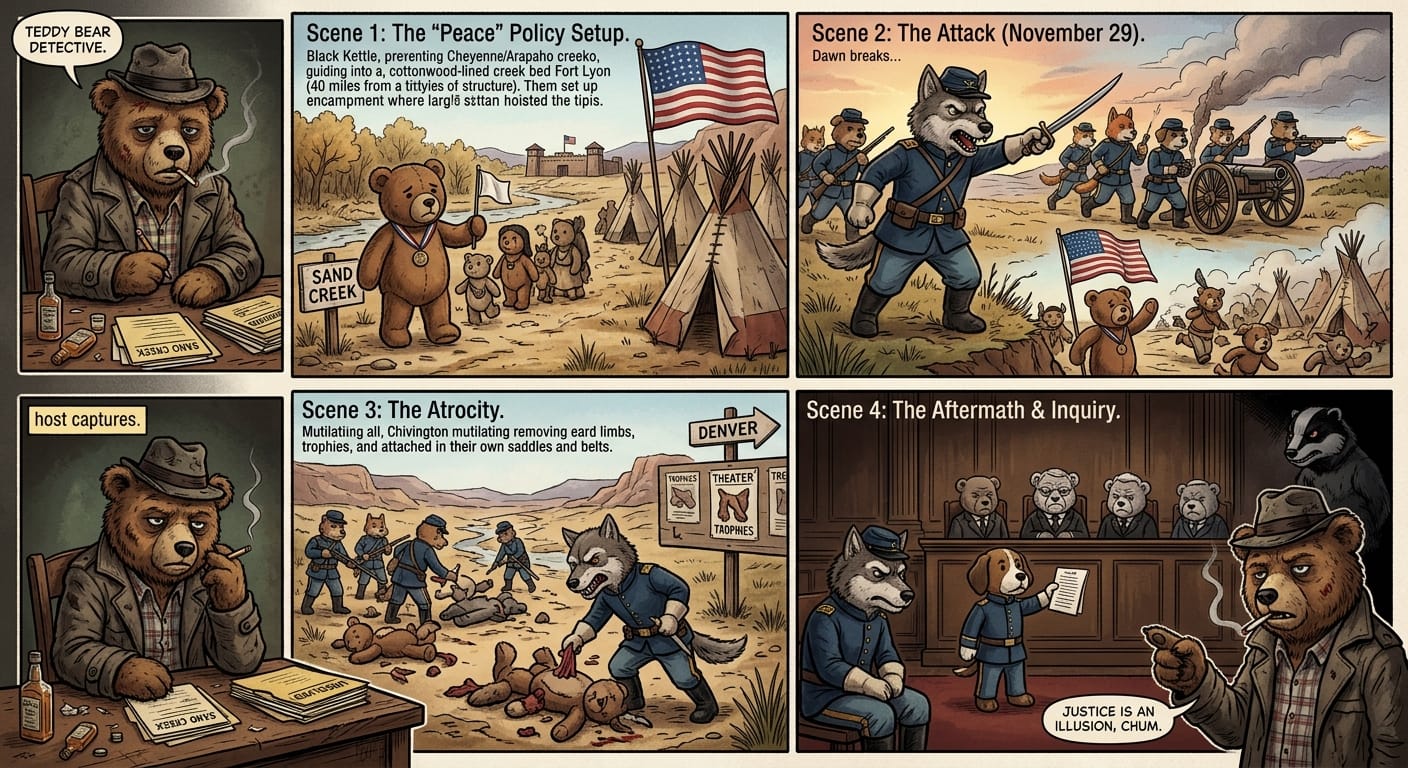
- The Sand Creek Massacre: When the Army Attacked a Peace Camp
- Wounded Knee: The Last Massacre of the Indian Wars
Compliance Never Produced the Promised Safety
What connects these three moments — and the hundreds of lesser-documented removals, skirmishes, and forced relocations that surround them — is the gap between the language used to justify them and the outcomes they produced. The Indian Removal Act of 1830 was framed as a voluntary exchange program; the “negotiations” that followed involved bribery, coercion, and outright fraud. The peace camp at Sand Creek flew an American flag and held a U.S. Army-issued protection letter. The Lakota at Wounded Knee had complied with orders to disarm. In each case, compliance with federal demands did not produce the promised safety.
The removal era was also a legal project. Between 1830 and 1890, the federal government used the treaty system — and then abandoned the treaty system in 1871 — to progressively compress Native land holdings into smaller and smaller areas. What could not be obtained through treaty negotiation was taken through congressional action. The Sioux Act of 1889 removed 9 million acres from the Great Sioux Reservation by simple majority vote.^1^ No Lakota consent was required because, after 1871, none was legally necessary.
The Scale of What Was Taken Requires Specific Numbers
The scale of what happened is difficult to hold in mind as a single fact. Before European contact, Native nations controlled the entire North American continent. By 1900, all federally recognized tribes combined held approximately 77 million acres — down from an estimated 2 billion acres at the time of first contact.^2^ The removal era between 1830 and 1890 accounts for an enormous portion of that loss, through a combination of military force, legislative action, and the deliberate manipulation of legal categories to transform occupied land into “available” land.
The Five Civilized Tribes — Cherokee, Choctaw, Creek, Chickasaw, Seminole — lost the American Southeast. The Plains nations lost the grasslands that had sustained the buffalo-based economies of the Lakota, Cheyenne, Arapaho, Comanche, and Kiowa. The California nations — mostly unrecognized in popular history — were reduced from an estimated 150,000 people at the time of Spanish contact to roughly 16,000 by 1900, through a combination of disease, vigilante massacres subsidized by the California state government, and the disruption of subsistence economies.^3^
Removal Built the Conditions That the Institutional Era Exploited
The removal era created the reservation system. It created the conditions — landlessness, confinement, destruction of subsistence economies, forced dependency on federal rations — that the institutional assimilation project of the late 19th and early 20th centuries would then exploit. The boarding schools drew from reservation populations. The allotment era targeted reservation land. The forced sterilization programs operated through IHS clinics on reservations. Each phase of federal Indian policy built on the geographic and political foundation laid by the removal era.
The events in this series — the Trail of Tears, Sand Creek, Wounded Knee — are the most legible examples of a larger, longer process. They are the events that entered American history textbooks because they were too large to fully ignore. They do not represent the whole of removal-era violence. They represent the part of it that left enough documentation to be undeniable.
─────────
Sources:
- Ostler, Jeffrey. The Plains Sioux and U.S. Colonialism from Lewis and Clark to Wounded Knee. Cambridge University Press, 2004.
- Wilkins, David E., and K. Tsianina Lomawaima. Uneven Ground: American Indian Sovereignty and Federal Law. University of Oklahoma Press, 2001.
- Madley, Benjamin. An American Genocide: The United States and the California Indian Catastrophe. Yale University Press, 2016.
The Series