How LA Became America's Gang Capital: Crips, Bloods and the Mexican Mafia
A prison gang on top, street sets underneath, and colors that traveled the country. The layered history of how Los Angeles earned its worst nickname.
Part of LA Gangs: ← Back to series hub
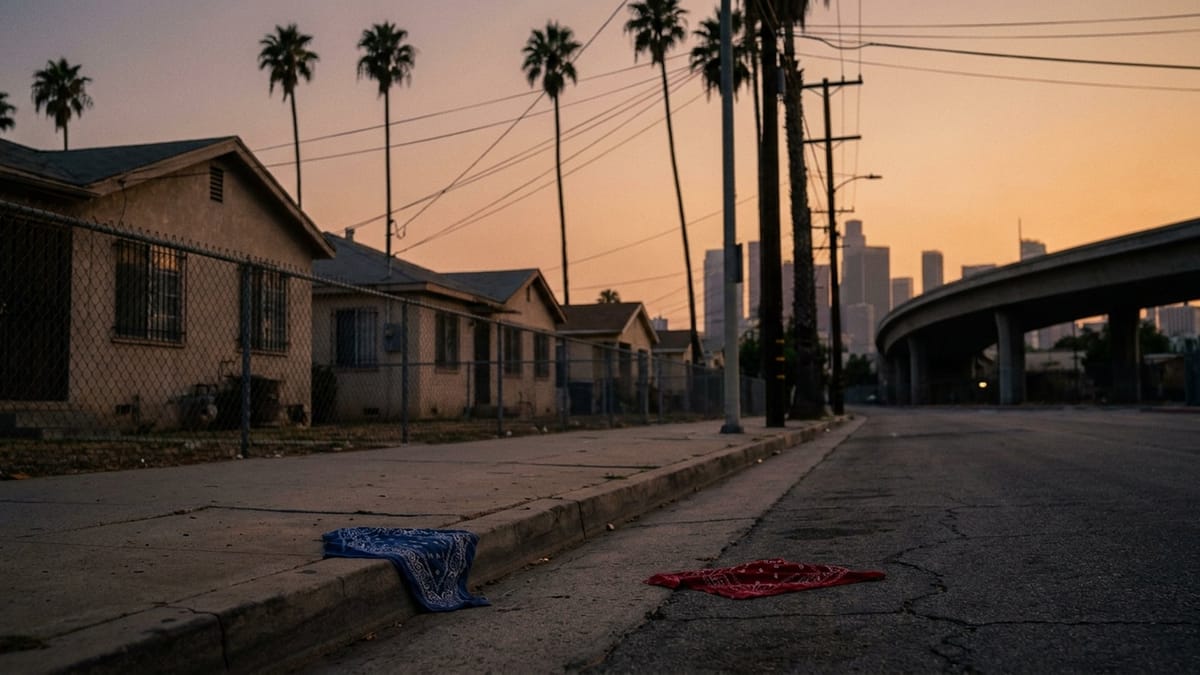
Los Angeles became America's gang capital in layers. By the early 1940s the city's newspapers were already calling young Mexican Americans in zoot suits "pachuco" gangs.2 In 1957 a teenage inmate founded the Mexican Mafia, a prison gang that would come to tax and command Latino street gangs across Southern California.3 5 The Crips arrived around 1969 and the Bloods formed against them in 1972.6 7 Crack money and guns turned all of it into a body count: from 1979 through 1994, gang violence killed 7,288 people in Los Angeles County.11 By the 2000s, the chief of police was quoting a civil rights lawyer who called LA "the gang capital of the country."1
Chicago would like a word. Our Chicago gangs hub makes the same claim for the Windy City, and both cities have a case. What makes Los Angeles different is the shape of the thing: a prison gang on top, street sets underneath, and colors and numbers that traveled far beyond the city.
Quick facts
- First big flashpoint: the Sleepy Lagoon case, 1942, and the Zoot Suit Riots, June 3-8, 19432
- Mexican Mafia founded: 1957, Deuel Vocational Institution, Tracy, California3
- Crips: Raymond Washington's crew, around 1969; Stanley "Tookie" Williams' West Side Crips, 19716
- Bloods: 1972, built around the Pirus of Compton7
- MS-13: started in Los Angeles in the 1980s15
- Worst year: 1992, when county gang homicides passed 800 for the first time10
- 2025: 230 homicides in the city of LA, the fewest since 196617
The First Layer: Pachucos, Sleepy Lagoon and a City That Blamed the Zoot Suit
Long before anyone in Los Angeles talked about blue and red, the city had already decided who its gang problem was. On August 2, 1942, a young man named José Gallardo Díaz was found dead near a reservoir known as the Sleepy Lagoon. Eight days later police rounded up Mexican American youths, and 22 of them went on trial. In January 1943 the jury convicted three of first-degree murder and nine of second-degree murder.2
The convictions didn't survive. In October 1944 a California appeals court reversed all twelve.2 But in between, in June 1943, the city exploded. The trial had inflamed tensions between zoot suiters, who wore the style with pride, and servicemen stationed in Southern California, who saw all that fabric as a snub to wartime austerity. The street fighting that followed took the suit's name: the Zoot Suit Riots.2
That's a pattern the rest of this story keeps repeating: a real problem, a panic, and a crackdown that lands on a whole neighborhood.
The Second Layer: A "Gang of Gangs" Inside the Prison Walls
In 1957 a 16-year-old inmate at the Deuel Vocational Institution in Tracy, Luis "Huero Buff" Flores of Hawaiian Gardens, had an idea. Mexican American convicts would set aside their street rivalries, protect themselves from guards and band together against Black and white inmates. The clique he gathered, about a dozen teenagers, became the first members of the Mexican Mafia, known as La Eme.3
Prison officials tried to break it up by spreading its members to other prisons. That only spread its influence. Inside, La Eme put taxes on drug sales, gambling and extortion, forcing Latino inmates to hand over a cut. In the 1980s it took that model to the street, working through East Los Angeles gang leaders.4
This is the part of LA gang history most outsiders miss. Southern California's Latino street gangs, the Sureños or South Siders, came to answer to a prison gang. Many show their loyalty by adding "13" to their names, for M, the thirteenth letter of the alphabet.5 The number on the wall in a South LA alley can point straight back to a cell block.
Prosecutors keep trying to cut the head off. In 1995 federal prosecutors charged 22 people under the RICO Act with crimes including murder, extortion and kidnapping, and the U.S. attorney declared the gang effectively crippled.4 It wasn't. In October 2026, Los Angeles County prosecutors charged nine people in a Pomona case: eight alleged Mexican Mafia associates accused of a murder conspiracy and extortion scheme, and a ninth accused of picking up the spent casings after a July shooting. Investigators say the victim had been put on an "86" list, barred from Pomona and from the gang's illegal casinos, and that a gunman fired 12 to 15 rounds at his car. These are charges, not convictions, and every defendant is presumed innocent.16
The Third Layer: Crips, Bloods and the Colors Everybody Knows
The Black gangs of South Los Angeles came out of a different world. The Watts uprising of August 1965 left 34 people dead and more than a thousand injured.8 The LA gangs hub traces how housing and policing set the stage for what came next.
By most accounts the central figure was Raymond Washington, who was in his midteens in 1969 when he started a crew called the Baby Avenues. Its members carried canes as an affectation, and the local paper started describing a group of assailants as "crips." Two years later, across town, a muscular young man named Stanley Williams formed the West Side Crips.6 The Crips were never one organization. They were a name that spread faster than anybody could control it.
The Bloods were born as the answer. Crip attacks on smaller crews pushed them together, and by 1972 groups like the Piru Street Boys of Compton were allied against the Crips.7 Every killing after that created another debt, which is the engine of the Crip-Blood war.
Washington was killed in a drive-by shooting in 1979.18 Williams was arrested that same year for four murders, sentenced to death, and executed at San Quentin in 2005,19 a story told in our piece on Tookie Williams.
The Fourth Layer: Refugees and a New Gang Called MS-13
The newest layer arrived from El Salvador. MS-13 started in Los Angeles in the 1980s among Salvadoran immigrants, many of them refugees from their country's civil war.15 Its "13" is the same Southern California number, a nod to the Mexican Mafia's position at the top.5
Crack Turned the Ecosystem Into a Body Count
Every layer was already in place when crack arrived. What crack added was money, and money bought guns. Gang homicides in Los Angeles County rose from 212 in 1984 to 271 in 1985 and 406 in 1988.9 In 1992 the county count reached 800 for the first time, the fifth record year in a row.10
The numbers behind those numbers are worse. A study in the Journal of the American Medical Association counted 7,288 people killed in gang violence in Los Angeles County from 1979 through 1994. Gang killings made up 43% of all homicides there. About a third of the people killed weren't in a violent gang at all, the median victim was 21, and fewer than 5% of the killings involved selling drugs.11 The cliché says these were drug wars. The data says they were mostly about turf, pride and payback.
In 1992, authorities estimated 150,000 gang members in Los Angeles County.12 In 2007 the LAPD counted more than 290 active gangs with over 31,000 members in the city alone.1
The Crackdown and the Truce
The city's answer was force. In April 1988, during Operation Hammer, about 1,000 LAPD officers swept South Central in a single weekend and arrested 1,453 people.14 The jails filled. The killing kept climbing.
The most hopeful moment came from the gangs themselves. On April 28, 1992, the day before the Rodney King verdicts, representatives of four Watts gangs, two Crip and two Blood, signed a peace treaty at a mosque in Watts, modeled on the 1949 armistice between Israel and Egypt.13 Within weeks, Crips and Bloods from across the county were gathering at Watts housing projects to celebrate, trading colors in scenes the Los Angeles Times called almost unfathomable before the riots.12 The same reporting noted the truce was unlikely to spread into the parts of the county where Latino gangs were based.12 And it didn't: the county set its record that year as violence among Latino gangs escalated to unprecedented levels.10 The full story is in Rodney King and the gang truce.
Why LA and Not Somewhere Else?
Here's our read, and it is a read, not a law of nature. Plenty of American cities had poverty, racist policing and crack. Los Angeles had all of that plus three things that compounded. It had a prison gang that turned a whole region's Latino street gangs into a hierarchy. It had a franchise model, Crip and Blood "sets," that made the names portable. And it had pop culture: the movies, records and labels like Death Row Records that sold LA gang style to the world.
The result travelled. Blood membership alone spread to state after state from the 1980s on,7 and the colors, the 13 and the set names turned up in cities that had never seen South Central, a story told in our nationwide gangs hub.
Where It Stands Now
The killing has fallen a long way. The city of Los Angeles recorded 230 homicides in 2025, the fewest since 1966.17 The gangs didn't disappear. The Crips, the Bloods, the Sureño cliques and La Eme are all still there, and as the Pomona case shows, the prison gang's rules still reach the street.16 The capital is quieter than it was. It hasn't abdicated.
For the wider map of American street gangs, see the gangs hub, and for how crack rewrote the country, the crack epidemic hub.
Frequently Asked Questions
Is Los Angeles really the gang capital of America?
It's a nickname, not an official ranking. LAPD Chief William Bratton quoted civil rights attorney Connie Rice calling LA "the gang capital of the country" in 2007 Senate testimony, when his department counted more than 290 active gangs in the city.1 Chicago makes the same claim, with its own history.
What does 13 mean in LA gang names?
It stands for M, the thirteenth letter of the alphabet, and signals loyalty to the Mexican Mafia among Southern California's Sureño gangs.5
When was the Mexican Mafia founded?
In 1957, inside the Deuel Vocational Institution in Tracy, California, by Luis "Huero Buff" Flores and about a dozen other young inmates.3
Who came first, the Crips or the Bloods?
The Crips, around 1969. The Bloods formed in 1972 to protect smaller crews from Crip attacks.6 7
Were most LA gang killings about drugs?
No. In the JAMA study of 7,288 gang killings in the county from 1979 through 1994, fewer than 5% involved selling drugs.11
Part of LA Gangs: ← Back to series hub
─────────
Sources:
- Bratton, William J. Testimony before the U.S. Senate Committee on the Judiciary on gang abatement and prevention, June 5, 2007. judiciary.senate.gov
- "1942: People v. Zamora (sic) / 1943: Zoot Suit Riots." A Latinx Resource Guide: Civil Rights Cases and Events in the United States, Library of Congress. guides.loc.gov
- Corwin, Miles. "Inside the Mexican Mafia." Los Angeles Times, December 15, 2008. latimes.com
- Pekow, Suzanne. "The Mexican Mafia." Gangster Confidential, American RadioWorks. americanradioworks.publicradio.org
- "History of the Mexican Mafia Prison Gang." Police Magazine. policemag.com
- Pesca, Mike. "Tookie Williams and the History of the Crips." NPR, December 7, 2005. npr.org
- "Bloods." Wikipedia. en.wikipedia.org
- "Watts Riots of 1965." Encyclopaedia Britannica. britannica.com
- "Total Murders Down Despite Record High in Gang Killings." Los Angeles Times, January 10, 1989. latimes.com
- Katz, Jesse. "County's Yearly Gang Death Toll Reaches 800." Los Angeles Times, January 19, 1993. latimes.com
- "Medical Researchers Call Gang Killings 'Epidemic' in County." Los Angeles Times, October 4, 1995. latimes.com
- Ford, Andrea, and Carla Rivera. "Hope Takes Hold as Bloods, Crips Say Truce Is for Real." Los Angeles Times, May 21, 1992. latimes.com
- "Watts truce." Wikipedia. en.wikipedia.org
- "Operation Hammer (1987)." Wikipedia. en.wikipedia.org
- "How We're Ganging Up On MS-13." Federal Bureau of Investigation, July 13, 2005. archives.fbi.gov
- City News Service. "Mexican Mafia associates accused of murder conspiracy, extortion." NBC Los Angeles, October 7, 2026. nbclosangeles.com
- Stoltze, Frank. "Homicides fall to lowest level since 1966 in city of LA." LAist, January 29, 2026. laist.com
- "Raymond Washington." Wikipedia. en.wikipedia.org
- "Stanley Williams." Wikipedia. en.wikipedia.org
Further reading:
- Davis, Mike. City of Quartz: Excavating the Future in Los Angeles. Verso, 1990.
- Hayden, Tom. Street Wars: Gangs and the Future of Violence. The New Press, 2004.
- Cannon, Lou. Official Negligence: How Rodney King and the Riots Changed Los Angeles and the LAPD. Times Books, 1997.