The Bloods: Born From the Crips' Own Violence
The Bloods formed in 1972 when Piru Street Boys in Compton refused Crip pressure and built a rival alliance around the color red.
The Bloods: Born From the Crips’ Own Violence
The Bloods formed in 1972 as a direct counter to Crip aggression. Smaller South Central crews facing Crip pressure to pay tribute or fold held a series of meetings and built a unified alliance instead — one that defined itself entirely by what it was against. That reactive origin shaped everything the Bloods became.
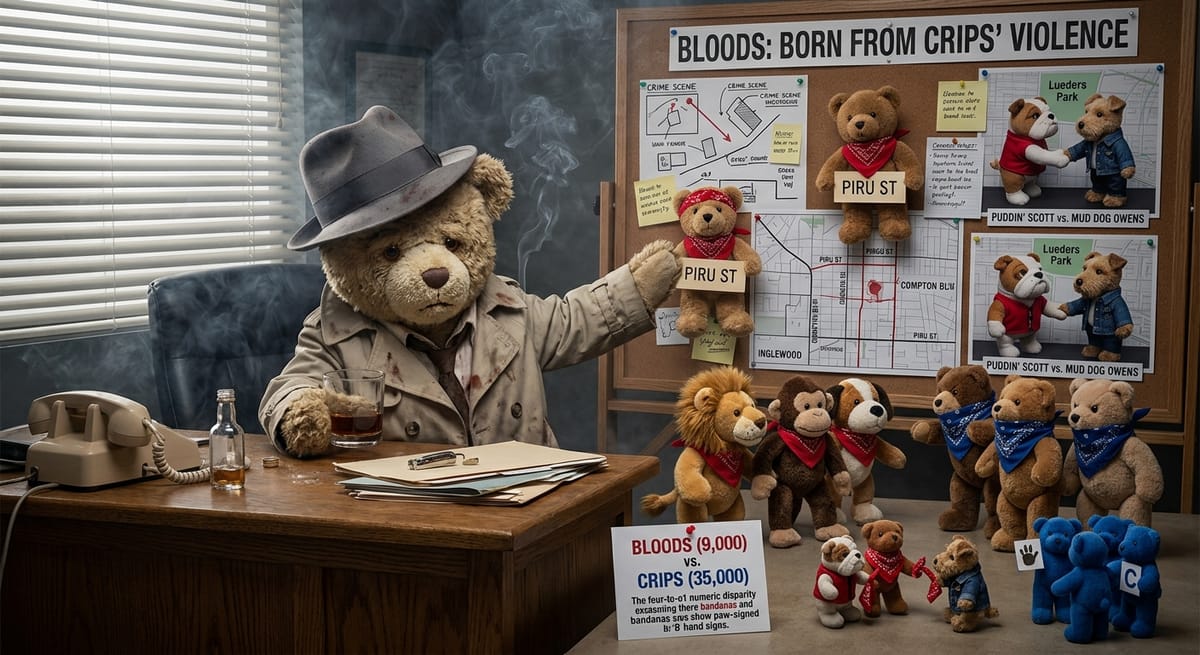
The Bloods didn’t start as an idea. They started as a response. By 1972, the Crips had grown aggressive enough that smaller neighborhood crews in South Central Los Angeles felt existential pressure — pay tribute, join up, or get rolled. The Piru Street Boys of Compton, centered on Piru Street near Compton Boulevard, were among the first to refuse.^1^ In 1972, Piru Street Boys leadership began meeting with other non-Crip sets — the Lueders Park Hustlers, the Bishops, the Denver Lanes — to form a unified front. What came out of those meetings was the Bloods, an alliance defined less by a shared origin than by a common enemy.
The Piru Street Boys Created the Blood Alliance
The Piru Street Boys had existed since the early 1970s, associated with the neighborhood around Piru Street in Compton. Their transformation into the founding chapter of the Bloods followed directly from Crip intimidation. Sylvester “Puddin” Scott and Vincent “Mud Dog” Owens are credited in LAPD records with being among the key organizers of the early Piru meetings that formalized the Blood alliance.^2^ The name “Bloods” spread from that alliance outward, adopted by sets across South Central, Compton, and Inglewood who needed an identity strong enough to stand against the Crips’ numerical advantage.
The color red — counterpoint to Crip blue — came from the Brim sets, another early Blood-affiliated crew from the Inglewood area. Red bandanas, red laces, red stitching on clothing. Members used “Blood” or “Cuzz” as greeting, eventually settling on “Blood” exclusively to distinguish from the Crip use of “Cuzz.” The hand sign — fingers formed into the letter B — became the symbol. Where Crips replaced B with CK (Crip Killer) in writing, Bloods replaced C with BK (Blood Killer). These identity markers weren’t just symbolism; they were survival codes in a city where wearing the wrong color on the wrong block could get you shot.
How the Bloods Spread Beyond Los Angeles
The Bloods, like the Crips, operate through autonomous sets with no central leadership. Bloods sets include the Brims, Pirus, Bounty Hunter Watts Bloods, Denver Lanes, and dozens of others across Los Angeles County. Individual sets have their own leaders, their own territory, and their own internal rules. The broader Blood identity is more an oppositional alliance than a unified organization — a fact that law enforcement has often failed to account for when treating “the Bloods” as a monolithic entity.
By the mid-1980s, Blood sets had spread beyond Los Angeles along the same migration and incarceration routes that carried Crip presence across the country. The Bloods arrived in New York City in the early 1990s, where the gang took a different form. The United Blood Nation, founded in 1993 at Rikers Island by Omar Portee (known as O.G. Mack) and Leonard “Deadeye” McKenzie, was a prison gang first, adapted for New York’s borough geography.^3^ The New York Bloods had little connection to the original Piru founding — they shared the name, the color, and the general opposition to rivals, but were organizationally distinct.
Why Did the Bloods Emphasize Violence When They Were Outnumbered?
The LAPD counted approximately 9,000 Blood members in Los Angeles County in 1992, against an estimated 35,000 Crips in the same geography — a ratio that explains the Blood emphasis on reputation and aggression as survival tactics.^4^ Outnumbered roughly four to one in their home city, Bloods sets developed a culture of demonstrated violence as deterrence. The disparity also pushed Blood expansion into prison systems, where numbers could be built outside the street geography that favored the Crips.
The crack epidemic reshaped both gangs’ economics. Bloods sets that had operated primarily through robbery and extortion shifted toward drug distribution in the 1980s as crack made drug dealing the most available income source in South Central and Compton. The profits made the violence more lethal — more money meant more weapons, and better weapons meant more funerals.
The Recursive Logic Behind Los Angeles Gang Formation
What the Bloods represent, structurally, is the recursive logic of gang formation: a gang formed to resist another gang’s violence produces more violence, which requires more resistance, which produces more gangs. The Crips’ aggressive expansion created the Bloods. The Bloods’ formation hardened the Crips. The Crip-Blood war over the next three decades would claim thousands of lives across Los Angeles — people who grew up in the same zip codes, attended the same schools, and faced the same structural conditions, killing each other on streets that the rest of the city mostly agreed to ignore.
The Bloods exist in 2024 in roughly the same form they have for fifty years — decentralized sets, loose affiliation, localized leadership, persistent presence in the same neighborhoods. Federal prosecutions under RICO statutes have taken down individual sets and leaders without meaningfully disrupting the gang’s overall operation. The Piru founding sets still operate in Compton. The New York chapter that branched from Rikers Island has its own trajectory. None of the original Piru meeting organizers still hold influence — most are dead, imprisoned, or long out of the life. The institution survived them all, which is the point: what was built in 1972 in response to pressure had less to do with personalities than with the conditions that made an armed alliance feel necessary.
The 1992 Rodney King truce briefly brought the Bounty Hunter Watts Bloods and Grape Street Crips to a ceasefire table — one of the few moments the war interrupted itself. See also Crips origins and the LA Gangs series hub for the full arc of South Central’s gang history.
Part of LA Gangs — ← Back to series hub
─────────
Sources:
- Alonso, Alex A. “Racialized Identities and the Formation of Black Gangs in Los Angeles.” Urban Geography 25, no. 7 (2004): 658–674.
- Los Angeles Police Department. 1992 Gang Violence Report. City of Los Angeles, 1993.
- Levitt, Steven D. and Sudhir Alladi Venkatesh. “An Economic Analysis of a Drug-Selling Gang’s Finances.” Quarterly Journal of Economics 115, no. 3 (2000): 755–789.
- Klein, Malcolm W. The American Street Gang: Its Nature, Prevalence, and Control. Oxford University Press, 1995.
- Hayden, Tom. Street Wars: Gangs and the Future of Violence. The New Press, 2004.