Chicago Gangs: America's Gang Capital
The complete history of Chicago's gang wars — Gangster Disciples Vice Lords Black P Stones Latin Kings Folk Nation People Nation and drill music.
Chicago Gangs: America’s Gang Capital
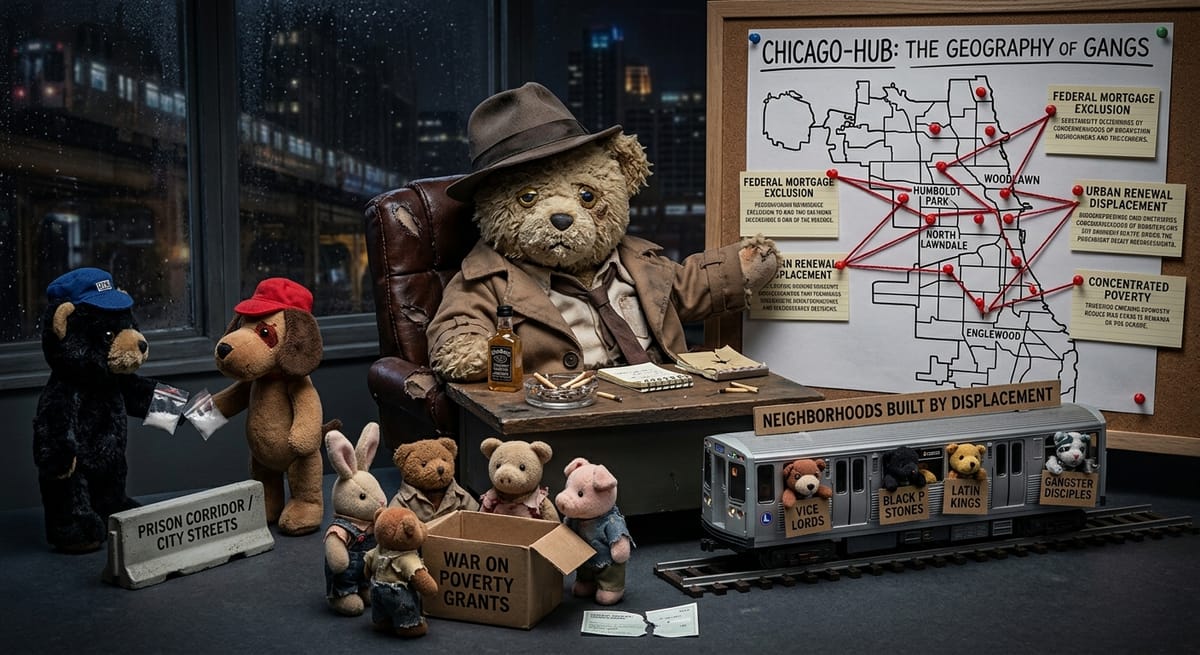
Chicago’s gang problem is not an accident of culture or personal failure. It is an artifact of specific policy decisions, made over decades, that concentrated poverty, segregated neighborhoods, and then criminalized the social structures that poverty and segregation produced.
In This Series
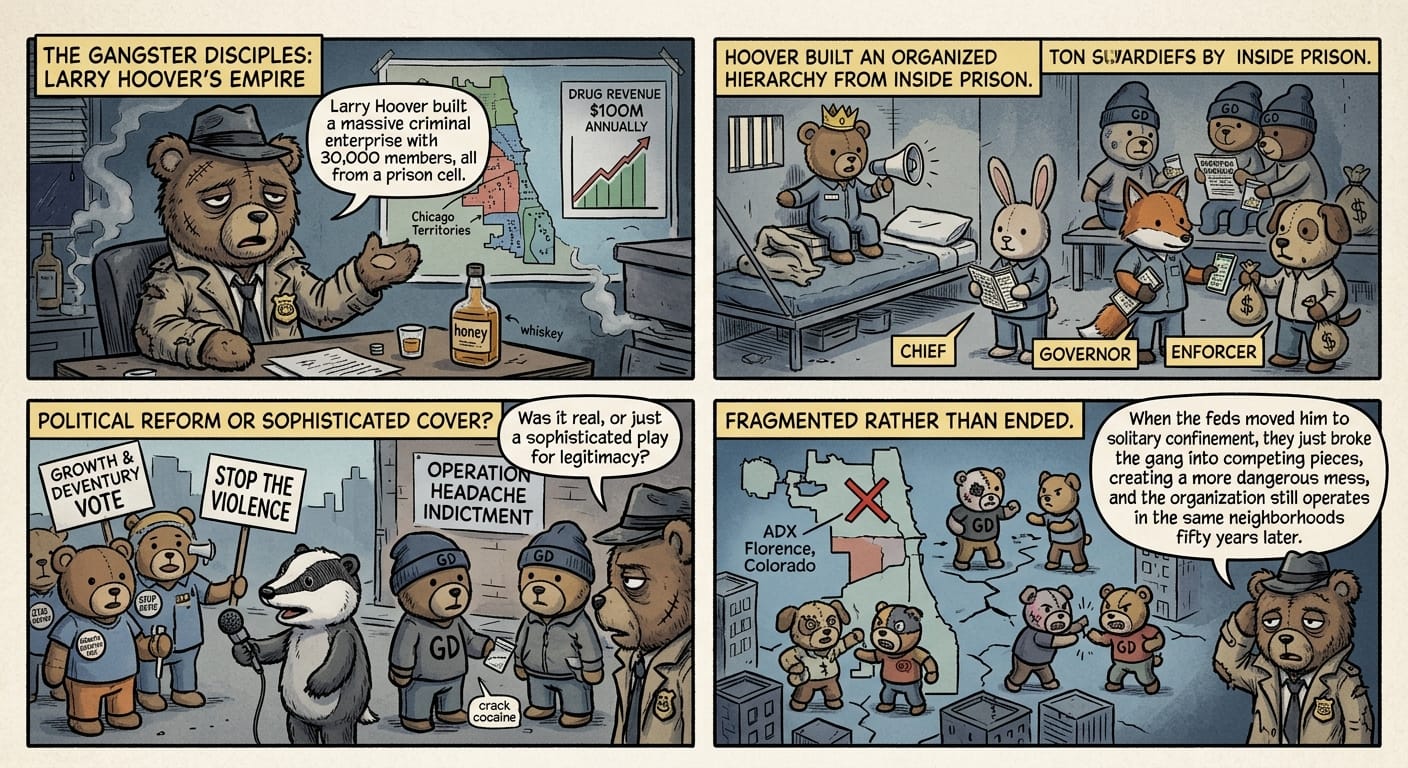
- The Gangster Disciples: Larry Hoover’s Empire
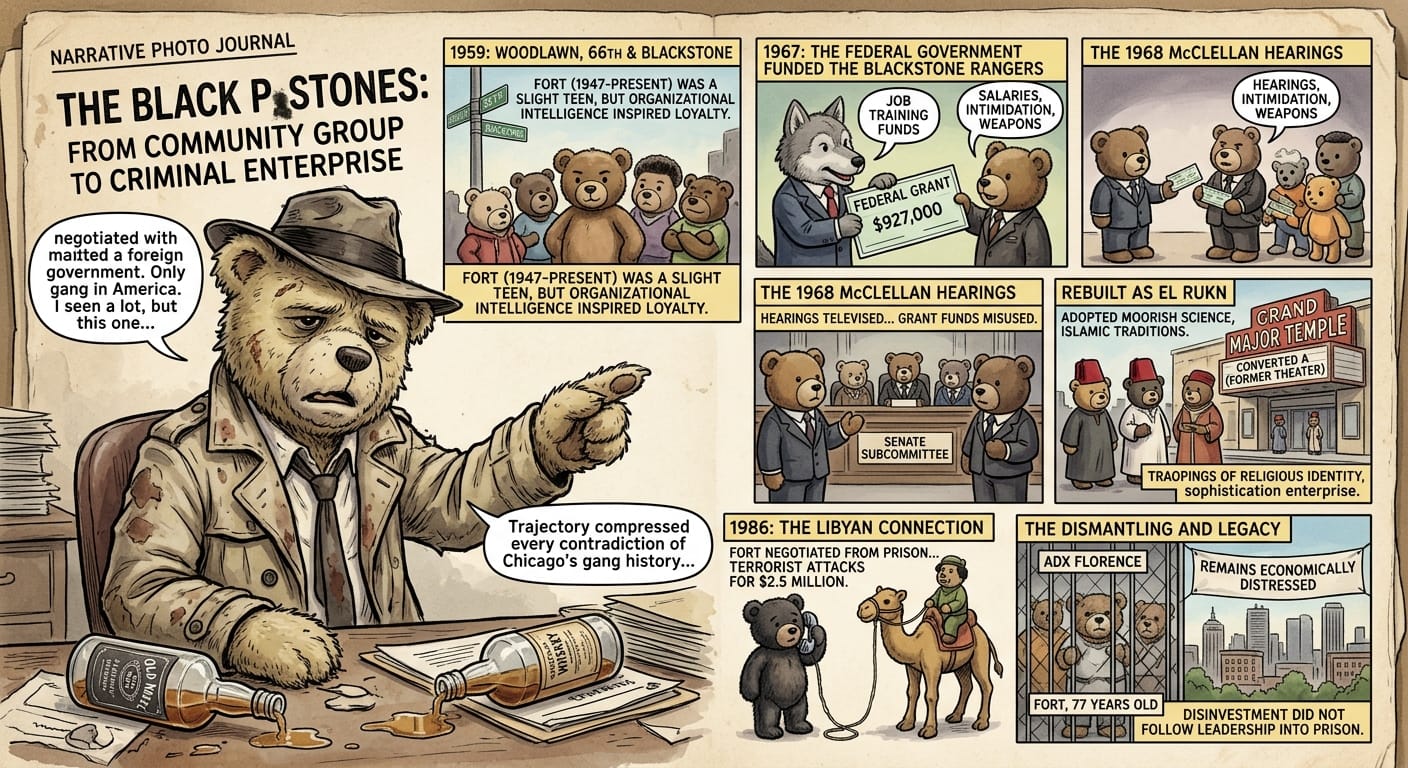
- The Black P Stones: From Community Group to Criminal Enterprise
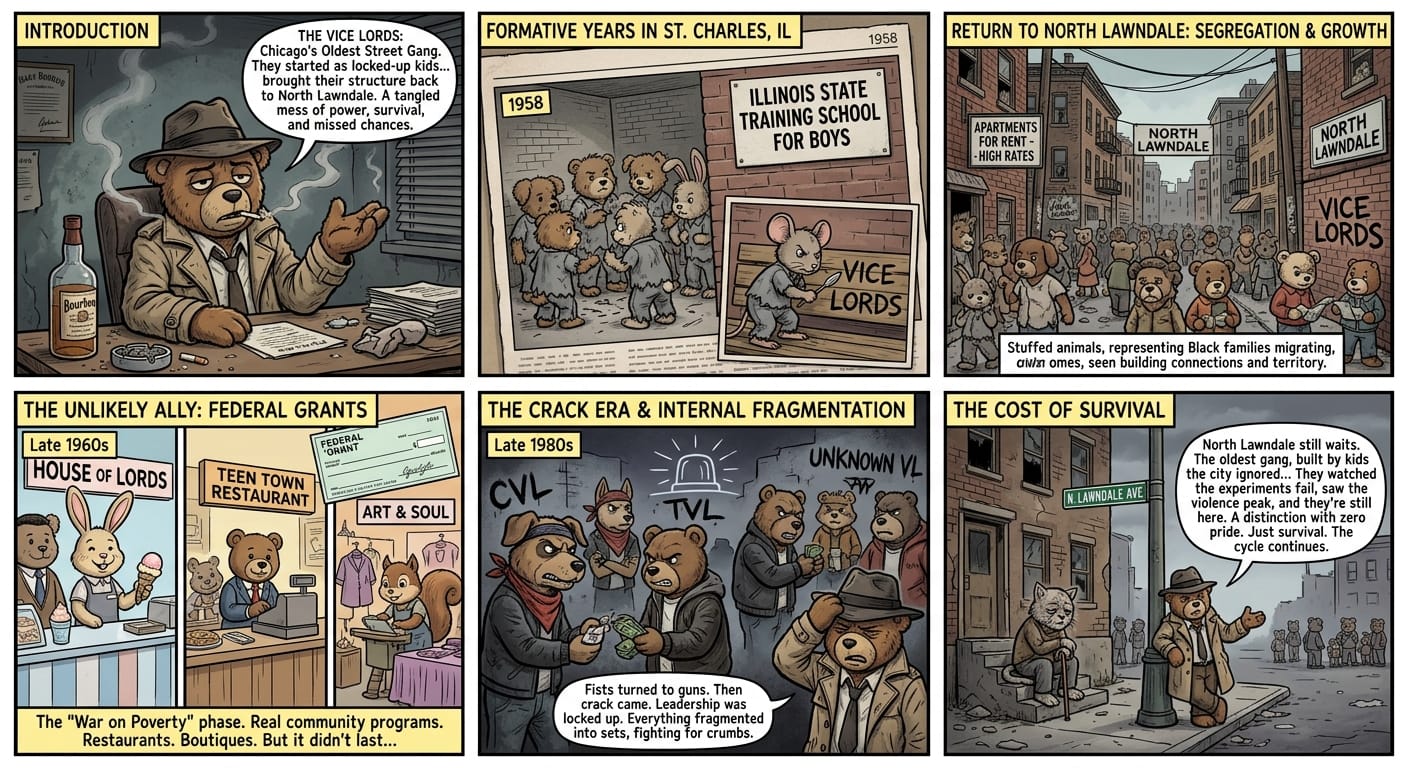
- The Vice Lords: Chicago’s Oldest Street Gang
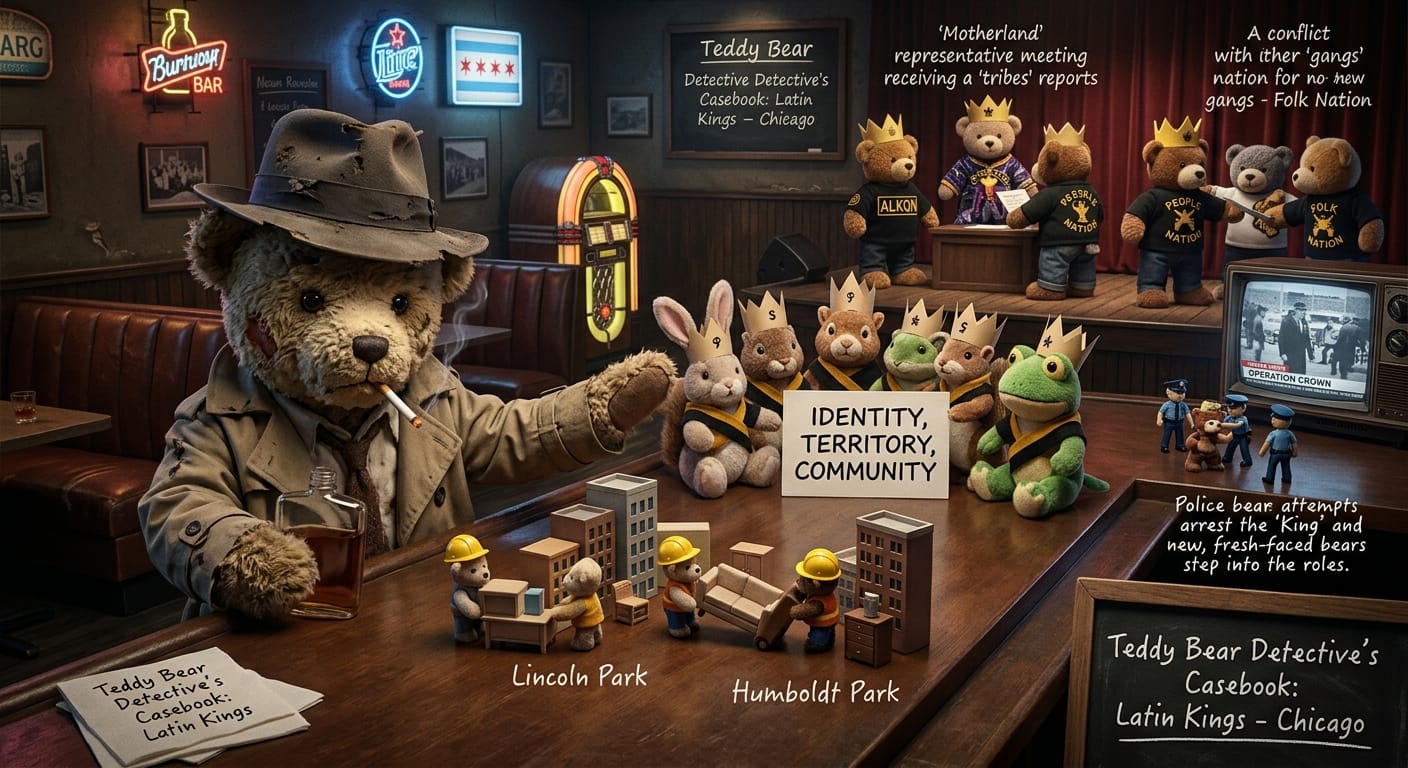
- The Latin Kings in Chicago
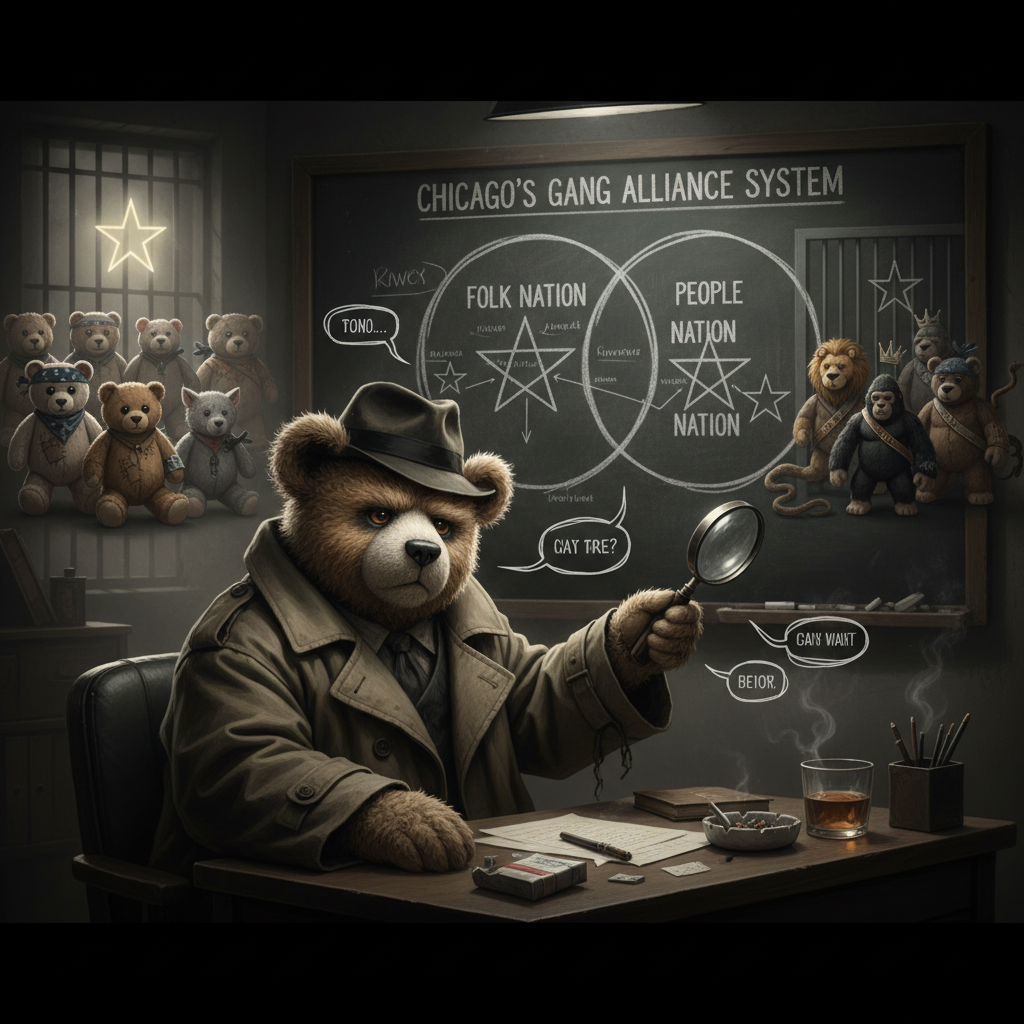
- Folk Nation vs People Nation: Chicago’s Gang Alliance System
- Chief Keef and Drill Music: When Chicago’s Violence Got a Soundtrack
The Pattern
Chicago’s street gangs were built in neighborhoods that were built by displacement. The Vice Lords organized in North Lawndale after white families left with federally backed mortgages that Black families couldn’t access. The Black P Stones organized in Woodlawn after Puerto Rican families were pushed there from neighborhoods demolished by urban renewal. The Latin Kings organized in Humboldt Park after Puerto Rican migrants were cleared from Lincoln Park. Every major gang in Chicago’s history traces back to the same sequence: a community is concentrated by discriminatory policy, services are withdrawn, and a generation of young men build the only institutions available to them.
What the Evidence Shows
The Vice Lords formed in 1958 inside a juvenile detention facility. The Blackstone Rangers organized in Woodlawn in the early 1960s and briefly received federal War on Poverty grants before those were cut. The Gangster Disciples under Larry Hoover grew to an estimated 30,000 members and $100 million in annual drug revenue while Hoover ran the organization from inside Illinois state prison. The Folk Nation vs. People Nation alliance system organized Chicago’s gangs into two opposing blocs starting in the late 1970s, a framework that moved from prison corridors to city streets and then to other cities across the Midwest and South.
The crack cocaine epidemic arrived in Chicago in the mid-1980s and transformed the economics of gang membership. Chicago’s homicide count peaked at 943 in 1974, declined, then climbed again to 506 in 2012 — a surge associated with the fracturing of centralized gang leadership following federal prosecutions, which produced dozens of competing splinter factions with no internal authority capable of limiting violence.
Why Chicago’s Gang Leadership Kept Reaching for Political Legitimacy
Chicago’s gang leadership spent fifty years navigating two simultaneous pressures: the criminal opportunity that gang membership represented and the political possibility that gang organization represented. Jeff Fort tried to use federal grants and religious identity to build something durable. Larry Hoover tried to rebrand the Gangster Disciples as a political organization and register voters. Both attempts were genuine, however mixed with self-interest, and both were crushed by federal prosecution before their results could be fully measured. What was left in both cases was a criminal organization without the political ambition that had briefly complicated the picture.
Chief Keef’s emergence in 2012 made Chicago’s South Side gang violence globally audible. Drill music carried the specificity of block-by-block conflict to an audience that found it compelling enough to make a 16-year-old on house arrest into a star with an Interscope deal. That transaction — converting South Side violence into entertainment revenue that flowed everywhere except back to Englewood — is a compressed version of the city’s relationship to its poorest neighborhoods across decades.
Federal Prosecution Made Chicago’s Gang Violence Worse, Not Better
The pattern of federal prosecution dismantling gang leadership while leaving structural conditions intact has produced a Chicago gang landscape that is more fragmented and arguably more violent than it was under centralized leadership. When Hoover ran the Gangster Disciples from prison, there was at least a hierarchy capable of making and enforcing decisions. After Operation Headache and the subsequent prosecutions, dozens of competing splinter groups operate without coordination, which means without the capacity for internally enforced ceasefires that centralized leadership occasionally used.
The policy response that reduced Chicago gang violence most meaningfully was not prosecution but economic development — targeted investment in Woodlawn, Englewood, and North Lawndale produced measurable results in the periods when it was sustained. Those investments were never sustained long enough to change the underlying structure.
Chicago gang violence is lower in 2024 than at its 1974 or 2012 peaks. It is still, by any international comparison, extraordinary — a product of the most segregated major city in the United States, built on discriminatory housing policy, sustained by disinvestment, and managed by a criminal justice system that has been treating the symptoms for sixty years without addressing the disease.
─────────
Sources:
- Hirsch, Arnold R. Making the Second Ghetto: Race and Housing in Chicago, 1940–1960. Cambridge University Press, 1983.
- Venkatesh, Sudhir Alladi. Gang Leader for a Day. Penguin Press, 2008.
- Hagedorn, John M. A World of Gangs: Armed Young Men and Gangsta Culture. University of Minnesota Press, 2008.
The Series