Rodney King and the Gang Truce That Almost Worked
The Watts gang truce was signed three days before the Rodney King verdict — and cut gang homicides 44 percent before the city refused to fund what peace required.
Rodney King and the Gang Truce That Almost Worked
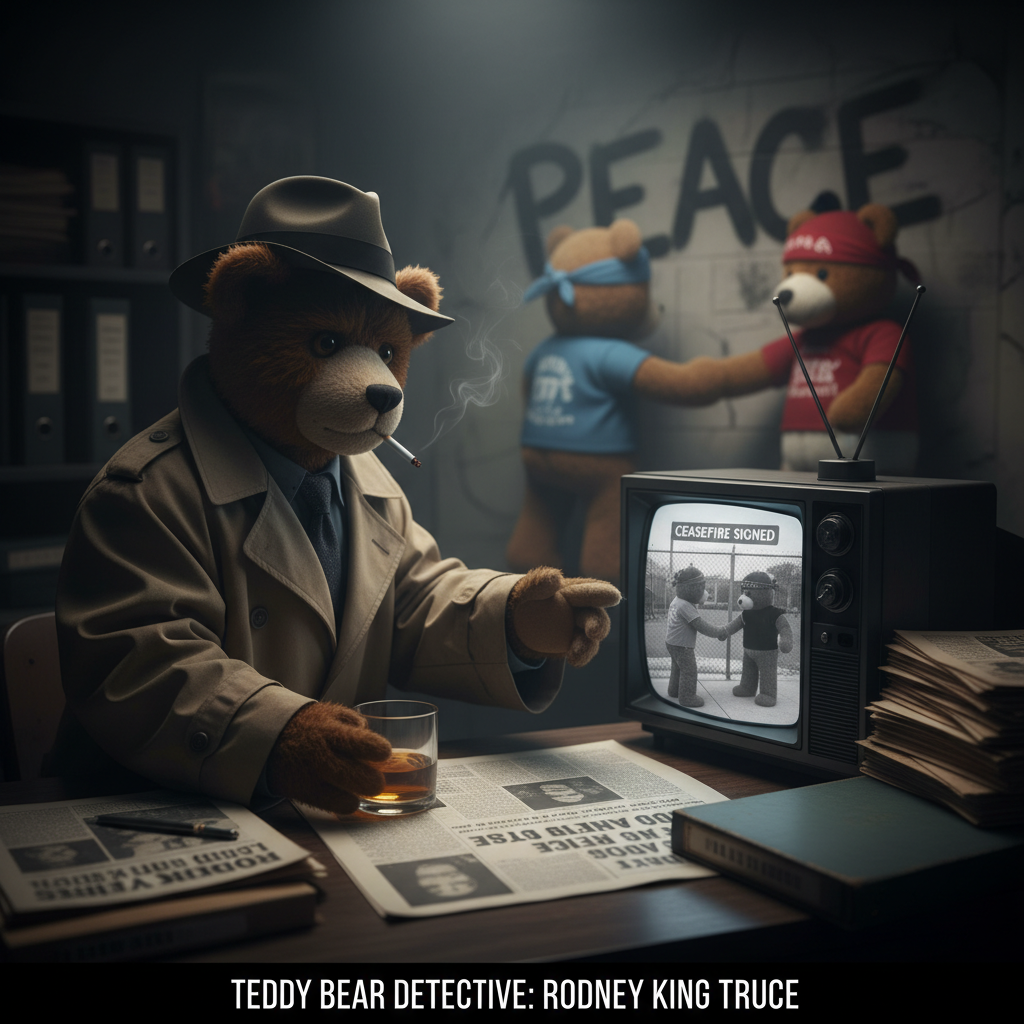
The 1992 Los Angeles riots exposed something most people missed: the gang truce in Watts was already signed before the verdict came down. Crip and Blood sets negotiated a ceasefire on April 26, three days before the Rodney King acquittals triggered the city’s worst unrest since 1965. When the riots began, Watts held. The truce worked — until the city decided not to fund what it required.
On March 3, 1991, Rodney King, a 25-year-old Black man, was beaten for 81 seconds by four Los Angeles police officers after a traffic stop on the 210 Freeway near Foothill Boulevard. George Holliday, a neighbor who heard the noise, filmed it from his balcony with a Sony Handycam. The footage — showing King struck more than 50 times with batons while lying on the ground — was broadcast nationally within days and cracked open a conversation about LAPD brutality that the department had been suppressing for decades.^1^
What happened next — the acquittal, the riots, and the gang truce that briefly emerged from the wreckage — is one of the most complex chapters in Los Angeles history.
The Acquittal Triggered Six Days of Destruction
The four officers — Sergeant Stacey Koon and Officers Laurence Powell, Timothy Wind, and Theodore Briseno — were tried in Simi Valley, a predominantly white suburb, before a jury with no Black members. On April 29, 1992, all four were acquitted on all charges. Within hours, Los Angeles exploded. Over six days, 63 people were killed, more than 2,000 were injured, 12,000 were arrested, and approximately $1 billion in property was destroyed across the city.^2^
The LAPD, caught off guard by the scale and speed of the uprising, failed to deploy adequately in the first critical hours. Police Chief Daryl Gates was at a fundraiser in Bel-Air when the riots began. National Guard deployment was delayed. South Central, Koreatown, Pico-Union, and parts of Hollywood burned while the city’s emergency response fumbled.
The Truce That Formed Before the Verdict
What is less often told is that a gang truce in Watts was already in negotiation before the riots began. In the weeks following the King verdict announcement date, leaders of the Grape Street Crips and the Bounty Hunter Watts Bloods — two of the most consistently violent rival sets in Los Angeles — met at Nickerson Gardens, a housing project in Watts, to discuss a ceasefire.^3^ The meetings were facilitated in part by community organizers including Aqeela Sherrills and Daude Sherrills, brothers who had grown up in Watts and maintained credibility with both sides.
The truce was signed on April 26, 1992, three days before the verdict. When the acquittals came and riots broke out across the city, Watts — the neighborhood that had erupted in 1965 and that many expected to be the epicenter of the 1992 uprising — was comparatively calm. The truce held.
The Truce Cut Gang Homicides by 44 Percent in Watts
In the months following, the Watts truce produced measurable results. Gang homicides in the 77th Street LAPD division, which covers Watts, dropped 44 percent in the six months after the truce compared to the six months prior.^4^ Across Los Angeles, gang killings declined significantly from the 1992 peak of 803. Crip and Blood sets in other parts of South Central began their own ceasefire negotiations, modeled on the Watts example.
The peace was attributed by its architects to a simple recognition: the gangs and the community around them shared a common enemy in the conditions of their lives — poverty, police brutality, housing deprivation, school failure — and were killing each other instead of addressing those conditions. Aqeela Sherrills later said the truce was partly inspired by the Israeli-Palestinian negotiations at Camp David, which showed him that even deeply entrenched enemies could be brought to a table.
The truce also produced more direct asks. Gang leaders submitted a proposal to the city called “Give Us the Hammer and Nails,” requesting $3.7 billion in investment for South Central — infrastructure, jobs, schools, hospitals. The proposal was largely ignored by city and state government.^5^
Why Did the Truce Fall Apart Without Investment?
Without the infrastructure investment the truce organizers requested, the peace had no economic foundation. Young men without jobs, without economic alternatives, and with gang ties that predated the truce had no new structure to orient around. By 1994, violence was climbing again. The LAPD, whose leadership had been ambivalent about the truce from the start, did not adjust policing strategies to support it. The federal “three strikes” law passed in 1994 swept large numbers of young men from the truce neighborhoods into California’s prisons, where the gang structures that the truce had tried to soften were reinforced rather than dismantled.
Rodney King himself became a complicated symbol of the moment. He received a $3.8 million civil settlement from the City of Los Angeles in 1994. His personal life after the settlement — multiple arrests, addiction struggles — added pathos to a story that had already carried too much weight. He drowned in his swimming pool in Rancho Cucamonga on June 17, 2012, at age 47.
The 1992 truce showed that the people closest to gang violence — not law enforcement, not politicians — were capable of negotiating peace when they chose to. It also showed that peace without investment is temporary. The structural conditions that made the truce necessary were never addressed. Los Angeles did not give Watts the hammer and nails. The gangs that laid down their grievances for a few years picked them back up, and the killing resumed in communities that the city had decided, implicitly, to write off.
The Crip-Blood war context explains why the truce mattered. The Crips origins piece covers the gang’s founding. For the full arc, see the LA Gangs series hub.
Part of LA Gangs — ← Back to series hub
─────────
Sources:
- Cannon, Lou. Official Negligence: How Rodney King and the Riots Changed Los Angeles and the LAPD. Times Books, 1997.
- Los Angeles Police Department. After-Action Report: The Civil Disturbance in Los Angeles, April 29–May 4, 1992. City of Los Angeles, 1992.
- Sherrills, Aqeela. Interview. Frontline: Rampage. PBS, 2001.
- Hayden, Tom. Street Wars: Gangs and the Future of Violence. The New Press, 2004.
- Hunt, Darnell, ed. Screening the Los Angeles Riots. Cambridge University Press, 1997.