The Crack Epidemic: How One Drug Rewrote America
Between 1984 and 1994 crack cocaine remade American cities — not alone but by accelerating every structural failure already in place. The policy response locked the damage in for thirty more years.

The Crack Epidemic: How One Drug Rewrote America
Between 1984 and 1994, crack cocaine remade American cities. It did not do this alone. It arrived into neighborhoods that had been weakened by deindustrialization, redlined out of wealth accumulation, and policed rather than invested in for decades. But it accelerated every negative trend already in motion, and the policy response to it — mandatory minimums, the 100-to-1 sentencing disparity, the Anti-Drug Abuse Acts of 1986 and 1988 — locked the damage into legal architecture that outlasted the epidemic itself by thirty years.^1^
In This Series
- How Crack Hit America: The Drug That Rewrote the Rules — The chemistry, the price point, and how crack spread city by city through existing urban networks.
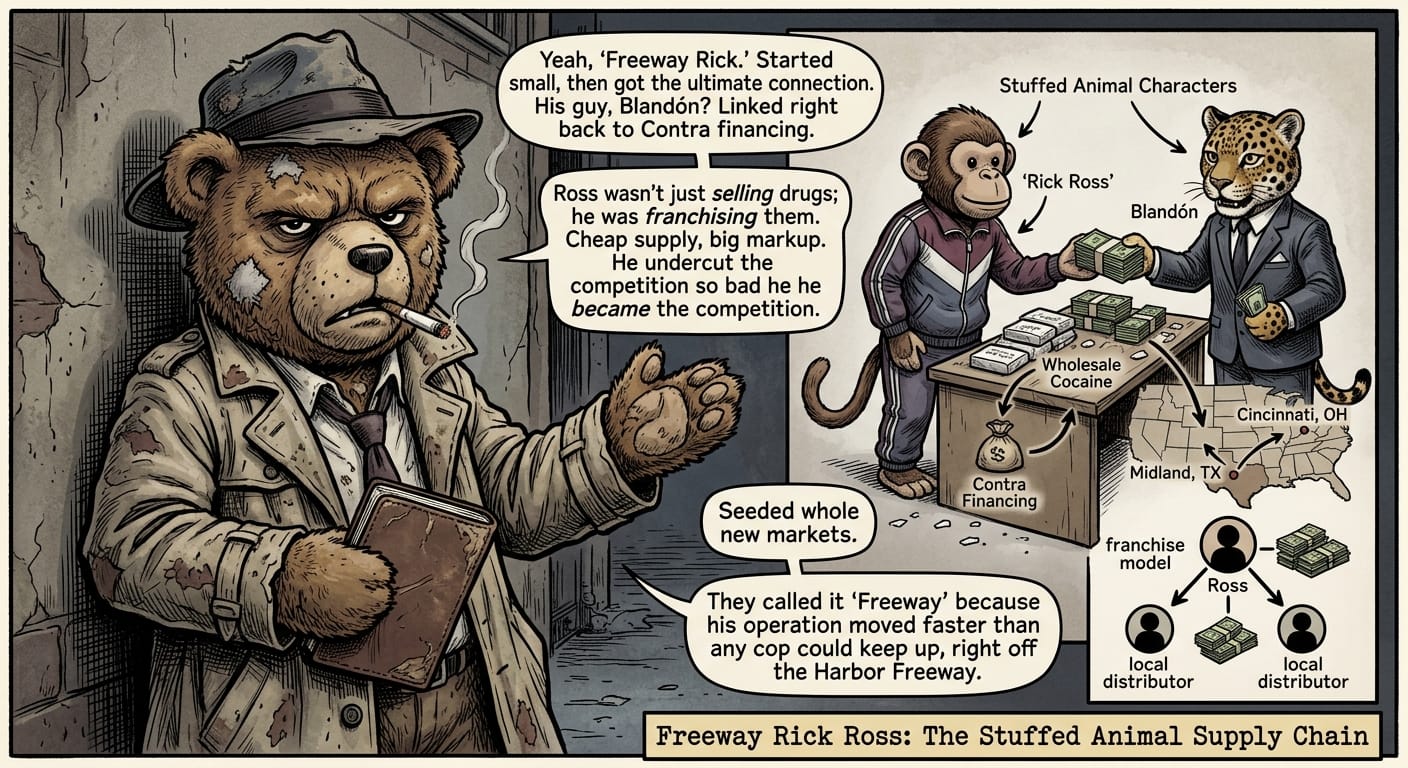
- Freeway Rick Ross: The Biggest Crack Dealer in American History — How one man’s supply-chain advantage turned South Central Los Angeles into a crack distribution hub that seeded markets nationwide.
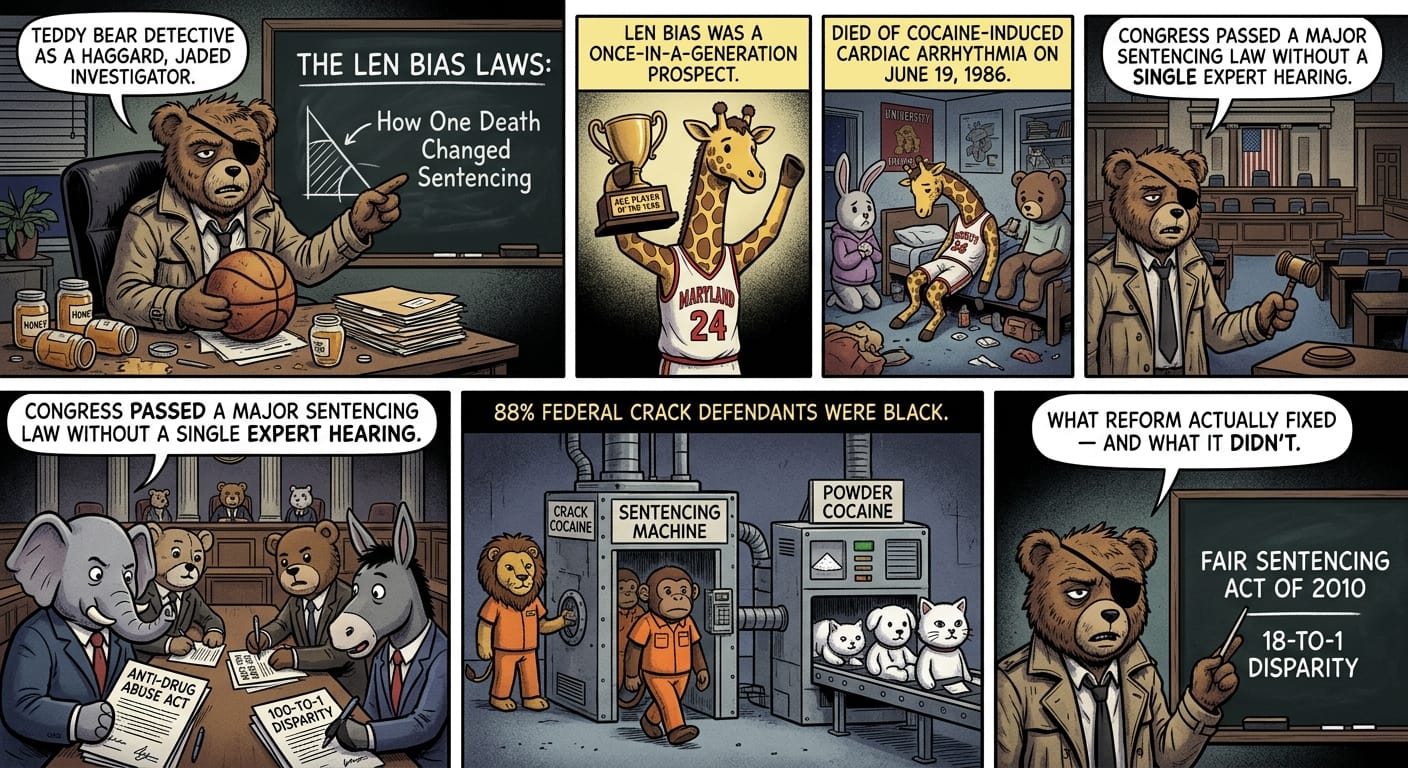
- Len Bias and the 1986 Drug Laws: How One Death Changed Sentencing — The basketball star whose death from powder cocaine triggered six weeks of lawmaking that produced the harshest drug sentencing regime in American history.
- The CIA-Contra Connection: Did the Government Help Flood Black Neighborhoods? — Gary Webb’s “Dark Alliance” investigation, the institutional retaliation against it, and what the CIA’s own inspector general confirmed.
- Crack vs Powder: The Sentencing Disparity That Had No Scientific Basis — How the 100-to-1 mandatory minimum ratio was created, maintained, and finally partially reformed 24 years later.
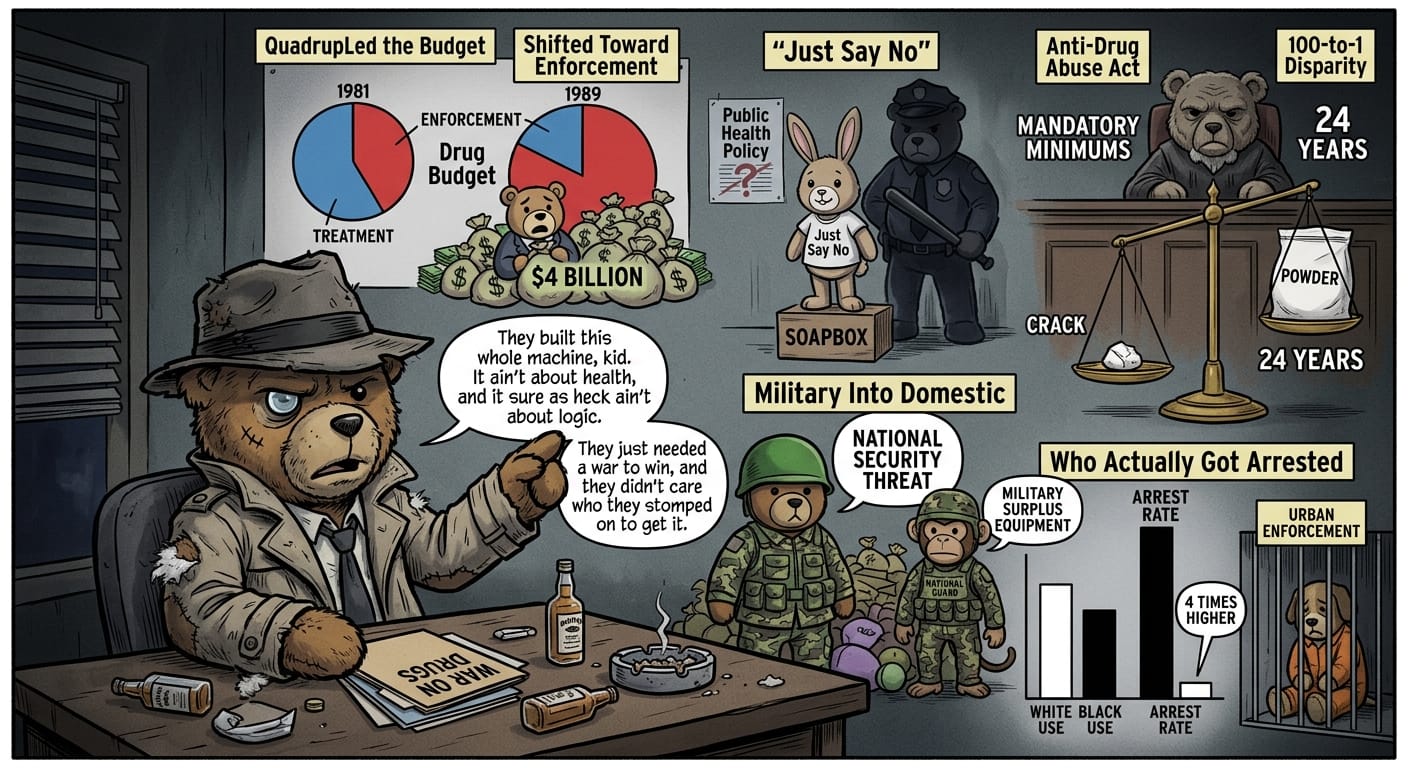
- Reagan and the War on Drugs: How a Slogan Became a Machine — The policy apparatus Reagan built, how it weaponized enforcement over treatment, and the mass incarceration system it produced.
The Pattern Across These Stories
Look across the six pieces in this series and one pattern is consistent: the crack epidemic was not a natural disaster. It was the collision of an extraordinarily addictive and cheap product with a market primed by structural poverty, and a political response that chose punishment over treatment at every fork in the road.
The chemistry created the opening. Crack cocaine’s five-to-fifteen-minute high, achievable for five dollars, produced a consumption pattern that generated compulsive use at income levels that powder cocaine never reached. The price point was not incidental — it was a market innovation that made addiction accessible to people who had been cocaine’s demographic fringe.
Freeway Rick Ross didn’t invent crack. He solved a logistics problem: how to acquire cocaine cheaply enough to sell at retail margins that made the business worth running at scale. His answer — go around the Italian mob wholesale network and buy directly from Nicaraguan-connected suppliers — produced a supply chain so efficient that his pricing set the market rate for Los Angeles crack and his distribution network seeded markets across the Midwest. The business insight was real. So was the trail of addiction behind it.
The CIA-Contra story sits at the most contested edge of this history. What Gary Webb documented — federal agencies aware of Contra-affiliated drug trafficking and declining to interfere — was confirmed by the CIA’s own inspector general in 1998. Whether that constitutes the government “flooding Black neighborhoods” depends on how you weigh deliberate targeting against systemic indifference. The people in South Central whose neighborhoods were flooded have generally not found the distinction a meaningful one.
The Policy That Made It Worse
Reagan’s drug war did not create the crack epidemic, but the policy apparatus it constructed converted a public health crisis into a carceral one. The Anti-Drug Abuse Act of 1986 — drafted in six weeks, passed with almost no hearings, triggered by the death of Len Bias from powder cocaine — established mandatory minimums whose 100-to-1 crack-to-powder sentencing disparity had no pharmacological basis. It was political architecture wearing the clothes of public safety.
The people who bore that architecture were named. Kemba Smith: 24.5 years for conspiracy, no prior record, no personal drug sales. Hundreds of thousands of others like her, whose names didn’t make the newspapers. They bore sentences calibrated to produce political advantage for people who didn’t live in their neighborhoods and whose children weren’t going to prison under mandatory minimums for holding five grams.^2^
What the Epidemic Left Behind
The crack epidemic’s acute phase — the years when homicide rates peaked, when crack houses were on corners, when emergency rooms were overwhelmed — was largely over by the mid-1990s. The structural aftermath was not. A generation of Black men entered the criminal justice system during the mandatory minimum years and emerged — or did not emerge — with felony records that stripped voting rights, housing access, federal benefits, and employment prospects. The neighborhoods those men came from absorbed the loss.^1^
The crack epidemic did not destroy Black urban America. But it landed on communities that were already under compressive force, and it gave the political system a justification for the most aggressive criminalization program in American history. That program ran for decades. The epidemic that provided its launch excuse was over long before the program wound down.
─────────
Sources:
- Alexander, Michelle. The New Jim Crow: Mass Incarceration in the Age of Colorblindness. The New Press, 2010.
- Reinarman, Craig and Harry Levine, eds. Crack in America: Demon Drugs and Social Justice. University of California Press, 1997.
- Webb, Gary. Dark Alliance: The CIA, the Contras, and the Crack Cocaine Explosion. Seven Stories Press, 1998.
The Series