The Crips: How a South Central Youth Group Became America's Most Famous Gang
How two teenagers in South Central Los Angeles built the Crips in 1969 — and why the LAPD's occupied-territory policing guaranteed what grew.
The Crips: How a South Central Youth Group Became America’s Most Famous Gang
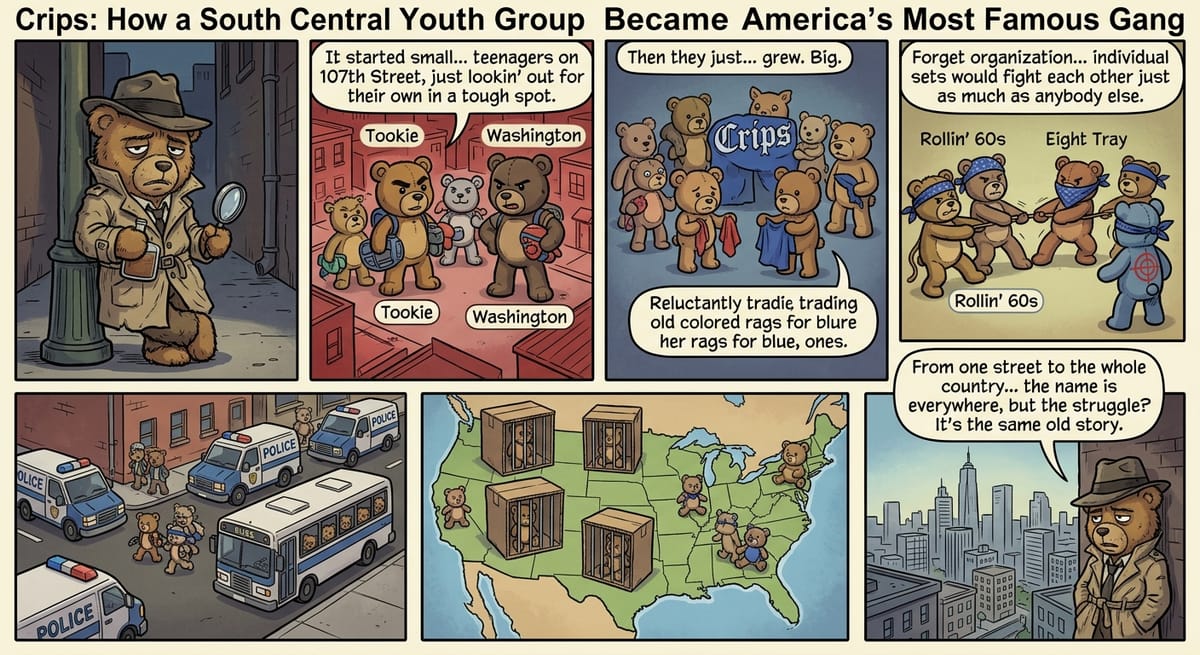
The Crips started in 1969 as a neighborhood protection crew run by two teenagers in South Central Los Angeles. Stanley “Tookie” Williams and Raymond Washington founded the gang on 107th Street when Williams was 17 and Washington was 15, in a neighborhood already sorted into zones of abandonment by decades of federal housing policy. By the 1990s, the FBI tracked Crip presence in 221 cities across 41 states.^1^
Stanley “Tookie” Williams and Raymond Washington founded the Crips in 1969 on the east side of South Central Los Angeles, initially organizing around 107th Street as a neighborhood protection crew. They were teenagers — Williams was 17, Washington 15 — and the city they grew up in had already sorted itself into zones of abandonment. Redlining had concentrated Black families into South Central through decades of federally backed housing discrimination, cutting them off from the suburbs that white working-class families fled to after World War II. The schools were overcrowded and underfunded. The LAPD under Chief William Parker ran the area like an occupied territory. The Crips didn’t form in a vacuum — they formed in the exact place and conditions that produced them.
A Protection Crew That Outlived Its Reason for Existing
The original crew Williams and Washington assembled wasn’t a criminal organization. It was closer to a block association with fists. Raymond Washington had spent time in the Baby Avenues gang and wanted something separate, something that claimed South Central as its own. Williams brought size — he was already known as a bodybuilder — and organizational muscle. The name itself is disputed. One version traces it to “Cribs,” a reference to their youth. Another points to “Crips” as a corruption of “Crypts,” evoking the cemetery-adjacent territory some early members claimed. By 1971, flyers circulating in South Central used the spelling that stuck: Crips.^1^
What made them different early on was scale. Most LA gangs of the late 1960s were neighborhood-specific and relatively small — the Businessmen, the Slausons, the Gladiators. The Crips absorbed some of those groups and recruited aggressively across South Central, Compton, and into the San Fernando Valley. By 1972, there were an estimated 18 separate Crip sets operating across Los Angeles.^2^ The confederation model — autonomous sets loosely sharing a name and identity — let the gang expand faster than any top-down structure could have managed.
The Crips Have Never Had a Central Leader
The Crips are not a unified organization. There is no national leader, no command structure, no franchise fees flowing to a central office. What exists is a loose affiliation of sets — Rollin’ 60s Crips, Eight Tray Gangster Crips, Grape Street Crips, Shotgun Crips, among hundreds of others — that share the blue color, the name, and a broad sense of opposition to Bloods. Individual sets often have more beef with other Crip sets than with Bloods. The Rollin’ 60s and Eight Tray Gangsters, two of South Central’s largest Crip sets, have been at war with each other for decades.^3^
The blue associated with Crips reportedly entered gang culture by accident. Washington wore blue bandanas, and the color became associated with his crew. By the mid-1970s it was hardened into identity — blue rags, blue laces, blue everything. Members began using “cuzz” as an in-group address, and began replacing the letter “b” in writing with “ck” (Crip Killer) as a slur against rivals. These micro-codes multiplied as sets grew: specific hand signs, tattoo placements, the way a cap was tilted.
Prison and Migration Spread the Crips Nationwide
The Crips spread beyond Los Angeles along two paths: migration and incarceration. When families moved out of South Central — pushed by rising rents, policing, or economic necessity — gang affiliation traveled with them to Compton, Long Beach, and eventually to cities as far as Kansas City and Seattle. Prison was the second vector. California’s state prison system, particularly facilities like San Quentin, Pelican Bay, and Corcoran, became places where Crip identity was consolidated, formalized, and exported. Men served their time and returned to their cities carrying gang structure with them.^4^
By 1985, law enforcement estimated there were more than 30,000 Crip members in Los Angeles County alone. By the early 1990s, the FBI’s National Gang Threat Assessment tracked Crip presence in 221 American cities across 41 states. The crack cocaine epidemic of the 1980s poured fuel on the expansion — the Crips, like other LA street gangs, became distribution networks for crack moving through neighborhoods the legitimate economy had given up on.
Why the Crips Became a National Symbol
The Crips became a symbol that exceeded what they actually were — a name attached to every fear white America had about Black urban life in the 1980s and 1990s. Politicians used them as shorthand. Law enforcement used them as justification. The 1988 film Colors gave them a face; gangsta rap gave them a soundtrack. The actual Crips — a loose network of competing neighborhood sets — were flattened into a single monster, which made it easier to militarize policing in South Central while ignoring why South Central produced what it produced.
Forty years of targeted disinvestment doesn’t produce gang members. It produces conditions. The Crips filled a structural hole: in neighborhoods with no jobs, no safety net, and aggressive hostile policing, the gang offered protection, income, identity, and belonging. That doesn’t justify the violence. But it explains the supply.
Stanley Williams was arrested in 1979 for the murder of four people in two separate incidents and sentenced to death. Raymond Washington was shot and killed in 1979, at age 25, in a dispute on the streets he helped build. The gang Washington and Williams started as teenagers had already outlived both of them before either turned 30. The Crips are still operating — still fractured, still fighting each other, still embedded in communities that the American economy still hasn’t decided are worth investing in. The name is everywhere. The conditions that made the name are mostly unchanged.
The Crip-Blood war that followed the gang’s formation defined Los Angeles for two decades. Tookie Williams, the co-founder who spent 24 years on death row, represents the gang’s most contested legacy. The 1992 Rodney King truce briefly interrupted the killing, and Suge Knight’s Death Row Records showed what happened when gang culture reached the music industry.
Part of LA Gangs — ← Back to series hub
─────────
Sources:
- Bastian, Eric. Origins of the Crips and Bloods. Los Angeles Police Department Historical Archive, 1993.
- Cureton, Steven R. Hoover Crips: When Cripin’ Becomes a Way of Life. University Press of America, 2008.
- Klein, Malcolm W. The American Street Gang: Its Nature, Prevalence, and Control. Oxford University Press, 1995.
- Fleisher, Mark S. Dead End Kids: Gang Girls and the Boys They Know. University of Wisconsin Press, 1998.
- Davis, Mike. City of Quartz: Excavating the Future in Los Angeles. Verso, 1990.