Red Summer: The 1919 Race War That Swept America
Between April and November 1919 white mobs attacked Black communities in at least 26 US cities. The deadliest single event — the Elaine Massacre in Arkansas — killed an estimated 100 to 856 Black people. Nothing that caused it was resolved.
Red Summer: The 1919 Race War That Swept America
Between April and November 1919, white mobs attacked Black communities in at least 26 cities and rural counties across the United States. The NAACP’s James Weldon Johnson named it the Red Summer. The name referred to blood, not politics. It was the peak of a wave of anti-Black violence that had been building since Black workers began migrating north during World War I, and it produced the deadliest single incident of racial violence in American history — the Elaine Massacre in Arkansas — which killed an estimated 100 to 856 Black people.
Part of From Reconstruction to Jim Crow — ← Back to series hub
Why 1919? The Setup That Made the Violence Inevitable
World War I had ended in November 1918. Nearly 400,000 Black Americans had served in the military, including 200,000 sent to France. Many had fought in integrated units alongside French troops and returned home having been treated, for the first time in their lives, as full human beings by a nation that didn’t share the American racial hierarchy. They came back to a country that expected nothing to have changed.^1^
At the same time, the Great Migration — which had begun accelerating around 1916 — was moving Black workers into Northern industrial cities at unprecedented rates. Between 1910 and 1920, approximately 500,000 Black people left the South for Chicago, Detroit, Pittsburgh, and New York. They were filling factory jobs vacated by workers who had left for the war, and they were building communities in neighborhoods where white residents had not expected them to appear. White labor unions, fearful of wage competition, locked Black workers out of membership. White residents of Northern cities, confronting the reality that the racial hierarchies they had held as a Southern problem were arriving on their doorsteps, organized to expel Black newcomers by force. The summer of 1919 was when the violence that had been building for three years reached its peak.
What Happened City by City
In Charleston, South Carolina, white sailors attacked Black residents on May 10, 1919, killing two men and wounding eighteen others. The Navy initially reported the attack as a “riot,” implying mutual combat; most witnesses described a one-sided assault.
In Longview, Texas, on July 10, 1919, a white mob burned the home of Samuel Jones, a Black schoolteacher who had arranged the sale of cotton directly to Northern buyers rather than through white middlemen — a form of economic independence that triggered the attack. Jones escaped. The mob then burned much of the Black neighborhood.
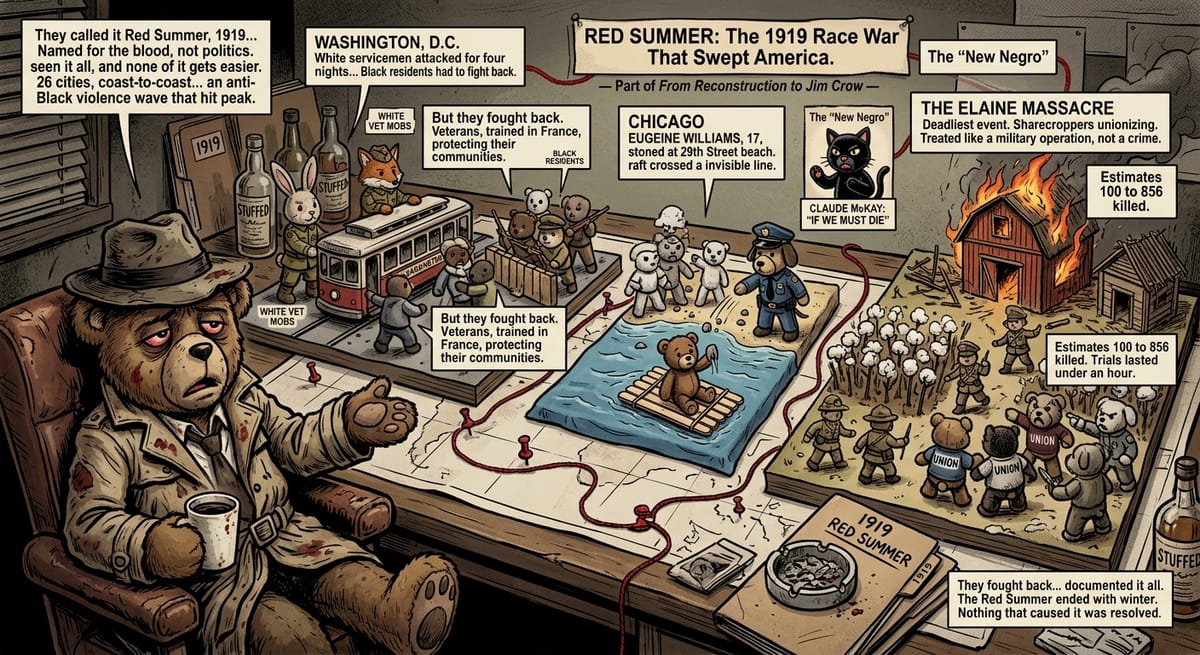
In Washington, D.C., beginning July 19, 1919, white servicemen and civilians attacked Black residents for four consecutive nights after a white woman reported being touched by a Black man — a report that was unsubstantiated. The mobs, composed substantially of white military veterans, dragged Black men off streetcars and beat them. On the fourth night, Black residents of Washington organized armed self-defense. They fired back. The riots ended. Fifteen people died over four days.^2^
In Chicago, the Red Summer’s bloodiest and most extensively documented urban event began on July 27, 1919, when Eugene Williams, a seventeen-year-old Black teenager, drifted on a homemade raft across the informal racial boundary at the 29th Street beach on Lake Michigan. White men on shore threw rocks at him until he drowned. Police refused to arrest the man identified as throwing the fatal rocks and instead arrested a Black bystander. Thirteen days of violence followed, killing 38 people — 23 Black, 15 white — and injuring 537 more. More than 1,000 Black families were left homeless when white mobs burned their homes.^3^
In Knoxville, Tennessee, in August 1919, a National Guard unit called in to suppress violence fired artillery into a Black neighborhood.
In Omaha, Nebraska, on September 28, 1919, a white mob of 5,000 seized Will Brown from the Douglas County courthouse, where he was being held on a rape accusation. They lynched him, shot his body hundreds of times, burned it, and dragged it through the streets behind a car. When Mayor Edward Smith tried to stop the mob, they nearly lynched him as well. Federal troops under General Leonard Wood took control of the city.^4^
The Elaine Massacre Was the Deadliest Event of the Red Summer
The deadliest event of the Red Summer took place in rural Phillips County, Arkansas, beginning September 30, 1919. Black sharecroppers in the Elaine area had organized a union — the Progressive Farmers and Household Union of America — to negotiate collectively for fairer cotton prices. On the night of September 30, a group of union members met at a church in Hoop Spur. White law enforcement officers arrived and shots were exchanged. In the killing that followed, one white deputy was killed. White posses, which ultimately included federal soldiers, swept through the Black community of Elaine and the surrounding area for days. Estimates of the number of Black people killed range from 100 to 856; the definitive count has never been established because the killing was treated as a military operation rather than a crime, and no systematic investigation occurred. Twelve Black men were sentenced to death and sixty to prison terms on the basis of trials lasting less than an hour each.^5^
The “New Negro” Fought Back, and the Record Shows It
What distinguished 1919 from earlier eras of racial terror was the degree of organized Black armed self-defense. In Washington, Chicago, and numerous smaller cities, Black veterans who had learned to fight in France came home and fought back. The “New Negro” rhetoric of the Harlem Renaissance was not simply cultural — it was a statement that the postwar generation of Black Americans was not going to accept violence with the stoicism that had characterized, out of necessity, responses to the Klan era of the 1870s and 1880s.
Claude McKay’s poem “If We Must Die,” published in 1919, named what was happening without flinching: “If we must die, let it not be like hogs / Hunted and penned in an inglorious spot.” The poem circulated across Black America as the summer’s violence was ongoing.
The resistance did not stop the violence. It did not prevent a single lynching or save a single neighborhood. But the record of 1919 is not simply a record of massacre — it is also a record of Black communities that refused to be exterminated without a fight, and that documented what was being done to them with every journalistic and legal tool available. Ida B. Wells had built that documentation methodology over the previous twenty-seven years, and the NAACP investigators who arrived in Chicago, Elaine, and East St. Louis were using her framework. The Red Summer ended with winter. Nothing that caused it was resolved.
─────────
Sources:
- Tuttle, William M., Jr. Race Riot: Chicago in the Red Summer of 1919. Atheneum, 1970.
- McWhirter, Cameron. Red Summer: The Summer of 1919 and the Awakening of Black America. Henry Holt, 2011.
- Chicago Commission on Race Relations. The Negro in Chicago: A Study of Race Relations and a Race Riot. University of Chicago Press, 1922.
- Sandburg, Carl. The Chicago Race Riots, July, 1919. Harcourt, Brace and Howe, 1919.
- Whitaker, Robert. On the Laps of Gods: The Red Summer of 1919 and the Struggle for Justice That Remade a Nation. Crown, 2008.