Black Codes and Convict Leasing: Slavery by Another Name
Black Codes were laws passed in 1865 to recreate slavery without the name. When Congress struck them down convict leasing replaced them — imprisoning Black people on manufactured charges and leasing their labor for profit until 1928.
Black Codes and Convict Leasing: Slavery by Another Name
Black Codes were state laws passed by former Confederate states in 1865 to restore the economic and social structure of slavery without using the word. When those laws were struck down, convict leasing took their place — a system that imprisoned Black people on manufactured charges and leased their labor to mines and plantations for profit. The apparatus ran for more than sixty years after emancipation.
Part of From Reconstruction to Jim Crow — ← Back to series hub
The Confederacy Lost the War and Immediately Legislated a Replacement
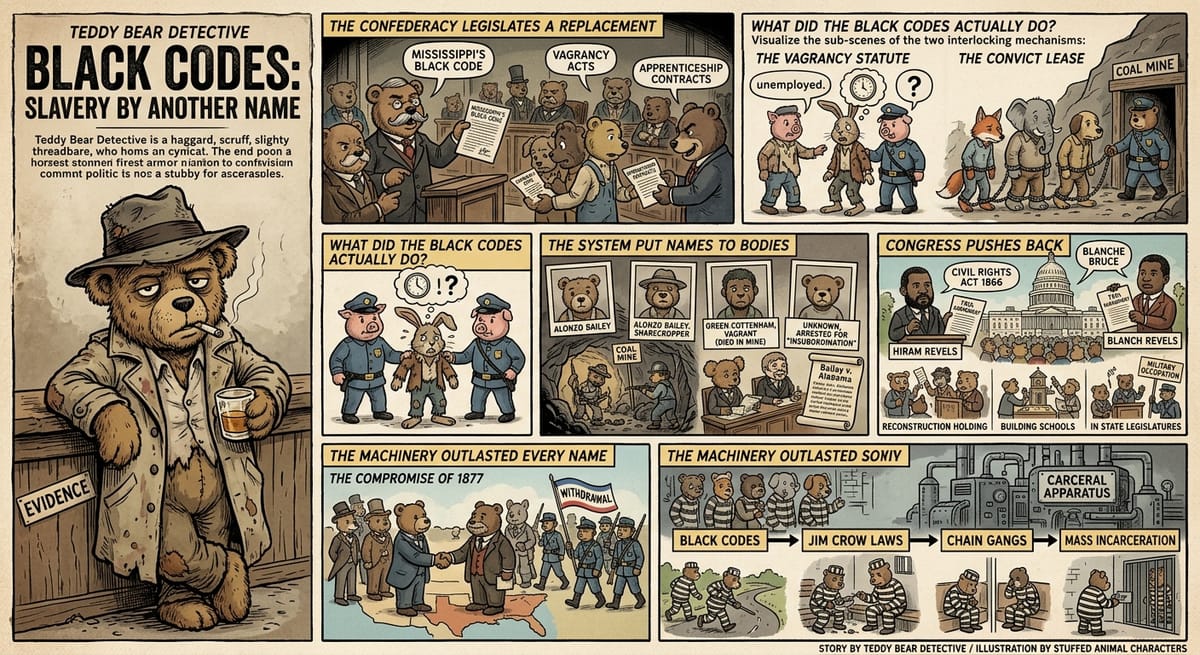
Beginning in the summer and fall of 1865, every former Confederate state passed what became known collectively as the Black Codes — a coordinated set of statutes designed to restore the economic and social structure of slavery without using the word. Mississippi’s Black Code, enacted in November 1865, was among the first and most explicit. It required all Black residents to present written proof of employment every January or face arrest for vagrancy. It prohibited Black Mississippians from renting land in urban areas. It barred them from owning firearms. It created a system of “apprenticeship” that allowed courts to bind Black children to white employers — preferably their former enslavers — without parental consent.^1^
South Carolina’s Black Code, passed the same month, went further: it required any Black person seeking work outside of farming or domestic service to obtain a special license from a local judge. The cost and the discretion to deny it rested entirely with white authorities. Louisiana’s code prohibited Black workers from leaving plantations without permission, and required them to work ten hours a day with no pay for “insubordination.” These were not informal customs. They were statutes.
The stated rationale was public order and the need to “protect” freedpeople who were, in the white planter class’s framing, unprepared for the responsibilities of freedom. The actual function was to keep cotton and tobacco moving.
What Did the Black Codes Actually Do?
The Black Codes operated through two interlocking mechanisms: the vagrancy statute and the convict lease.
Vagrancy was defined so broadly as to capture almost any Black man who was not working for a white employer. Being “unemployed,” being found away from one’s place of residence after dark, failing to carry proof of employment — all of these were criminal offenses that carried fines most Black people could not pay. When they couldn’t pay, they were imprisoned. When they were imprisoned, the state leased them to planters, mine operators, and railroad companies who needed labor. The prisoners — nearly all of them Black, many of them newly freed from actual slavery — worked under armed guard, often chained, in conditions that contemporary observers described as worse than slavery had been.^2^
The economics drove it. Under slavery, an enslaver had a financial stake in keeping workers alive. Under convict leasing, the lessee paid a flat fee to the state per prisoner per year and had no such incentive. If a man died, the state sent a replacement. In Alabama, the coal mines operated by Tennessee Coal, Iron and Railroad Company received convict laborers at rates as low as $9 per month per prisoner in the 1880s. The death rate in Alabama’s convict mines between 1880 and 1904 ran at roughly 10 percent annually — meaning the average prisoner could expect to die in the mines within a decade of their sentence, regardless of its length.^3^
The System Put Names to Bodies, Then Erased Them
The Equal Justice Initiative has documented that in the years immediately following the Civil War, the convict leasing system and the Black Codes ensnared hundreds of thousands of Black people across the South. In Mississippi, within two years of the war’s end, the state penitentiary had gone from a facility holding roughly 250 prisoners to one leasing out more than 1,000, nearly all of them Black.
Some names survived. Alonzo Bailey, an Alabama sharecropper, was arrested in 1908 for failing to fulfill a labor contract — he had taken a $15 advance from a white employer and left before working it off. Bailey challenged his conviction all the way to the U.S. Supreme Court, which ruled in 1911 that peonage of this kind violated federal law. His case, Bailey v. Alabama, is one of the few where a name and a face emerged from a system designed to keep its victims anonymous.^4^
Green Cottenham was not so lucky. Douglas Blackmon documented Cottenham’s case in his Pulitzer Prize-winning book Slavery by Another Name: arrested in 1908 on a charge of “vagrancy” in Shelby County, Alabama, Cottenham was sentenced to thirty days of hard labor and leased to a U.S. Steel subsidiary mine. He died in that mine four months later. He was approximately twenty-two years old.
Congress Pushed Back, Then the Federal Government Quit
The Black Codes triggered an immediate political response from Congress. The Radical Republicans passed the Civil Rights Act of 1866, which formally invalidated the Black Codes, and then the Fourteenth Amendment, which enshrined equal protection in the Constitution. The Military Reconstruction Acts of 1867 placed the former Confederate states under military occupation and required them to hold new constitutional conventions with Black male participation before they could regain full representation in Congress.
For roughly a decade, Reconstruction held. Black men voted, held office, built schools, and organized politically across the South. Hiram Revels and Blanche Bruce served in the U.S. Senate from Mississippi. More than 2,000 Black men served in public office during Reconstruction — as legislators, sheriffs, judges, and postal workers.^5^
Then the federal government withdrew. The Compromise of 1877, which resolved the disputed 1876 presidential election in Rutherford Hayes’s favor, involved the removal of remaining federal troops from the South. Without enforcement, the Fourteenth Amendment became text on paper. The Black Codes were formally struck from state statutes, but their successors — Jim Crow laws, vagrancy codes, and the fully developed convict lease system — took their place and expanded. By the 1880s, convict leasing was operating across every former Confederate state and generating significant state revenue. Alabama earned more from its convict lease program than from any other single source of income in the late nineteenth century.
The Machinery Outlasted Every Name It Was Given
The formal convict leasing system was not abolished across all Southern states until 1928, when Alabama ended it under federal and journalistic pressure. But its mechanisms survived the name change: chain gangs, debt peonage, and the racialized application of vagrancy law continued through the 1940s and beyond. The mass criminalization of Black life — the use of the criminal justice system as an economic extraction mechanism targeted at a specific population — had been built, tested, and institutionalized in the decades following emancipation.
The Black Codes were not an aberration or a last gasp of a dying system. They were the prototype. Every element that defined American mass incarceration in later eras — the criminalization of poverty, the use of prison labor for private profit, the enforcement of racial hierarchy through carceral tools — was present in the legislation Mississippi, South Carolina, and Louisiana passed in the six months after Appomattox.
The system did not invent new mechanisms. It renamed old ones.
The first Ku Klux Klan operated in parallel, providing the extralegal enforcement that the Black Codes provided through law. Both were products of the same project. The lynching era that followed was its continuation, and Ida B. Wells spent her career building the evidentiary record of what that continuation cost. The geographic reach of the system extended far beyond the South through sundown towns and the housing policies that formalized exclusion nationwide.
─────────
Sources:
- Foner, Eric. Reconstruction: America’s Unfinished Revolution, 1863–1877. Harper & Row, 1988.
- Blackmon, Douglas A. Slavery by Another Name: The Re-Enslavement of Black Americans from the Civil War to World War II. Doubleday, 2008.
- Mancini, Matthew J. One Dies, Get Another: Convict Leasing in the American South, 1866–1928. University of South Carolina Press, 1996.
- Bailey v. Alabama, 219 U.S. 219 (1911). U.S. Supreme Court.
- Equal Justice Initiative. Reconstruction in America: Racial Violence After the Civil War, 1865–1876. EJI, 2020.