White Collar Crime in American History
White collar crime causes losses that dwarf conventional criminal property crime — Madoff's $64 billion fraud and $95 billion in annual Medicare theft happen in suits and boardrooms with far less prosecution than street crime.

White Collar Crime in American History
White collar crime is the category of financial and institutional fraud where the perpetrator wears a suit, holds a title, and operates within systems of professional legitimacy — and causes losses that dwarf conventional criminal property crime by orders of magnitude. The term was coined by sociologist Edwin Sutherland in 1939, who argued that crime committed by people of high social status in the course of their occupation was systematically ignored by criminologists and law enforcement in ways that crime committed by the poor was not.^1^ Eight decades later, that observation remains largely true.
In This Series
- Corporate Fraud: When Companies Lie
- Financial Crimes: Rigged Markets and Stolen Billions
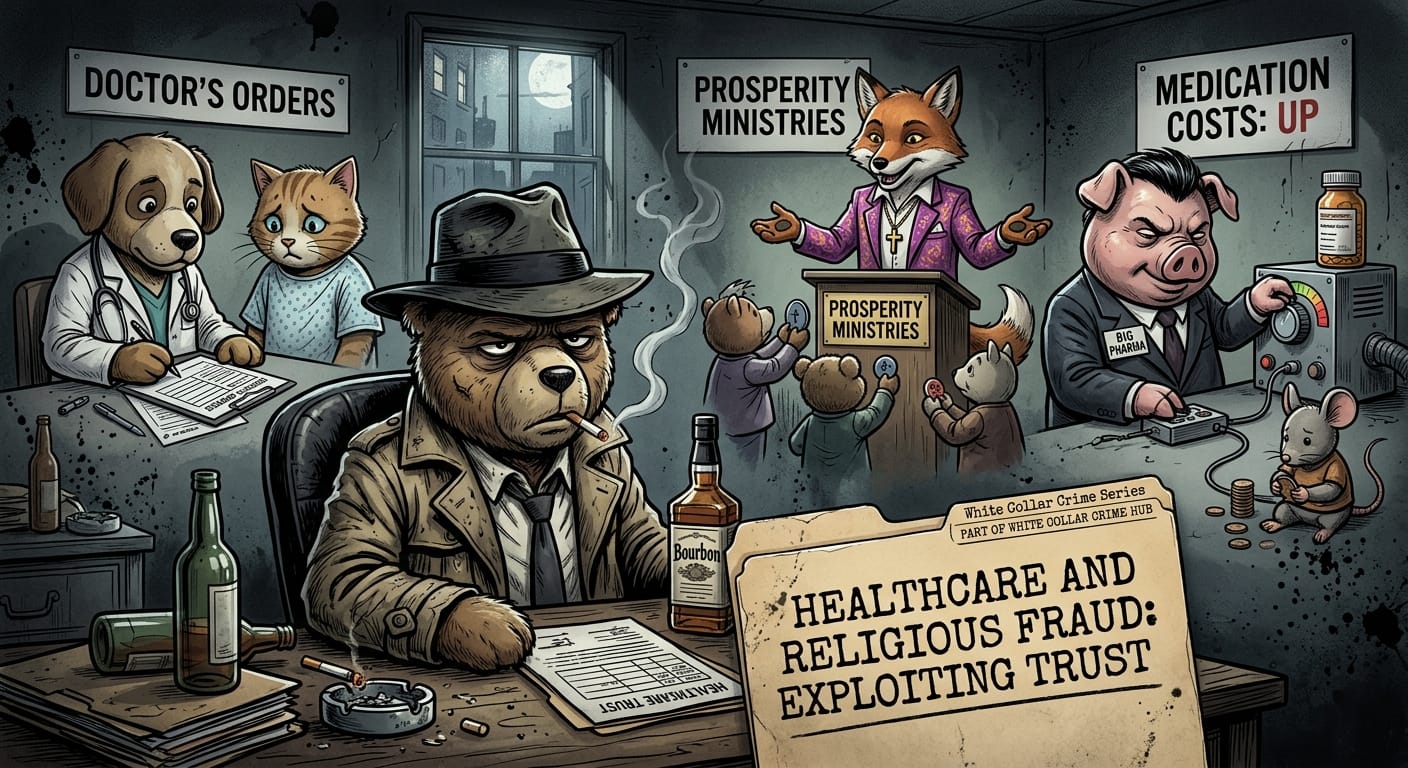
- Healthcare and Religious Fraud: Exploiting Trust
- Political Corruption: America’s Oldest Tradition
The Raw Numbers Establish a Scale Problem That Doesn’t Get Enough Attention
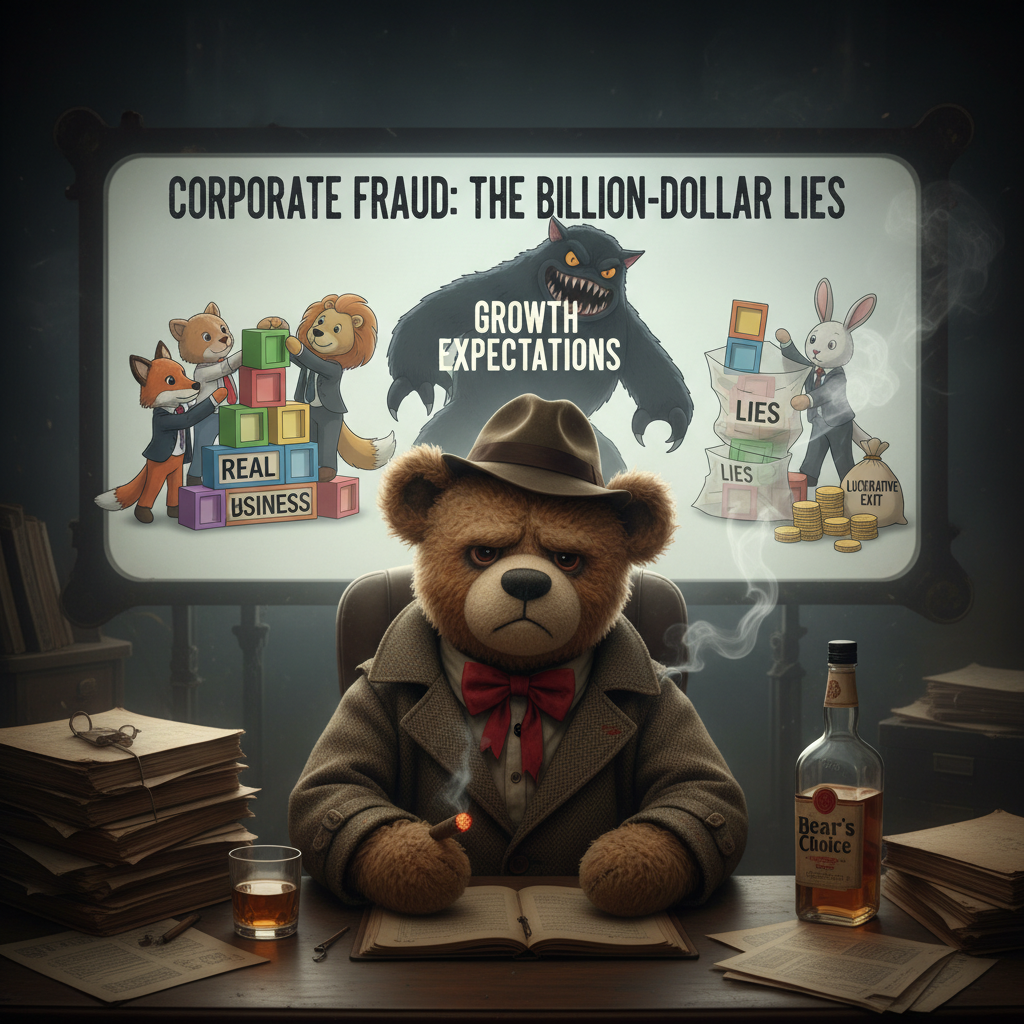
Bernie Madoff defrauded 37,000 investors of $64.8 billion in fictitious account balances. WorldCom inflated its books by $11 billion. Enron hid $1 billion in debt and manipulated its reported earnings across years of statements audited by a firm collecting $52 million annually to sign off on them. The LIBOR manipulation affected an estimated $350 trillion in financial contracts. Medicare and Medicaid improper payments — fraud plus billing errors — totaled $95.7 billion in a single fiscal year. Drug pricing practices cost Americans an additional $400-500 billion annually above what comparable wealthy nations pay for the same medications.^2^
Street crime in the United States costs an estimated $15-20 billion annually in property losses. The comparison is not to suggest that street crime is unimportant. It is to establish a factual baseline: the financial crimes in this section cause losses that dwarf conventional criminal property crime by orders of magnitude. That scale is rarely reflected in the cultural or prosecutorial weight assigned to each category.
Every Major Case in This Section Involved an Oversight Failure That Should Have Caught It
Arthur Andersen audited Enron and WorldCom and collected tens of millions in fees while signing off on fraudulent statements. The SEC received detailed, documented complaints about Bernie Madoff from a professional analyst in 2005 and again in 2007, reviewed them, and took no action. The NASD, which regulated securities brokers, did not identify the systematic pump-and-dump scheme at Stratton Oakmont until investors had lost hundreds of millions. The Centers for Medicare and Medicaid Services paid Farid Fata’s fraudulent billing for years before his own employee reported him.^3^
The oversight failures are not primarily the result of individual incompetence, though individual failures occurred. They are the result of structural conditions: auditors paid by the companies they audit, regulatory agencies with fewer resources than the industries they regulate, and oversight systems designed to verify compliance rather than detect sophisticated manipulation.
The Victims Are Named in These Articles Because They Rarely Are Elsewhere
Charles Prestwood, who lost $1.3 million in Enron pension savings after 33 years with the company, is named in a few news articles. Gloria Gaines, the retired teacher who lost $100,000 to Stratton Oakmont, appears in less coverage. The 550 patients Farid Fata administered unnecessary chemotherapy to are named in court documents, some of them, but most are not.^3^ The people who died rationing insulin — Alec Rasmussen, 26 years old, Minneapolis, 2017 — appear in academic research papers and occasional journalism.
The perpetrators are the protagonists of their own stories. Jordan Belfort sold $1 million in memoir rights, then $1 million in film rights, then tours as a motivational speaker. Elizabeth Holmes appeared on magazine covers and is the subject of a documentary, a podcast, a book, and a television series. Sam Bankman-Fried had a Michael Lewis biography released days before his conviction. Martin Shkreli has a YouTube channel with hundreds of thousands of subscribers. This is not an argument against coverage of white collar criminals. It is a note about where the weight falls. The victims of these crimes are named in the articles that follow as a deliberate editorial choice.
The Most Harmful Conduct in This Section Is Legal
Perhaps the most important insight this section tries to convey is the one that’s hardest to make vivid: much of what causes the most harm is legal. Pharmaceutical price gouging kills people through insulin rationing, and it is legal. Prosperity gospel extracts money from financially struggling people through promises no secular business could legally make, and it is legal. The revolving door between regulatory agencies and the industries they regulate is legal. The lobbying system that allows organized money to shape the rules under which it operates is legal.^4^
The crimes in this section — Enron, Madoff, Cunningham, Fata — are the cases where participants crossed into territory the law clearly prohibits. They are surrounded by a much larger territory of conduct that causes similar or greater harm and is not prohibited, because the people with the power to prohibit it benefit from it.
Sarbanes-Oxley, Dodd-Frank, the False Claims Act whistleblower provisions, Medicare Strike Forces, the Inflation Reduction Act’s drug pricing provisions, the SEC’s expanded enforcement capacity — these reforms are real and they matter. The fraud landscape of 2024 is different from the fraud landscape of 2001, partly because of the cases in this section and the enforcement responses they produced.
What remains is the structural condition Sutherland identified in 1939: the people who design and benefit from systems of finance, healthcare, and politics are the people best positioned to exploit those systems, and they are also the people least likely to face the consequences that exploitation produces. White collar crime’s most durable feature is not the cunning of its perpetrators. It is the difficulty of making the harm visible to people who have reasons not to look.
─────────
Sources:
- Sutherland, Edwin H. White Collar Crime. Dryden Press, 1949.
- Pontell, Henry N., and Gilbert Geis, eds. International Handbook of White-Collar and Corporate Crime. Springer, 2007.
- Calavita, Kitty, Henry N. Pontell, and Robert H. Tillman. Big Money Crime: Fraud and Politics in the Savings and Loan Crisis. University of California Press, 1997.
- Rakoff, Jed S. “The Financial Crisis: Why Have No High-Level Executives Been Prosecuted?” New York Review of Books, January 9, 2014.
- McLean, Bethany, and Peter Elkind. The Smartest Guys in the Room. Portfolio, 2003.
In This Section