Corporate Fraud: The Billion-Dollar Lies
Enron WorldCom Theranos FTX WeWork — five companies across four decades that all followed the same structure: a real business hits a wall and leadership chooses the lie over the correction.
Corporate Fraud: The Billion-Dollar Lies
Corporate fraud at scale isn’t random — the same structure shows up across Enron, WorldCom, Theranos, FTX, and WeWork: a real business hits a wall, leadership chooses the lie over the correction, and every oversight institution that existed to catch the fraud had a financial reason not to. These five companies operated in different industries across four decades. The mechanism adapts to the moment. The structure stays the same.
In This Series
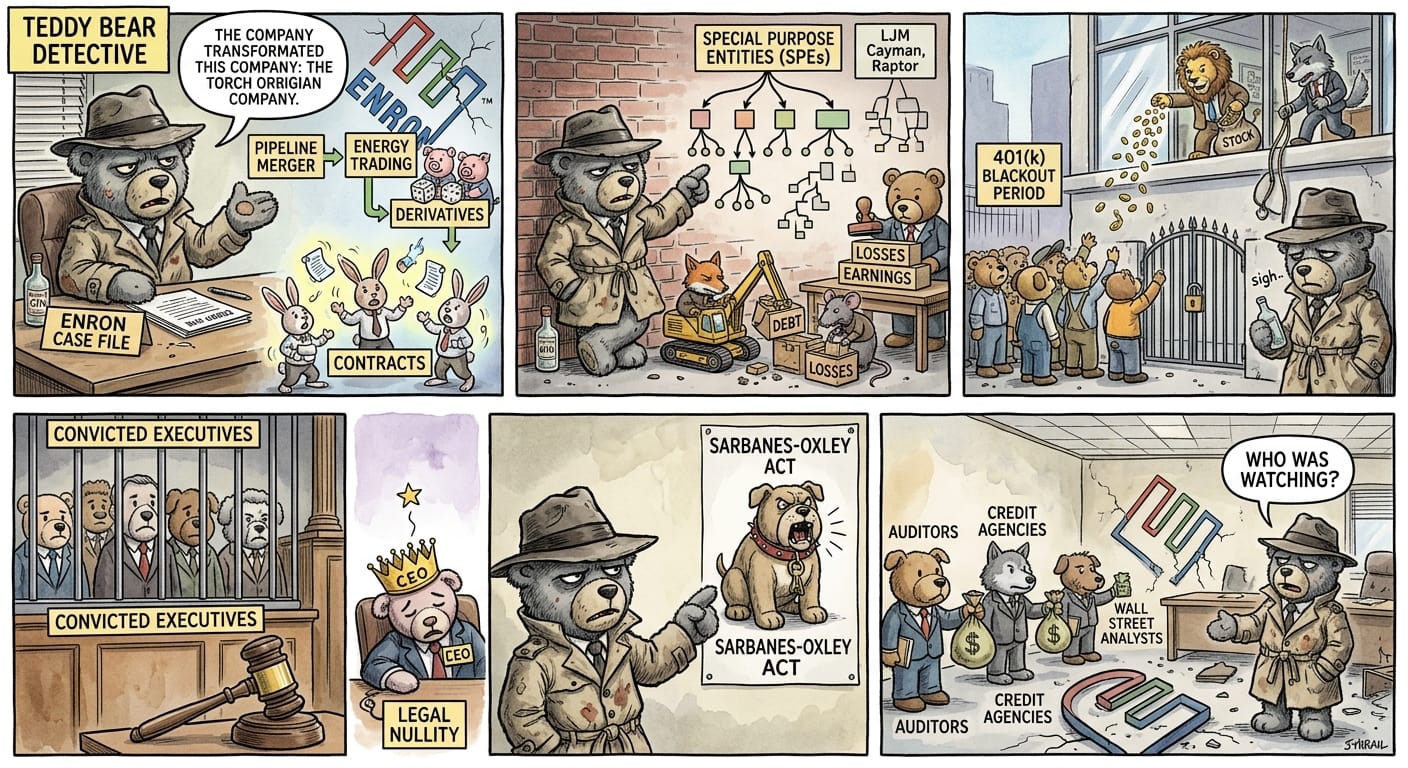
- Enron: The Company That Lied Until It Died — The energy trading fraud that hid $1 billion in debt through off-book partnerships and destroyed $1.2 billion in employee pension savings.
- WorldCom: The Fraud That Topped Enron — A $11 billion accounting manipulation built from reclassified line costs that took down the world’s largest corporate bankruptcy until then.
- Theranos: Elizabeth Holmes and the Fake Blood Test — A $9 billion blood-testing company whose core product didn’t work, deployed on real patients making real medical decisions.
- WeWork: Silicon Valley’s Most Delusional Company — How a real estate business became a $47 billion “physical social network” through narrative, not numbers.
- FTX: The Crypto King Who Lost Billions — An exchange that quietly transferred $8.9 billion in customer deposits to its CEO’s trading firm, then collapsed in ten days.
The Lie Has a Structure
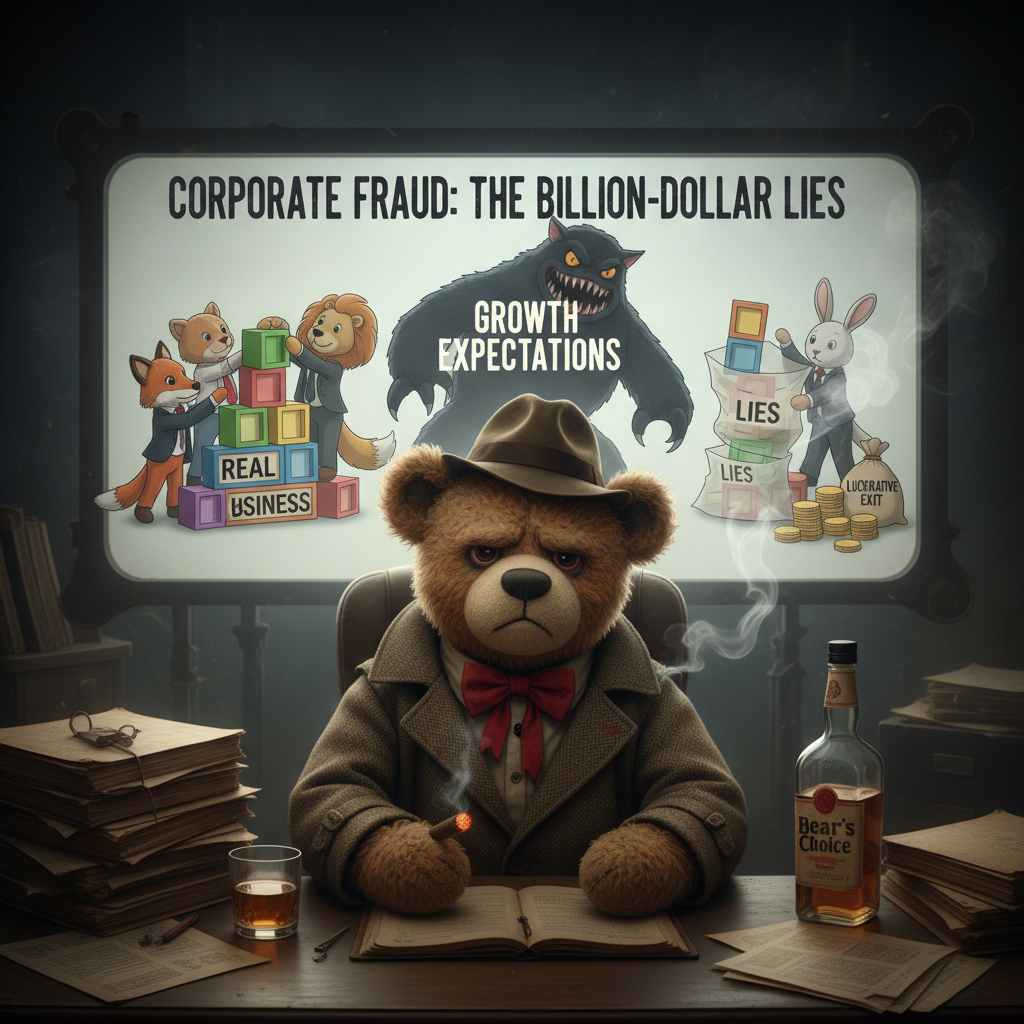
Every major corporate fraud follows a recognizable shape. It starts with something real — a genuine insight, a working product, a real market. Enron’s energy trading operation made real money in the early 1990s. Theranos’s underlying ambition — cheaper, more accessible blood testing — addressed a genuine problem. FTX was a functional crypto exchange before the customer deposits started disappearing into Alameda. WeWork really did serve a market for flexible office space.
The fraud begins when growth expectations outpace the underlying business, and instead of acknowledging the gap, leadership chooses to paper over it. Enron moved losses off its balance sheet through Andrew Fastow’s special purpose entities.^1^ WorldCom’s Scott Sullivan reclassified operating expenses as capital investments. Holmes kept claiming her Edison machine worked when internal data showed it didn’t. Bankman-Fried used a hidden code back door to transfer customer deposits to a trading firm he also controlled. The mechanism differs; the decision is the same: choose the lie over the correction.
Why Every Oversight Layer Missed It
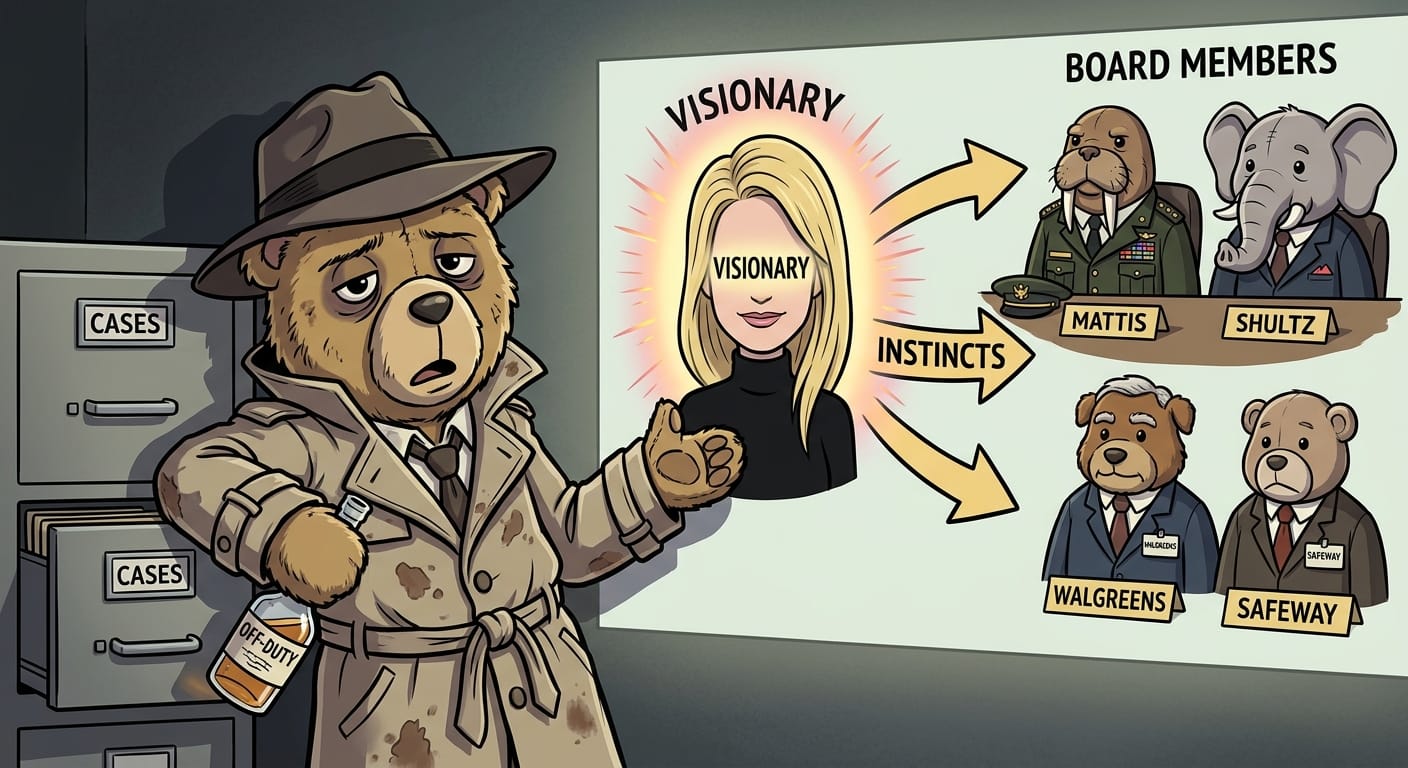
These companies did not operate in the dark. Enron’s financial statements were audited by Arthur Andersen, one of the five largest accounting firms in the world. WorldCom was also an Andersen client. Theranos had a board that included three former U.S. Secretaries of State and a former Secretary of Defense. FTX had celebrity endorsers, venture capital backing from Sequoia Capital and SoftBank, and a CEO who testified before Congress. WeWork had investment bank analysts producing research reports and valuation models.^2^
None of these oversight layers caught the fraud while it was running. In several cases, they actively validated it. Andersen collected $52 million from Enron in 2000 and signed off on financial statements it had reason to question. Sequoia Capital valued FTX at $32 billion after a 60-minute pitch meeting. The firms and individuals positioned to ask hard questions had financial interests in not asking them. The same pattern runs through the financial crimes series — Bernie Madoff’s SEC investigators were romantically pursuing jobs at Madoff’s firm while conducting examinations of it.
The Workers Pay, the Executives Keep Most of It
When Enron collapsed in December 2001, Charles Prestwood — 33 years with the company — lost $1.3 million in retirement savings. WorldCom’s 2,400 laid-off workers received no severance. Theranos patients received inaccurate test results that led to unnecessary medical procedures. The million-plus FTX customers who couldn’t withdraw their deposits included retail investors who had treated the exchange as a savings vehicle. WeWork’s contract cleaning and security workers, laid off before the IPO to improve financial metrics, received nothing.^3^
The executives who ran these frauds experienced consequences — prison sentences, SEC bans, fines — but they experienced them after extracting enormous personal wealth. Jeff Skilling got 24 years; he had already collected tens of millions. Elizabeth Holmes began serving an 11-year sentence in May 2023; Theranos investors had already lost $945 million. Adam Neumann, who never faced criminal charges, walked away from WeWork’s implosion with approximately $185 million in his pocket.
How Each Generation of Fraud Uses Its Moment
These frauds are not accidents. They are the predictable output of a system in which executives’ compensation is tied to stock price, auditors are paid by the companies they audit, investors are rewarded for finding the next big thing rather than the next sustainable thing, and the people with the most exposure to fraud — employees, customers, small investors — have the least information and the least power.
Sarbanes-Oxley in 2002 required CEOs to personally certify financial statements and strengthened auditor independence rules. It did not prevent Theranos, FTX, or WeWork. Each generation of corporate fraud uses the specific vulnerabilities of its moment: the accounting opacity of 2000s energy markets for Enron and WorldCom, the Silicon Valley storytelling premium for Theranos, the crypto opacity and regulatory vacuum for FTX, the venture capital growth-at-all-costs orthodoxy for WeWork.
Fraud of this scale requires cooperation — not just from the executives who design it, but from auditors who don’t push, analysts who don’t dig, boards who don’t ask, investors who don’t demand. That cooperation is usually not criminal. It is financial interest wearing the costume of reasonable professional judgment. Fixing corporate fraud means fixing those incentives, which means changing who benefits from the story being true. The next version of this series is already in progress somewhere.
─────────
Sources:
- McLean, Bethany, and Peter Elkind. The Smartest Guys in the Room. Portfolio, 2003.
- Cooper, Cynthia. Extraordinary Circumstances. Wiley, 2008.
- Carreyrou, John. Bad Blood. Knopf, 2018.
- Faux, Zeke. Number Go Up. Currency, 2023.
- Brown, Eliot. The Cult of We. Crown, 2021.
The Series