Pharmaceutical Price Gouging: The Legal Crime That Kills
Americans pay two to ten times what other wealthy countries pay for the same drugs — not because of research costs but because the U.S. is the only wealthy country that doesn't negotiate drug prices.
Pharmaceutical Price Gouging: The Legal Crime That Kills
Americans pay two to ten times what citizens of other wealthy countries pay for the same drugs made by the same manufacturers — not because of research costs or regulatory complexity, but because the United States is the only wealthy country that doesn’t systematically negotiate drug prices.^1^ In 2019, the average American spent $1,143 per person on prescription drugs, more than twice the average of comparable wealthy nations and more than three times the UK figure. The United States represents approximately 4.2% of the global population and accounts for roughly 40% of global pharmaceutical revenue. This is, in most of its forms, entirely legal.
Part of Healthcare and Religious Fraud — ← Back to series hub
How Does the Pricing System Hide What It’s Doing?
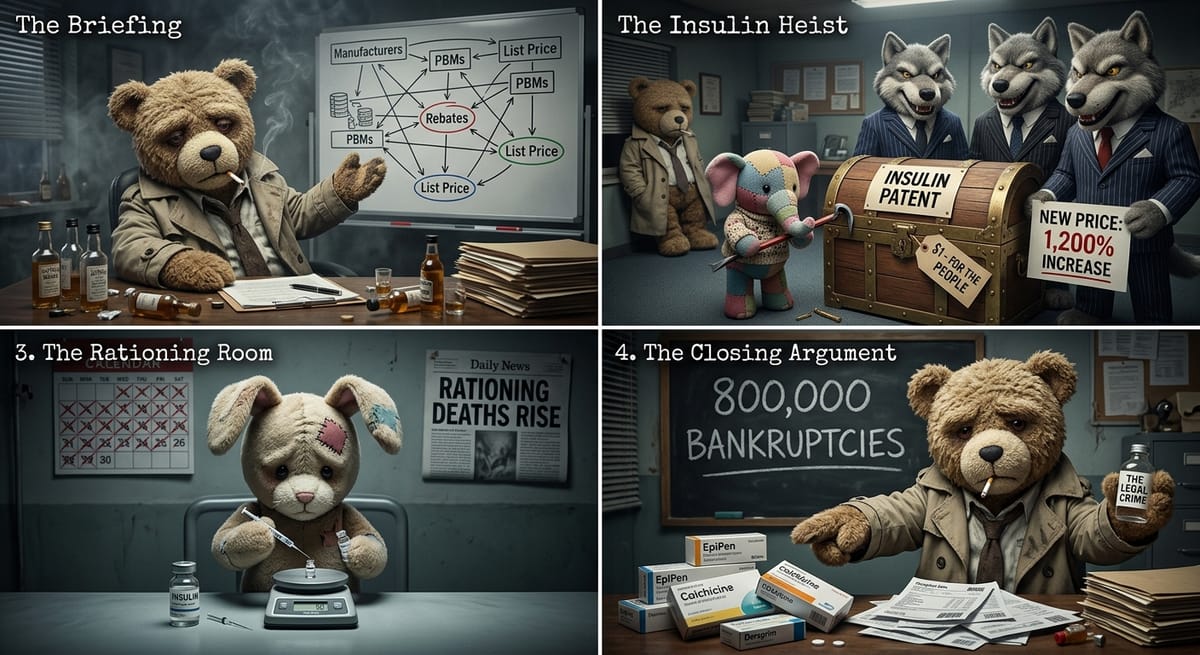
Pharmaceutical pricing in the United States involves multiple layers of participants — manufacturers, pharmacy benefit managers (PBMs), insurers, wholesalers, pharmacies — none of whom are required to disclose their actual transaction prices.^3^ The list price a manufacturer publishes is not the price that most purchasers pay; rebates and discounts negotiated between manufacturers and PBMs can bring the actual cost significantly lower. But patients without insurance, or patients in high-deductible plans before they’ve met their deductibles, often pay list price or close to it.
The system creates perverse incentives. PBMs negotiate rebates from manufacturers in exchange for favorable formulary placement — putting a drug on a list that insurance plans will cover. Higher list prices can mean higher rebates in dollar terms, which benefits the PBM. Manufacturers who raise list prices may actually capture more market share, not less, if the resulting rebates lead PBMs to favor them over competitors with lower prices. The complexity is not accidental; it exists in part because it obscures actual prices and makes comparison-shopping nearly impossible.
Insulin: The Most Documented Case of Pricing as a Death Sentence
Insulin has been available since 1923, when Frederick Banting and Charles Best sold their patent to the University of Toronto for $1 each, explicitly so the drug would be affordable.^2^ By 2019, the list price of Humalog, a fast-acting insulin manufactured by Eli Lilly, was approximately $275 per vial — up from $21 per vial in 1996, an increase of more than 1,200%. List prices for insulin roughly tripled between 2002 and 2013 at all three major manufacturers simultaneously, price coordination that multiple lawsuits and congressional investigations examined.
The consequences of insulin pricing are measurable in deaths. A 2019 study by Yale researchers documented that approximately one in four Americans with diabetes reported rationing insulin because of cost. Rationing insulin — reducing doses to make a vial last longer — can cause diabetic ketoacidosis, a life-threatening condition. In 2017, Alec Rasmussen, a 26-year-old from Minneapolis, died after rationing insulin; he had aged off his parents’ insurance and couldn’t afford the full cost of his prescription.^2^ Researchers have documented dozens of similar cases. Eli Lilly, Novo Nordisk, and Sanofi all announced insulin price caps following sustained public pressure — caps of $35 per month for some patients, implemented in 2022 and 2023, following the Inflation Reduction Act’s $35 cap for Medicare beneficiaries.
The Broader Pattern Extends Across Every Drug Category
Insulin is the most visible example of a pattern that extends across drug categories. Epinephrine auto-injectors (EpiPens) made by Mylan increased in price from approximately $57 for a two-pack in 2007 to $608 by 2016 — a 973% increase for a decades-old drug with no significant competition after a competitor’s product was withdrawn. Colchicine, a gout medication used since ancient times and largely off-patent for decades, was given exclusive marketing rights by the FDA in 2010 when URL Pharma ran a clinical trial confirming its efficacy; the company immediately raised the price from five cents per pill to five dollars per pill, a 10,000% increase, and sued to block generic competitors.
Daraprim, the toxoplasmosis drug, provides perhaps the most infamous single example — covered in the Martin Shkreli article — but it represents a systematic practice of acquiring drugs with no generic competition and raising prices to whatever the market will tolerate.
The People Who Bear the Highest Prices Have the Least Power to Fight Them
The people who pay the highest prices for drugs are those with the least leverage in the system: uninsured patients, underinsured patients, and patients in plans that require them to meet deductibles before coverage kicks in.^1^ Insurance companies negotiate, PBMs negotiate, hospital systems negotiate. Individual patients, particularly those without employment-based coverage or those in the gaps of the Medicaid system, pay list prices.
Between 2000 and 2020, more than 800,000 Americans declared bankruptcy citing medical debt as a primary or contributing cause, according to research published in the American Journal of Public Health.^4^ Drug costs are a significant component of medical debt, though not the only one. The population most affected by pharmaceutical pricing is disproportionately lower-income, disproportionately uninsured or underinsured, and disproportionately people of color, given the distribution of insurance coverage across racial groups in the United States. The Medicare Fraud article covers the parallel system where these same patients’ identities are exploited on the billing side.
The Inflation Reduction Act of 2022 gave Medicare the authority to negotiate drug prices for the first time, beginning with ten drugs in 2026 and expanding gradually. It also capped Medicare beneficiaries’ out-of-pocket drug costs at $2,000 per year beginning in 2025. These are the most significant changes to pharmaceutical pricing in decades, but they do not address prices for non-Medicare patients, do not cover the majority of drugs, and apply only to the government payer system rather than the private market. The pharmaceutical industry spent approximately $375 million lobbying against the bill’s pricing provisions.^3^ The fundamental market structure — in which the U.S. government does not negotiate most drug prices while every other wealthy government does — remains in place.
─────────
Sources:
- Anderson, Gerard F., et al. “It’s the Prices, Stupid: Why the United States Is So Different from Other Countries.” Health Affairs, 2003.
- Rajkumar, S. Vincent. “The High Cost of Insulin in the United States: An Urgent Call to Action.” Mayo Clinic Proceedings, 2020.
- Kesselheim, Aaron S., Jerry Avorn, and Ameet Sarpatwari. “The High Cost of Prescription Drugs in the United States.” JAMA, 2016.
- Himmelstein, David U., et al. “Medical Bankruptcy: Still Common Despite the Affordable Care Act.” American Journal of Public Health, 2019.