January 6th: When the Capitol Fell
On January 6 2021 rioters breached the U.S. Capitol for the first time since 1814 halting the certification of a presidential election for three hours while seven people died.
January 6th: When the Capitol Fell
At 2:12 p.m. on January 6, 2021, rioters breached the United States Capitol for the first time since British forces burned it in 1814, forcing Congress to suspend the certification of the 2020 presidential election while seven people died and approximately 140 police officers were injured. January 6 was not a spontaneous riot — it was the endpoint of a documented multi-month campaign to overturn a certified election result, organized in part by militia groups with roots in the same anti-government tradition as Ruby Ridge and Waco.^1^
Part of Standoffs and Sieges — ← Back to series hub
How the Certification Was Stopped for Three Hours
The certification of presidential election results under the Electoral Count Act of 1887 is a joint session of Congress, presided over by the sitting Vice President. On January 6, 2021, Vice President Mike Pence was in the Capitol to perform that role. President Donald Trump, who had lost the November 3, 2020, election to Joseph Biden by 306 to 232 electoral votes, had been publicly and privately pressuring Pence to refuse to certify the results or to delay certification.^2^
On the morning of January 6, Trump delivered a speech at a rally on the Ellipse, south of the White House, to tens of thousands of supporters who had traveled to Washington. He told the crowd the election had been stolen, urged them to march to the Capitol, and said, “If you don’t fight like hell, you’re not going to have a country anymore.” His attorney Rudy Giuliani spoke before him, calling for “trial by combat.” Representative Mo Brooks of Alabama, who had organized the rally, told the crowd to “start taking down names and kicking ass.”
As the rally proceeded, members of the Proud Boys — a far-right nationalist organization whose leader, Enrique Tarrio, had been ordered by Washington, D.C., police not to enter the city before January 6 due to a prior arrest — had already moved toward the Capitol. Members of the Oath Keepers, a militia organization led by Stewart Rhodes, had positioned members in a “quick reaction force” at a hotel in Arlington, Virginia, with weapons, and had members on the Capitol grounds.^3^
The first security perimeter on the Capitol’s west side was breached at approximately 12:53 p.m. By 2:12 p.m., rioters had pushed through Capitol Police lines and entered the building through broken windows and forced doors. Congressional proceedings were suspended. Members of the House and Senate were evacuated from the chamber floor or sheltered under seats and behind barricaded doors. Vice President Pence, whose motorcade had arrived at the Capitol, remained in a secure location in the building. Pence had informed Trump that morning that he did not believe he had the constitutional authority to refuse certification.
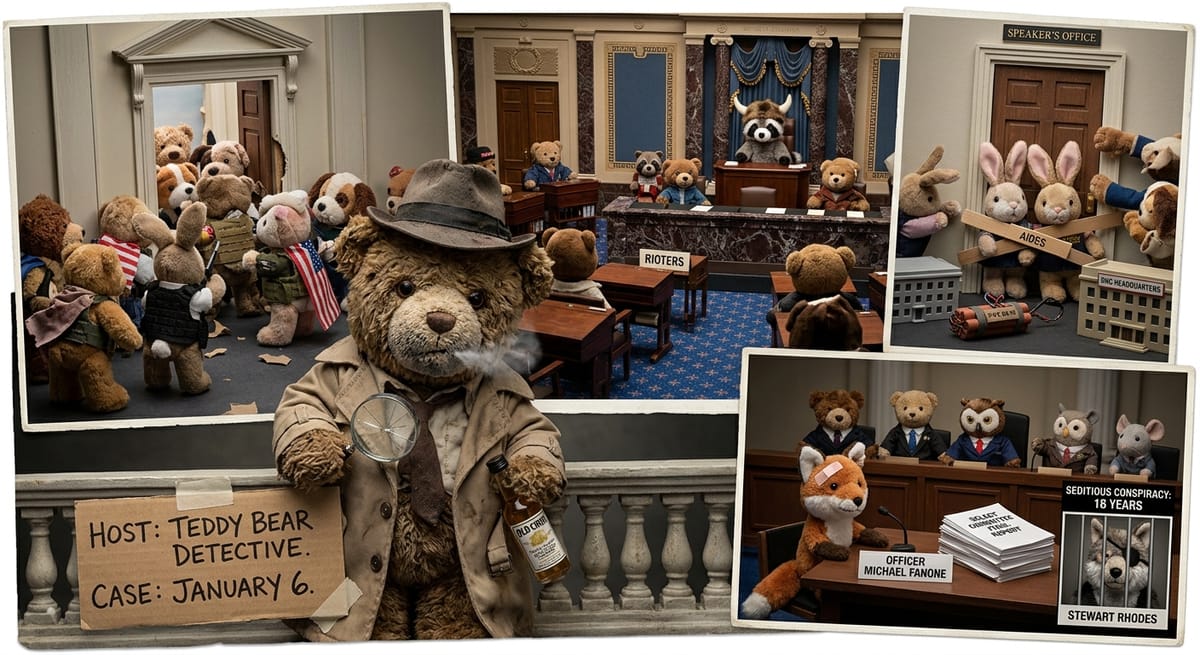
Inside the Capitol, rioters occupied the Senate chamber. Jacob Anthony Chansley — known as Jake Angeli or the “QAnon Shaman,” identifiable by his horned fur hat — sat in the Senate president’s chair. Rioters ransacked congressional offices, including the office of House Speaker Nancy Pelosi, where aide Ayanna Pressley’s staff was still sheltering. Senator Jeff Merkley’s office was ransacked. A pipe bomb was discovered at the Republican National Committee headquarters nearby; a second was found at the Democratic National Committee headquarters. Both were safely disarmed.
Officer Eugene Goodman of the Capitol Police confronted a group of rioters in the Senate gallery hallway and, outnumbered, deliberately led them away from the Senate chamber door by retreating — a maneuver later recognized by Congress with a Congressional Gold Medal. Capitol Police Officer Michael Fanone was dragged outside by rioters, tased repeatedly, and beaten with a flagpole. He suffered a heart attack during the assault and later testified before Congress about the experience.^4^
Which Organizations Planned It and Who Got Convicted
The January 6th Select Committee of the House of Representatives, established in June 2021, conducted more than 1,000 interviews, reviewed more than 1 million documents, and held 10 public hearings in 2022 before issuing a final report in December 2022. The report identified the attack as the culmination of a multi-part effort to overturn the 2020 election results, involving pressure campaigns directed at state election officials, the Justice Department, and Vice President Pence.
The committee identified multiple organized groups among the rioters. The Oath Keepers, led by Stewart Rhodes, communicated by encrypted messaging apps before and during the attack. Members moved through the Capitol in military-style “stack” formations. Rhodes himself, who remained outside the building, communicated with members inside. He was convicted of seditious conspiracy on November 29, 2022 — the most serious charge to emerge from January 6 prosecutions — and sentenced to 18 years in federal prison in May 2023.^5^
Enrique Tarrio, the Proud Boys leader who was not in Washington on January 6 due to the D.C. police order, was convicted of seditious conspiracy in May 2023 for his role in planning the attack. He was sentenced to 22 years — the longest January 6 sentence handed down. Four other Proud Boys leaders were also convicted of seditious conspiracy.
As of early 2025, more than 1,200 individuals had been charged in connection with January 6. Approximately 870 had been convicted — roughly 25% on felony charges. Convictions included charges of seditious conspiracy, obstruction of an official proceeding, assaulting law enforcement officers, and civil disorder.
The Documented Sequence That Led to the Breach
The Select Committee’s report detailed a documented sequence of events. After networks called the election for Biden in November 2020, the Trump campaign and outside allies pursued more than 60 legal challenges in state and federal courts. All failed. State election officials in Georgia, Arizona, Michigan, and Pennsylvania — including Republican officials — certified their results and rejected claims of fraud.
On December 19, 2020, Trump tweeted that supporters should come to Washington on January 6 and that it would “be wild.” Planning for the rally began immediately. On January 2, 2021, Trump called Georgia Secretary of State Brad Raffensperger and asked him to “find” 11,780 votes — exactly one more than Biden’s margin of victory in Georgia. Raffensperger recorded the call and later made it public.
At the Justice Department, Acting Attorney General Jeffrey Rosen and his deputy Richard Donoghue resisted pressure from Trump advisor Jeffrey Clark, who had drafted a letter to state legislatures falsely stating that DOJ had identified significant concerns with the election and encouraging them to appoint alternate electors. Rosen and Donoghue refused to sign. Trump considered replacing Rosen with Clark; he retreated after senior Justice Department officials threatened mass resignation.^2^
On the morning of January 6, Trump’s White House counsel Pat Cipollone and his deputy Patrick Philbin were urging staff not to go to the Capitol. Chief of Staff Mark Meadows was informed by 2:00 p.m. that the Capitol had been breached. Trump, according to testimony from White House aide Cassidy Hutchinson, was told about the breach and did not act to stop it for more than three hours. Hutchinson’s testimony included an account that Trump attempted to grab the steering wheel of his presidential SUV when Secret Service agents would not take him to the Capitol after the rally — an account disputed by other witnesses and not independently confirmed.
Pence was evacuated to a loading dock beneath the Capitol. His car was moved away from the building but not taken off Capitol grounds, reportedly because Pence refused to leave. He remained in the Capitol complex until the building was secured.
The Certification Survived — But the Political Dispute Didn’t End
Congress reconvened at approximately 8:00 p.m. and certified the Electoral College results at approximately 3:40 a.m. on January 7, 2021. Joseph Biden’s victory was formally certified.
Trump was impeached by the House of Representatives on January 13, 2021 — the second impeachment of his presidency — on a charge of incitement of insurrection. The vote was 232 to 197, with 10 Republicans joining all Democrats. He was acquitted by the Senate on February 13, 2021, with 57 senators voting to convict — seven Republicans among them — falling short of the two-thirds required.
In August 2023, Trump was indicted by a federal grand jury on four felony counts related to the effort to overturn the 2020 election: conspiracy to defraud the United States, obstruction of an official proceeding, conspiracy to obstruct an official proceeding, and conspiracy against rights. The case, brought by Special Counsel Jack Smith, was paused following Trump’s election to the presidency in November 2024 and subsequently dismissed.
Officer Brian Sicknick died on January 7, 2021. His death was attributed by the Capitol attending physician to strokes; the medical examiner ruled the manner of death as natural. Officers Howard Liebengood and Jeffrey Smith died by suicide within days of the attack. Officer Michael Fanone resigned from the Capitol Police in December 2021 and has continued speaking publicly about the attack. Officer Harry Dunn, who was among those inside the Capitol on January 6, testified before the Select Committee and before the Senate.^4^
More Than 1,200 Charged — and the Meaning Is Still Being Contested
The Capitol was secured by approximately 5:34 p.m. on January 6. The National Guard, whose deployment had been delayed, began arriving in force by early evening. The certification was completed in the early morning hours of January 7. The democratic process it was designed to interrupt continued.
The criminal accountability has been extensive by the standards of American political violence — more than 1,200 charged, more than 800 convicted, with the leaders of organized groups convicted of seditious conspiracy and sentenced to decades in federal prison. Whether those prosecutions represent adequate accountability for an attempt to prevent the certification of a presidential election remains a subject of active political and legal debate. The same white supremacist networks that fed the militia movement throughout the 1990s overlapped with January 6 organizing.
Seven people died in connection with January 6. The Capitol was occupied for approximately three hours. The results of the 2020 election were certified. The man convicted of the longest sentence — Enrique Tarrio, 22 years — was not inside the building. The certification that was interrupted was completed before dawn.
─────────
Sources:
- Select Committee to Investigate the January 6th Attack on the United States Capitol. Final Report. U.S. House of Representatives, 117th Congress, December 2022.
- Woodward, Bob, and Robert Costa. Peril. Simon & Schuster, 2021.
- Cheney, Liz. Oath and Honor: A Memoir and a Warning. Little, Brown, 2023.
- Fanone, Michael, and John Shiffman. Hold the Line: The Insurrection and One Cop’s Battle for America’s Soul. Atria Books, 2022.
- United States v. Stewart Rhodes et al. Verdict and Sentencing Records. U.S. District Court for the District of Columbia, 2022–2023.