Standoffs: When Americans Went to War With Their Government
Ruby Ridge Waco and January 6 all followed the same pattern — a small dispute escalated by force into a political rupture whose meaning outlasted the standoff itself.

Standoffs: When Americans Went to War With Their Government
American standoffs between citizens and the federal government follow a consistent pattern: a dispute, a decision to resolve it by force, a moment when force meets force, and a political meaning that outlasts the tactical outcome. Ruby Ridge, Waco, and January 6 each ended. None of them stayed contained. The movements they generated have produced violence in every decade since.
Three moments. Three different antagonists. One repeating structure that the U.S. government has not solved.
In This Series
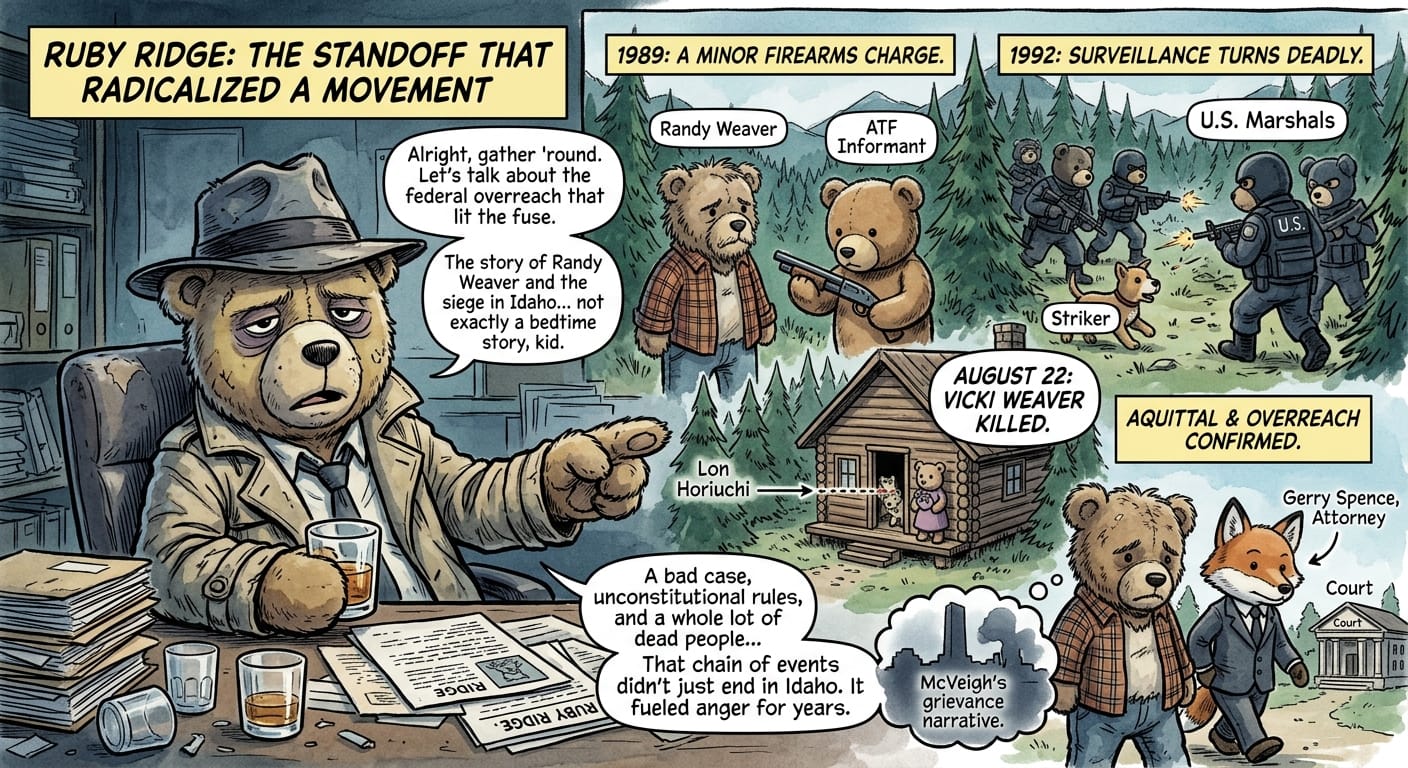
- Ruby Ridge: The Standoff That Radicalized a Movement — The 1992 Idaho siege that began with a minor gun charge and ended with a dead mother, a dead child, and a Senate investigation confirming unconstitutional rules of engagement.
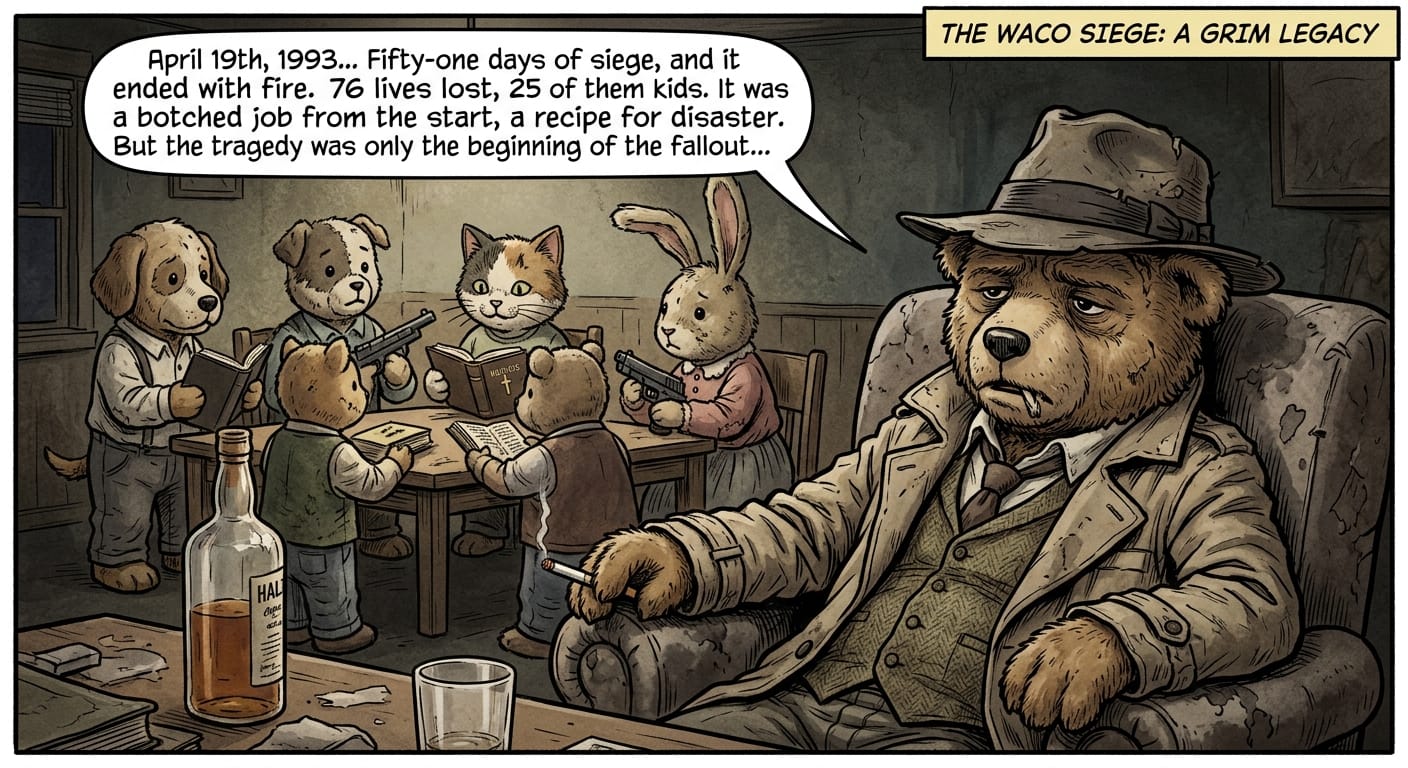
- Waco: The Siege, the Fire, and the Fallout — Fifty-one days of negotiation followed by an FBI assault, a fire that killed 76 people including 25 children, and a political aftermath that shaped American extremism for 30 years.
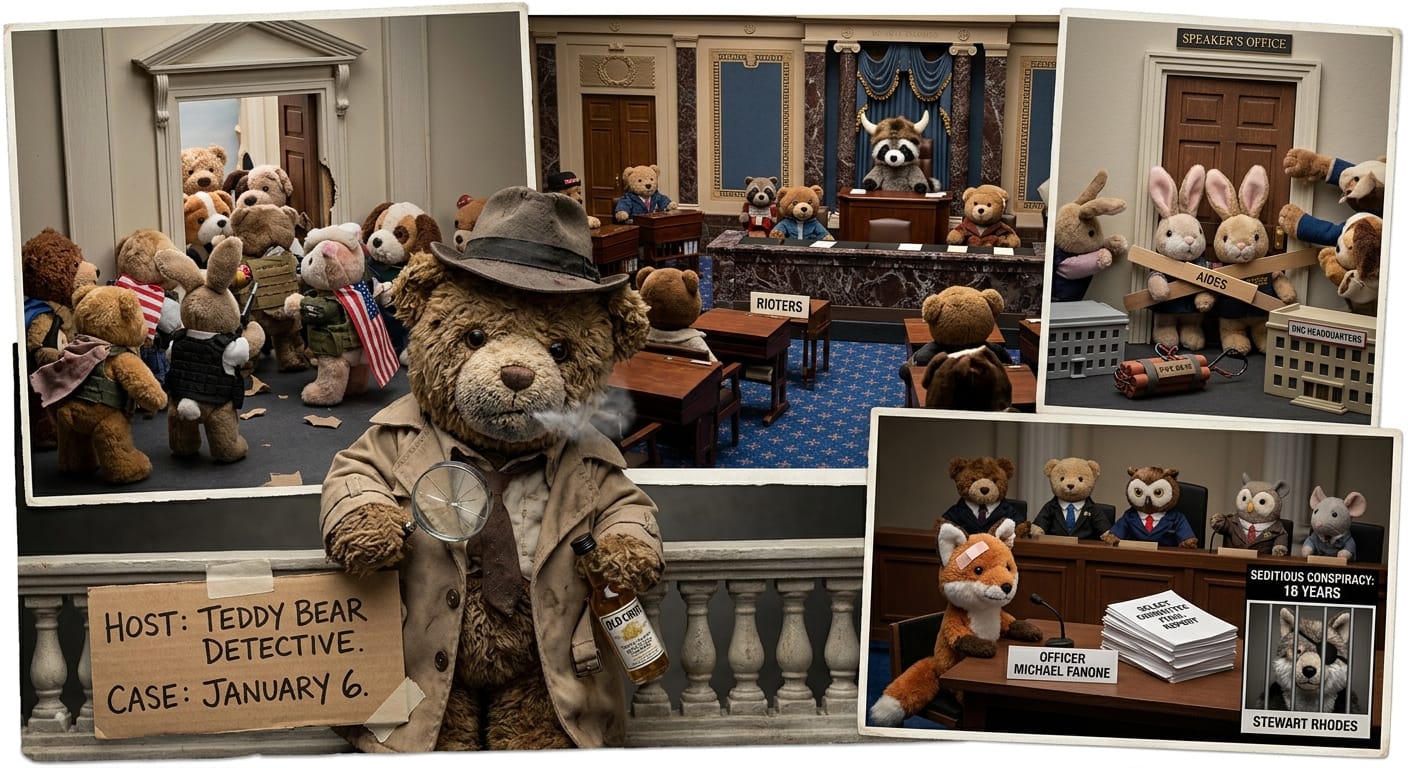
- January 6th: When the Capitol Fell — The 2021 breach of the U.S. Capitol, organized in part by militia groups, that halted the certification of a presidential election for three hours and produced more than 1,200 federal prosecutions.
Each Standoff Began Smaller Than It Ended
Standoffs between citizens and federal authority do not begin as confrontations. They begin as something smaller — a weapons charge, an allegation of firearms violations, a disputed election — and escalate through a series of decisions, each of which forecloses the previous off-ramp.
At Ruby Ridge, the original offense was two shotguns with barrels a quarter-inch shorter than the legal minimum under the National Firearms Act. The escalation path from that firearm sale to the deployment of the FBI Hostage Rescue Team and the deaths of Vicki Weaver and her son Samuel required multiple decision points at which a different choice was available: not pressuring Weaver to become an informant, pursuing the weapons charge through ordinary legal process, not issuing shoot-on-sight rules of engagement for armed adults. Each decision instead pushed toward a more confrontational resolution.
At Waco, the escalation began with a decision by ATF to execute a dynamic entry raid on February 28, 1993, with 76 agents arriving in cattle trailers — even after the undercover agent on-site phoned his supervisors to report that David Koresh knew the raid was coming. That decision produced a firefight that killed four agents and six Davidians, which produced a 51-day siege, which produced the April 19 assault, which produced the fire that killed 76 people including 25 children. At each stage, tactical options that might have been less catastrophic were discussed and rejected.
January 6 followed a different escalation arc — not government force meeting citizen resistance, but citizen force meeting government institutional process. The escalation path there ran through 60 failed court cases, pressure campaigns against state officials, pressure on the Vice President, and a rally that ended with tens of thousands of people marching to the building where Congress was certifying election results.
What Do Government Standoffs Actually Produce?
The most important thing these three cases have in common is not what happened during them. It is what happened after.
Ruby Ridge radicalized a movement. The deaths of Vicki Weaver and her son Samuel at the hands of federal agents became the foundational grievance text of the 1990s militia movement. Timothy McVeigh named Ruby Ridge and Waco as primary motivations for the Oklahoma City bombing on April 19, 1995. The Senate investigation that confirmed the government’s rules of engagement were unconstitutional — and that Lon Horiuchi faced no criminal consequences for killing a woman holding her infant — became movement literature. The government’s acknowledgment of error came after the damage was done.
Waco amplified that damage. The April 19 fire killed 76 people, including 25 children, and produced the same April 19 date that McVeigh chose for his bombing. The congressional hearings in 1995 aired the same themes as the Ruby Ridge hearings: disproportionate federal force, poor tactical decision-making, inadequate accountability. The Bundy Ranch standoff in Nevada in 2014 and the Malheur National Wildlife Refuge occupation in Oregon in 2016 both drew on the Waco and Ruby Ridge narratives as explicit justification.
January 6 produced the most extensive criminal accountability of any of the three standoffs. More than 1,200 charged, more than 800 convicted, with the leaders of the Proud Boys and Oath Keepers convicted of seditious conspiracy and sentenced to 18 and 22 years respectively. The certification of the 2020 election was completed before dawn on January 7. The democratic process that was targeted survived.
What January 6 also produced was a persistent political dispute about what happened and what it meant — a dispute that is ongoing in ways that Ruby Ridge and Waco are not.
Federal Overreach Created the Conditions for Domestic Terror
Ruby Ridge and Waco both demonstrated what happens when federal tactical doctrine outpaces legal and political judgment. The shoot-on-sight rules at Ruby Ridge were unconstitutional by the government’s own subsequent assessment. The decision to proceed with the February 28 raid at Waco after learning that the element of surprise was gone remains unexplained in any satisfying way. In both cases, the tactical imperative — resolve the standoff, enforce federal authority — displaced the question of proportionality.
That displacement has consequences that extend beyond the specific events. When the government uses excessive force in high-profile confrontations with citizens — even citizens who are armed, ideologically hostile, and in violation of specific laws — it provides empirical support for narratives about federal overreach that recruit people into movements that produce further violence. The connection between Ruby Ridge and the Oklahoma City bombing is not theoretical. McVeigh made it explicit. The KKK and militia organizations that absorbed those grievances spent the following decade acting on them.
January 6 presents the reverse problem: what happens when government institutions are the target rather than the instrument of force, and when the political will to use state force to stop the violence was slow to arrive. The Capitol Police were overwhelmed. The National Guard deployment was delayed. The building was occupied for approximately three hours.
The Facts Are Settled — the Meaning Isn’t
The standoffs covered in this series all ended. The Capitol was secured. The Branch Davidians were dead or in custody. Randy Weaver surrendered. End states were reached.
What did not end in any of these cases was the political meaning assigned to them by the movements they produced. Ruby Ridge and Waco became the narrative foundation of a radicalized anti-government movement that has produced violence in every decade since. January 6 became a contested event whose meaning is still being argued in courts, in Congress, and in elections.
These standoffs are documented here as historical events with documented facts, documented participants, and documented consequences. The facts are not in dispute. The meaning of those facts — what they reveal about federal authority, democratic legitimacy, and political violence — is a question that American political culture has not finished answering.
─────────
Sources:
- Walter, Jess. Every Knee Shall Bow: The Truth and Tragedy of Ruby Ridge and the Randy Weaver Family. ReganBooks, 1995.
- Danforth, John C. Final Report to the Deputy Attorney General Concerning the 1993 Confrontation at the Mt. Carmel Complex, Waco, Texas. U.S. Department of Justice, 2000.
- Select Committee to Investigate the January 6th Attack on the United States Capitol. Final Report. U.S. House of Representatives, 117th Congress, December 2022.
The Series