The Vice Lords: Chicago's Oldest Street Gang
Teenagers in a reform school started it. A few years later it had a nonprofit charter, an ice cream parlor and a Rockefeller grant. Then the city declared war on gangs, and the experiment was over.
Part of Chicago Gangs: ← Back to series hub
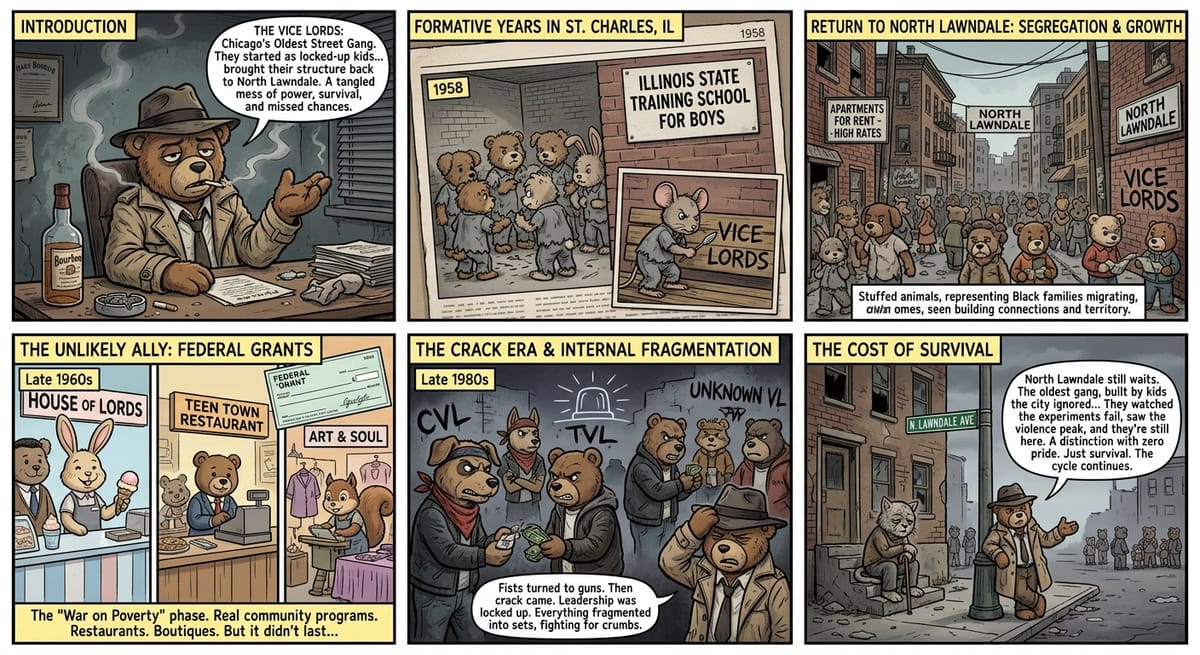
The Vice Lords are a Chicago street gang founded in 1958 by teenagers from North Lawndale who met while locked up at the Illinois State Training School for Boys in St. Charles.1 2 In the late 1960s, the Conservative Vice Lords incorporated as a nonprofit and ran small businesses and youth programs on foundation and federal anti-poverty money, until Mayor Richard J. Daley's 1969 "War on Gangs" sent leaders to prison and the funding melted away.3 4 5 Today the name covers many loosely connected factions, most of them in the People Nation alliance.1
Founded in St. Charles, 1958
The gang did not start on a street corner. It started in a reform school about 40 miles west of the city, where a group of North Lawndale boys found each other. Their recognized founder is Edwin "Pepalo" Perry, who with six others formed the group at St. Charles; Bobby Gore, who would later become its best-known public face, joined around then.2 6 The DEA dates the founding to 1958; some accounts say 1957.1 2
The name has a story attached. According to one widely repeated account, a founder looked up "vice" and found it meant "having a tight hold."2 (The earlier version of this page said the name meant a "lordship over vice." That is a reasonable reading, but it isn't how the founders explained it.)
When the boys got out, they brought the group home, recruited from the neighborhood, and started fighting other West Side "clubs." By 1964, police had named them a primary target.2
North Lawndale was already being emptied out
North Lawndale had been the biggest Jewish neighborhood in Chicago, home to about a quarter of the city's Jewish population at its peak.7 In the 1950s, Black families arriving from the South Side and the South moved in, and white residents left so fast that the white share of the population fell from 87 percent to under 9 percent in about ten years.7 The neighborhood grew to nearly 125,000 people by 1960, and then the bottom fell out: housing discrimination, contract selling, municipal neglect, and later the closing of big employers like International Harvester and Sears.7 In 1966, Martin Luther King Jr. rented an apartment there to draw attention to the conditions.7
Our view: you cannot tell the Vice Lords' story without that backdrop. A gang is partly what young men build when the institutions around them are walking out the door.
Teen Town, Art & Soul, and a Rockefeller grant
In the mid-1960s, the leadership started calling themselves the Conservative Vice Lords and turned toward community work.1 Gore later said the turn came because "the garbage wasn't getting picked up" and "the schools weren't functioning," so they decided to start "doing things in our community for ourselves."3
The group incorporated as a nonprofit in the late 1960s.4 With grants from major foundations, CVL organized young people, protested unfair housing and discriminatory working conditions, and opened small businesses: an ice cream parlor called Teen Town and the African Lion clothing store.3 4 With the Museum of Contemporary Art, it opened Art & Soul, a community art center.4 It put out a photo-illustrated 1968-69 annual report called "Report to the Public," the way a respectable charity would.4 The War on Poverty had made federal money available for community-run programs, and by 1968 private foundations were matching some of it.5 The Rockefeller Foundation backed CVL with a grant reported at about $250,000 to $275,000.2 6
(The earlier version of this page called Teen Town a restaurant, listed a "House of Lords" ice cream parlor, and called Art & Soul a clothing boutique. Teen Town was the ice cream parlor, the clothing store was the African Lion, and Art & Soul was an art center. We couldn't confirm a "House of Lords" business.)
This was not a clean conversion, and nobody involved claimed it was. The Tribune's obituary of Gore noted that CVL "remained notorious," with members deeply involved in drugs and violence for decades.3 Hull-House's education coordinator put it this way: "A core group truly had rejected street gang behavior, although those at the fringes did not."8
What ended the political phase?
The city did. In 1969, Mayor Daley and State's Attorney Edward Hanrahan launched a "War on Gangs." An official investigation into CVL followed, key members went to jail, and the Rockefeller support evaporated.8 By 1970, according to the Hull-House exhibit, CVL's leaders were imprisoned and the organization had foundered.4 The Nixon administration's cuts to War on Poverty and Model Cities programs took away the rest of the funding base.5
Gore himself was charged in a 1969 killing. He was convicted and served a 10-year sentence at Stateville, earning a GED and degrees from Northern Illinois University inside, and was released in 1979; supporters have always backed his claim of innocence.3 He then spent years at the Safer Foundation helping former prisoners find jobs, and died on February 12, 2013, at 76.3 (The earlier version of this page said Gore was convicted in 1975, got life, and was paroled in 2007. All three were wrong.)
The argument this page has always made still holds, framed as what it is, an argument: for a few years, gang infrastructure was being turned into community infrastructure, and the city chose to dismantle it rather than see what it became.
The factions: one name, many sets
"Vice Lords" is less a single gang than a family name. Federal prosecutors describe the Almighty Vice Lord Nation as a set of "sets," "decks" or "branches."9 Documented factions include:
- Conservative Vice Lords, the original branch that gave the nation its foundation2
- Traveling Vice Lords, which the DEA counts with the Conservatives as the largest factions1
- Unknown Vice Lords, described by the Chicago Tribune in 1994 as "one of the larger branches of the fragmented Vice Lords gangs"10
- Insane Vice Lords, Imperial Insane Vice Lords and Mafia Insane Vice Lords, all named in a 2015 federal indictment9
The factions act on their own, and they fight each other. In 1994, Unknown Vice Lords leader Willie Lloyd's faction was feuding with another Unknown Vice Lords faction.10 After Lloyd's 1992 release from prison, a long war over control of the nation followed.2 The Four Corner Hustlers, sometimes linked to Vice Lord history, are listed by the DEA as a separate gang.1
In the 1980s, with the founding generation dead or in prison, younger leaders adopted Islamic language and texts, which is where names like "Lords of Islam" come from.2
Symbols and the People Nation
The Vice Lords were among the founders of the People Nation, formed around 1978 with the Latin Kings and the El Rukns (now the Black P Stones) in answer to the Folk Nation.1 Their allies include the Stones and the Latin Kings; their main rivals are the Gangster Disciples and other Folk gangs.1 Publicly documented symbols include a top hat and cane, a five-pointed star and the colors red, gold and black.2
Frequently Asked Questions
Who started the Vice Lords? A group of North Lawndale teenagers held at the Illinois State Training School for Boys in St. Charles, led by Edwin "Pepalo" Perry. The DEA dates the founding to 1958, though some accounts say 1957.1 2
Are the Vice Lords People Nation? Yes. The Vice Lords helped form the People Nation alliance around 1978, alongside the Latin Kings and the El Rukns, as a counterweight to the Folk Nation.1
What are the different Vice Lord factions? The best-documented include the Conservative, Traveling, Unknown, Insane, Imperial Insane and Mafia Insane Vice Lords. They share a name and an alliance but operate independently and have fought one another.1 9 10
What did the Vice Lords do with federal money in the 1960s? The Conservative Vice Lords incorporated as a nonprofit and used War on Poverty money and foundation grants, including Rockefeller Foundation support, to run youth programs and open Teen Town, the African Lion clothing store and the Art & Soul art center.3 4 5 The experiment ended after Chicago's 1969 War on Gangs.8
What happened to Bobby Gore? Gore was charged in a 1969 killing, convicted, and served a 10-year sentence until his release in 1979, while maintaining his innocence. He spent the rest of his life helping former prisoners and young people, and he died in February 2013.3
Are the Vice Lords still active? Yes. The DEA's 2017 Chicago assessment counted the Vice Lords among the city's biggest gang threats, with thousands of members nationwide.1 Federal cases against Vice Lord sets continue in other states, including a May 2026 sentencing of two Unknown Vice Lords members in Memphis.11
Part of Chicago Gangs: ← Back to series hub
Related reading: Folk vs. People · Black P Stones · Latin Kings (Chicago) · Gangster Disciples · Latin Kings (New York), the parallel reform attempt in New York
─────────
Sources:
- Drug Enforcement Administration, Chicago Field Division. Cartels and Gangs in Chicago (DEA-CHI-DIR-013-17). May 2017. Archived copy, web.archive.org
- "Almighty Vice Lord Nation." Wikipedia. en.wikipedia.org
- "Bobby Gore, former gang leader who worked with community groups, 1936-2013." Chicago Tribune, February 26, 2013. chicagotribune.com
- "Hull-House Museum Opens Off-Site Exhibits on Conservative Vice Lords." UIC Today, University of Illinois Chicago, June 5, 2012. today.uic.edu
- Hunter, Devin. "Report to the Public: An Untold Story of the Conservative Vice Lords [Exhibit Review]." The Lakefront Historian, July 19, 2012. lakefronthistorian.com
- "Bobby Gore." Wikipedia. en.wikipedia.org
- "North Lawndale, Chicago." Wikipedia. en.wikipedia.org
- Laurenson, Lydia. "Can a Gang Bring Peace to the Streets?" In These Times, January 4, 2013. inthesetimes.com
- United States v. Clark et al., Indictment, No. 2:15-cr-20472 (E.D. Mich., filed July 29, 2015). justice.gov
- "21 Arrests in Gang Tied to Lloyd." Chicago Tribune, April 14, 1994. chicagotribune.com
- U.S. Department of Justice, Office of Public Affairs. "Gang Members Sentenced to 50 Years Each for Murdering Fellow Gang Member." May 13, 2026. justice.gov
- Open Library. A Nation of Lords: The Autobiography of the Vice Lords, editions record. openlibrary.org
Further reading (books cited on the earlier version of this page, plus one the brief asked for):
- Dawley, David. A Nation of Lords: The Autobiography of the Vice Lords. Anchor Press, 1973; reissued by Waveland Press, 1992.12
- Hagedorn, John M. A World of Gangs: Armed Young Men and Gangsta Culture. University of Minnesota Press, 2008.
- Hirsch, Arnold R. Making the Second Ghetto: Race and Housing in Chicago, 1940-1960. Cambridge University Press, 1983.
- Keiser, R. Lincoln. The Vice Lords: Warriors of the Streets. Holt, Rinehart and Winston, 1969.
- Perkins, Useni Eugene. Explosion of Chicago's Black Street Gangs: 1900 to Present. Third World Press, 1987.
- "Street Gangs: Better or Worse?" Life, September 5, 1969.