The Black P Stones: From Community Group to Criminal Enterprise
Jeff Fort turned the Blackstone Rangers from a War on Poverty grant recipient into a gang convicted of negotiating terrorist attacks with Muammar Gaddafi's Libya.
The Black P Stones: From Community Group to Criminal Enterprise
The Black P Stones are the only American street gang to negotiate with a foreign government. Jeff Fort built the Blackstone Rangers from a street corner in Woodlawn into a criminal empire with federal grant funding, religious identity, and eventually a terrorism conviction tied to Libyan money — a trajectory that compressed every contradiction of Chicago’s gang history into one organization.
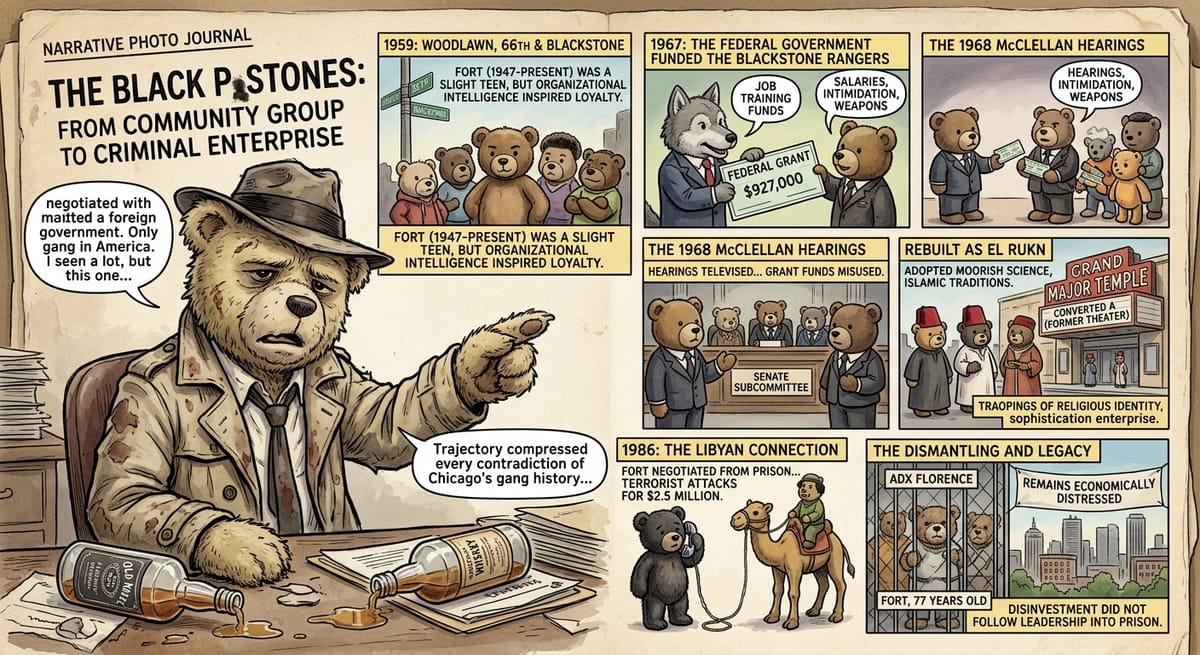
The Blackstone Rangers formed in 1959 in the Woodlawn neighborhood on Chicago’s South Side, organized around a corner at 66th Street and Blackstone Avenue. Their founder, Jeff Fort, was born on February 20, 1947, in Aberdeen, Mississippi, and arrived in Woodlawn as a child. He was a slight teenager with no obvious physical advantage, but he had organizational intelligence and the ability to inspire loyalty — or at least command it — from young men who needed somewhere to belong.^1^ By the mid-1960s, Fort had built the Blackstone Rangers into one of the most powerful gangs in Chicago.
The Federal Government Funded the Blackstone Rangers
What made the Blackstone Rangers distinctive in the late 1960s wasn’t their violence — it was their politics. Fort presented the Rangers as a community organization representing Woodlawn’s dispossessed youth, and he was persuasive enough to attract major institutional attention. In 1967, the Woodlawn Organization, a community group supported by the Saul Alinsky network, sponsored a federal grant application for the Rangers and the rival Disciples to receive job training funds through the Office of Economic Opportunity.^2^
The grant — eventually totaling $927,000 — became one of the most controversial programs of the War on Poverty. A 1968 Senate subcommittee investigation led by Senator John McClellan found that Blackstone Rangers leadership had used grant funds to pay gang members’ salaries, that mandatory attendance at training sessions was enforced through intimidation, and that weapons had been purchased with federal money. The hearings were nationally televised and produced lasting damage to the War on Poverty’s credibility. Fort was convicted of misusing the grant funds and sentenced to five years in prison.^3^
Fort Rebuilt the Organization as El Rukn
Fort emerged from federal prison in the early 1970s and rebuilt his organization under a new name: the El Rukns, adopting the name, aesthetic, and some theology of Moorish Science, a Black Islamic tradition. The El Rukns — alternately called the Almighty Black P Stone Nation, with the P added to the original Rangers name — took on the trappings of religious identity while operating as an increasingly sophisticated criminal enterprise.
By the early 1980s, the El Rukns controlled drug distribution across several South Side Chicago neighborhoods, with estimated annual revenues in the tens of millions of dollars. They operated out of a building at 3947 South Drexel Boulevard that they called the Grand Major Temple — a converted theater that served as headquarters, meeting hall, and command center.^4^
The organization’s most extraordinary episode came in 1986, when Fort, then serving a sentence in the Bastrop Federal Correctional Institution in Texas, allegedly negotiated with agents of the Libyan government of Muammar Gaddafi. The government claimed Fort agreed to carry out terrorist attacks in the United States in exchange for $2.5 million in Libyan funding, including potentially shooting down a U.S. aircraft. Five El Rukn members were convicted in 1987 on terrorism-related charges. Fort himself was convicted in 1988 and received an additional 80 years in federal prison, on top of a prior 13-year sentence for drug charges.^5^
What Survives of the Black P Stones Today
After Fort’s second conviction, the El Rukns were effectively dismantled by federal prosecution. The building on Drexel Boulevard was seized. The organization restructured back toward its Blackstone Rangers identity and operating name, becoming the Black P Stones — with individual sets dispersed across the South Side, connected by shared identity but without the centralized leadership Fort had maintained from prison for years.
The path from a street corner at 66th and Blackstone to a federal terrorism conviction is not a straight line — it winds through War on Poverty grants, religious identity adoption, drug distribution empire, and negotiations with a North African state. But it traces the logic of an organization that consistently reached for power through whatever channels were available, institutional and otherwise, in a neighborhood that conventional power had largely abandoned.
Jeff Fort is currently housed at ADX Florence in Colorado, one of only a handful of American gang leaders confined in the federal supermax facility alongside Gangster Disciples founder Larry Hoover. He is 77 years old. The Black P Stones still operate on Chicago’s South Side, affiliated under the People Nation umbrella with the Vice Lords and Latin Kings. The Woodlawn neighborhood where Fort organized in the 1960s remains one of Chicago’s most economically distressed communities — disinvestment did not follow the gang leadership into prison.
Part of Chicago Gangs — ← Back to series hub
─────────
Sources:
- Perkins, Useni Eugene. Explosion of Chicago’s Black Street Gangs: 1900 to Present. Third World Press, 1987.
- Fish, John Hall. Black Power/White Control: The Struggle of the Woodlawn Organization in Chicago. Princeton University Press, 1973.
- United States Senate Permanent Subcommittee on Investigations. Riots, Civil and Criminal Disorders. Government Printing Office, 1968.
- Hagedorn, John M. A World of Gangs: Armed Young Men and Gangsta Culture. University of Minnesota Press, 2008.
- United States v. Fort et al., 847 F.2d 389 (7th Cir. 1988).