The Gangster Disciples: Larry Hoover's Empire
A gang leader ran a corporation from a prison cell, tried to turn it into a political machine, and watched the federal government choose to crush it instead. Then his sentence outlived his power.
Part of Chicago Gangs: ← Back to series hub
The Gangster Disciples are a Chicago street gang that Larry Hoover built into one of the most formally organized criminal enterprises in the city's history, much of it run from inside a prison. Hoover helped found the Folk Nation alliance, attempted a political rebrand in the 1990s, and was convicted in federal court in 1997.1 2 In May 2025 President Donald Trump commuted his federal life sentence, but Hoover, now 75, remains in custody on a 1973 Illinois murder sentence while Gov. JB Pritzker weighs a clemency petition. The gang he built has long since broken into factions.3 4
Hoover, Barksdale and the Merger
Hoover was born November 30, 1950, in Jackson, Mississippi, and his family moved to Chicago when he was a small child. As a teenager he led the Supreme Gangsters on the South Side.5 In 1969 he and David Barksdale, leader of the Black Disciples, combined their organizations as the Black Gangster Disciple Nation.5 6
The union did not survive its founder. Barksdale died in 1974 of kidney failure linked to a gunshot wound from four years earlier.7 Researcher George Knox of the National Gang Crime Research Center traced what happened next: the umbrella splintered along leadership lines, and by 1978 the Gangster Disciples, the Black Disciples and the Black Gangsters were separate gangs.7 That is the short answer to the most common question about the Disciples. GD and BD share a founding myth, a six-point star and an alliance, and they have spent decades fighting each other anyway.
Hoover himself was in prison by then. On February 26, 1973, William "Pooky" Young, 19, was abducted and shot dead in an Englewood alley. Prosecutors said Hoover ordered the killing after Young was accused of stealing drugs and money from the gang. Hoover and Andrew Howard were each sentenced to 150 to 200 years.5 4 Howard was paroled in 1992. Hoover never was.4
Running It From Prison
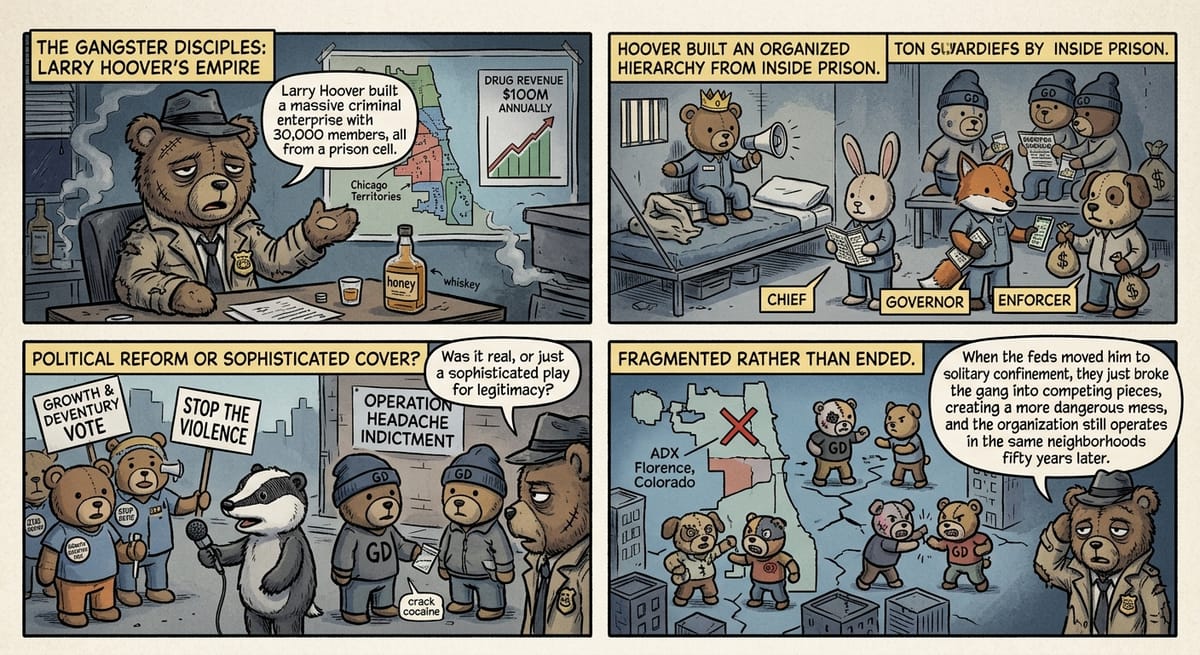
The Gangster Disciples became famous less for their size than for their org chart. When federal prosecutors finally charged Hoover in 1995, the indictment described a gang with two boards of directors, one inside prison and one outside, and a chain of command running from Hoover as "chairman" down through governors, regents and coordinators assigned to sections of Chicago and its suburbs. Money flowed up the ladder. Members had to memorize the gang's laws. Ranking members, the indictment said, made subordinates buy drugs from them at inflated prices and pay a "street tax," and punished violations with fines, beatings or murder.1
Prosecutors attributed enormous scale to the operation: a $100 million retail drug enterprise and roughly 30,000 members.2 Those are the government's figures from the case, not an audited count, and they have been repeated ever since.
The evidence that Hoover was in charge came largely from his own voice. He was recorded on a hidden microphone directing street operations while he was in state custody.4 The irony is that he had spent years in the minimum-security Vienna Correctional Center, where, the Chicago Tribune reported in 1994, he had been held for seven years, while supporters lobbied the parole board for his release.8
'Growth and Development'
By the early 1990s Hoover was telling anyone who would listen that he had changed. The letters GD, his movement said, now stood for "Growth and Development." A political action committee called 21st Century VOTE (Voices of Total Empowerment) registered voters, coached midnight basketball, staged City Hall rallies of as many as 5,000 people and drew politicians of every stripe to its forums.8 Two men who had risen high in the gang made it to aldermanic runoffs in 1995. The group's representatives were consulted by a mayoral candidate, civil rights groups and, according to the Los Angeles Times, even President Bill Clinton.1
Its leaders insisted Hoover did not control it. The Tribune found that several of its officials had criminal records and close ties to him, and that young Disciples marched under its banner.8 The federal government's answer came in the 1995 indictment, which alleged that the PAC was financed in part by a special street tax on drug sales, known inside the gang as "the P," for political money. "They run it," U.S. Attorney James B. Burns said of the gang's relationship to the group.1
Both readings of the experiment have survived. One says Growth and Development was the most sophisticated cover a gang leader ever built: a way to buy legitimacy, parole support and political protection with drug money. The other says that whatever Hoover's motives, a gang was turning thousands of young men into voters and organizers, and the government chose to destroy it before anyone could learn what it might become. Hoover's lawyers now say he has renounced the gang and that he "did not create the fire. He grew up in it." His prosecutors have never stopped arguing the first reading.4 3
Operation Headache and the 1997 Conviction
The investigation, which began in 1989, ended in a sweep on August 31, 1995, dubbed Operation Headache. About 250 officers and federal agents fanned out across the South Side, the suburbs and the state prisons. Thirty-nine people were charged, Hoover among them, and he was flown from the Dixon Correctional Center to federal custody.1
In May 1997 a federal jury convicted Hoover and six associates on every count after about 12 hours of deliberation.2 The appeals court later described Hoover as the gang's "chairman of the board" and upheld his conviction for running a continuing criminal enterprise, with a life sentence.9 Prosecutors celebrated the case as stripping away the "veneer of legitimacy" that the gang had bought through its political work.2
Fragmentation
Federal officials had said the goal was to remove the top so the bottom would be easier to control. "If we can keep all of them in prison for life without parole," Burns said in 1995, "it'll make it substantially easier for us to control [the Gangster Disciples] on the outside."1 Even in 1997, police on the South Side were predicting that without a leader the gang would "fight it out among themselves."2
They were right. Without central authority, the Gangster Disciples splintered. A 2019 University of Illinois at Chicago report found that many of the city's Black gangs, the Disciples included, had broken into small neighborhood cliques with little formal leadership, often made up of young men from rival traditional gangs.10 The organization did not disappear. Its discipline did, and with it the ability of anyone, including Hoover, to order peace.
Where Hoover Is Now
For nearly three decades after his federal conviction, Hoover was held in the federal supermax prison in Florence, Colorado, much of the time in isolation.4 Prosecutors fought every attempt to shorten his sentence, arguing that he still held sway over the gang from prison.3 A federal judge rejected his bid for a reduced sentence under the First Step Act in 2021.5
Then, on May 28, 2025, Trump commuted his federal life sentence.5 3 It did not set him free. Hoover still owed the state of Illinois 150 to 200 years for the Young murder, and within days Colorado prison officials confirmed he had been transferred into their custody under the Interstate Corrections Compact; Illinois said he remained under its jurisdiction but not in its custody.11 In an October 22, 2025, clemency petition to Pritzker, his lawyers said he was at the Colorado State Penitentiary, had suffered three heart attacks since leaving federal prison, and called his continued imprisonment a "slow, state-sanctioned death sentence."12
The Illinois Prisoner Review Board heard the petition on April 7, 2026. Former federal judge John Gleeson, who once prosecuted John Gotti, testified that Hoover "poses no risk of danger to the community." A Cook County prosecutor answered that "William Young never got a second chance."4 Cook County State's Attorney Eileen O'Neill Burke has asked the governor to deny clemency. By mid-May 2026 the board had sent its confidential recommendation to Pritzker, who faces no deadline to act.13 As of October 10, 2026, no decision had been publicly reported, and Hoover remained in custody.
Frequently Asked Questions
Is Larry Hoover still in prison? Yes. Trump commuted his federal life sentence in May 2025, but Hoover is still serving a 150-to-200-year Illinois sentence for the 1973 murder of William Young, and has been held in Colorado under an interstate compact. His clemency petition has been with Gov. Pritzker since May 2026, and as of October 10, 2026, no decision had been announced.
What's the difference between the Gangster Disciples and the Black Disciples? They began as one organization, the Black Gangster Disciple Nation, formed in 1969 when Hoover's Supreme Gangsters joined David Barksdale's Disciples. After Barksdale's death in 1974 the umbrella split, and the Black Disciples kept Barksdale as their king while the Gangster Disciples followed Hoover. Both are Folk Nation, and they have often been at war.
What does 'Growth and Development' mean? It was Hoover's 1990s rebranding of the GD initials, presented as a turn from crime toward politics, education and community work. Prosecutors said it was a front funded by drug money. Supporters say it was a real attempt at change that the government cut short.
Are the Gangster Disciples Folk Nation? Yes. Hoover is credited with organizing the Folk alliance inside Illinois prisons in the late 1970s, and the Gangster Disciples have always been its anchor gang.
Why was Hoover at ADX Florence? After his 1997 federal conviction, he was moved from the Illinois system to federal prison and spent most of the next three decades at the supermax in Florence, Colorado. The case against him rested on evidence that he had run the gang from state prison, and prosecutors argued for years that he still held influence over it.
Do the Gangster Disciples still exist? Yes, but not as the corporation Hoover ran. The name survives in Chicago and in other cities, while researchers describe a gang broken into small, independent cliques without a functioning central command.
The Sentence Outlived the Power
Hoover's story is often told as a rise and a fall. It is better told as an experiment nobody let finish. A gang leader built a disciplined enterprise from a prison cell, then tried to point that discipline at politics. The government decided the politics was a disguise and took the whole thing apart from the top. What was left was a structure without a head, in neighborhoods that had not been given anything else.
The man is 75 and has been in custody since 1973. The organization he built stopped answering to him long ago. The only part of the arrangement that still works exactly as designed is the sentence.
Related reading: Folk Nation vs People Nation · The Black P Stones · The Vice Lords · Chief Keef and Chicago Drill, the music that grew up in the South Side neighborhoods the Disciples' splintered factions left behind
Part of Chicago Gangs: ← Back to series hub
─────────
Sources:
- Pasternak, Judy. "U.S. Moves to Crack Powerful Chicago Gang." Los Angeles Times, September 1, 1995. latimes.com
- Tyson, Ann Scott. "Chicagoans See Gang Verdict As First Step in Reconciliation." Christian Science Monitor, May 12, 1997. csmonitor.com
- Meisner, Jason. "Trump commutes federal life sentence for former Gangster Disciples boss Larry Hoover." Chicago Tribune, via Corrections1, May 29, 2025. corrections1.com
- Main, Frank. "Gangster Disciples founder Larry Hoover has wife, ex-NY mob prosecutor push parole board to free him." Chicago Sun-Times, April 7, 2026. suntimes.com
- "Larry Hoover." Wikipedia. en.wikipedia.org
- "Black Disciples." Wikipedia. en.wikipedia.org
- Knox, George W. "The Black Disciples." National Gang Crime Research Center gang profile. ngcrc.com
- "21st Century VOTE Giving Gangs Taste of Real Power." Chicago Tribune, September 28, 1994. chicagotribune.com
- United States v. Hoover, 246 F.3d 1054 (7th Cir. 2001). FindLaw
- Hagedorn, John, et al. The Fracturing of Gangs and Violence in Chicago. Great Cities Institute, University of Illinois at Chicago, January 2019. PDF via WTTW
- Seidel, Jon, and David Struett. "Larry Hoover, Robert Crimo III have Illinois prison sentences to serve, but where?" Chicago Sun-Times, May 30, 2025. suntimes.com
- Sfondeles, Tina, and Jon Seidel. "Drug kingpin Larry Hoover asks Gov. JB Pritzker for freedom." Chicago Sun-Times, October 22, 2025. suntimes.com
- Main, Frank, Tina Sfondeles and Tom Schuba. "Gangster Disciples founder Larry Hoover's bid for freedom is now in Gov. JB Pritzker's hands." Chicago Sun-Times, May 14, 2026. suntimes.com
Further reading (books cited on the earlier version of this page):
- Perkins, Useni Eugene. Explosion of Chicago's Black Street Gangs: 1900 to Present. Third World Press, 1987.
- Venkatesh, Sudhir Alladi. Gang Leader for a Day. Penguin Press, 2008.
- Hagedorn, John M. A World of Gangs: Armed Young Men and Gangsta Culture. University of Minnesota Press, 2008.