The Latin Kings in Chicago: How a Humboldt Park Gang Became a Nation
Puerto Rican kids pushed from block to block by urban renewal picked a name that said what the city wouldn't: we are kings here. Seven decades later the crown is still on the walls.
Part of Chicago Gangs: ← Back to series hub
The Latin Kings formed in Chicago among Puerto Rican youth who had been pushed from neighborhood to neighborhood by urban renewal and highway building, and they grew into the Almighty Latin King Nation, one of the oldest and largest Latino street gangs in the country.1 In 1981 they joined the People Nation alliance, which set their friends and enemies for the next two decades.1 The founding date is still argued over: some accounts say 1954, while the most detailed neighborhood history finds no record of the name before a vote at a Humboldt Park community center in May 1964.1 2
Either way, the name announced both ethnicity and aspiration: to be a king in a city that treated Puerto Ricans as expendable. And the gang put down roots in exactly the blocks where the city had pushed its Puerto Rican families, which is the story the rest of this page tells.
Puerto Rican Displacement Created the Conditions for the Latin Kings
Puerto Ricans began arriving in Chicago in significant numbers after World War II, many recruited to fill factory jobs. Urban renewal and expressway construction cleared the "slum" buildings where many poor Puerto Rican and Black families lived, and many of the displaced landed in West Town and Humboldt Park.1
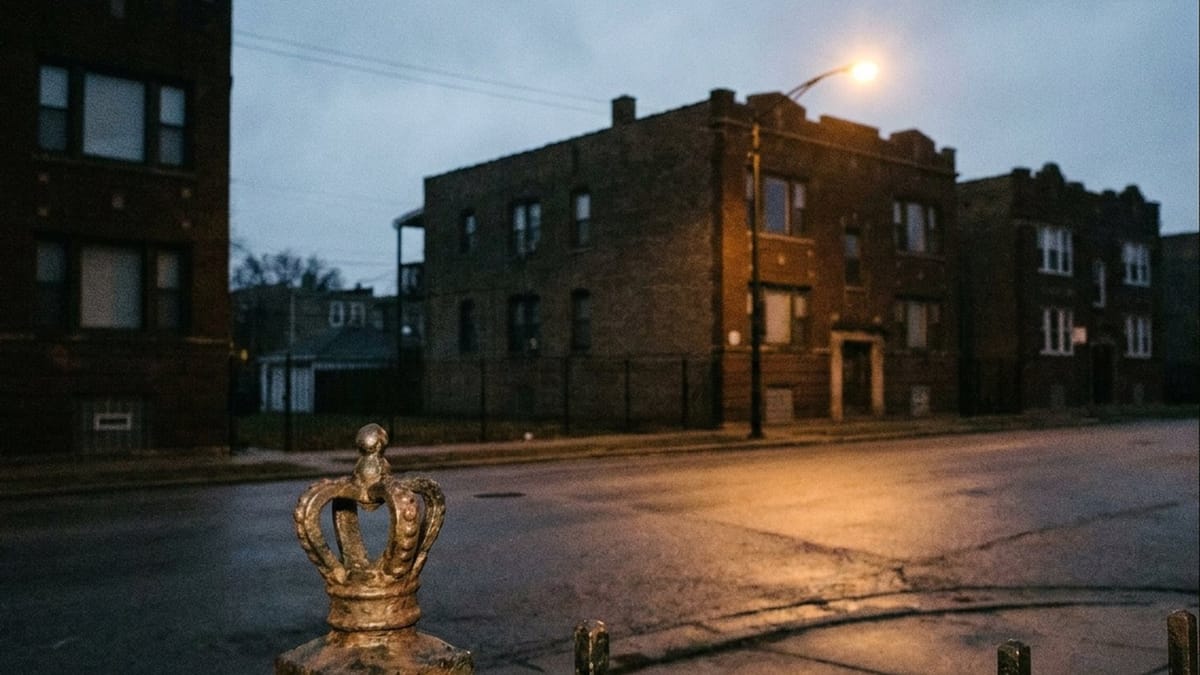
The Latin Kings emerged from that concentration. They were a neighborhood protective organization first, asserting identity and territory in a city where Puerto Rican residents faced discrimination from both white ethnic neighborhoods and the city's political machine. Over time they developed a formal structure, with a constitution, ranks, the colors black and gold, and the crown, drawn with three or five points, that distinguished them from less formalized street crews.3
How the Latin Kings' Internal Structure Set Them Apart From Other Chicago Gangs
The Chicago organization is the Almighty Latin King Nation (ALKN), the King Motherland Chicago faction. It is organized into chapters called "tribes," a Crown Council that sets rules and holds disciplinary hearings, and regional "Incas," with the top leaders known as "coronas."2 That structure, more formalized than most street gangs, enabled internal discipline and cross-city coordination.
The political philosophy the Latin Kings articulated, emphasizing Latino pride, unity against oppression and mutual support, attracted members who were genuinely interested in community identity as well as those who wanted the protection and income the gang provided. The duality created ongoing tension between leaders who saw political organizing as primary and those who saw it as cover for criminal enterprise.
In 1981 the Latin Kings joined the People Nation alliance, aligning with the Vice Lords, Black P Stones and other People gangs against Folk gangs including the Gangster Disciples.1 The alignment gave them a broader support network but also drew them into conflicts beyond their Northwest Side home territory. Neighborhood histories record long wars with Two Six in Little Village, the Satan Disciples and the Maniac Latin Disciples, and by the end of the 1980s the Kings were also fighting nominal allies such as the Latin Counts.1
What Did Federal Prosecution Actually Accomplish Against the Latin Kings?
Federal prosecutors went after the top. Gustavo "Gino" Colon, a corona, got a life sentence in 2000 for running a continuing criminal enterprise. In January 2012, Augustin "Big Tino" Zambrano, described by prosecutors as the highest-ranking Latin King in the country, was sentenced to 60 years for racketeering conspiracy. By then, the U.S. Attorney's office said, more than 80 Latin Kings members and associates had faced state or federal charges since 2006, and about 65 had been convicted federally. Prosecutors put the gang at some 10,000 members in Illinois alone.4
The prosecutions produced what happened in most such cases: leadership decapitation without structural disruption. New leaders emerged from below, and the gang kept operating in Humboldt Park and other Latino neighborhoods while expanding its reach through the prison system.
Chicago's Latin Kings Are Not the Same Organization as New York's
New York's Latin Kings are not the same organization. Luis Felipe founded the New York chapter in 1986 inside Collins Correctional Facility, a state prison, and it grew into the separate Bloodline faction, which calls itself the Almighty Latin King and Queen Nation.2 5 Both share the name, colors and crown, but they developed separate structures, separate leadership and separate political identities. The Chicago chapter's deep roots in the People alliance gave it a particular position in Chicago's gang ecosystem; the New York chapter developed its own trajectory.
The Latin Kings in Chicago are still operating in Humboldt Park and adjacent neighborhoods where the organization was founded more than six decades ago. The communities they emerged from, built by urban renewal displacement, sustained by segregation and shaped by decades of disinvestment, are still recognizable as the geography that produced the gang. Federal prosecutions have cycled through multiple generations of leadership without changing that underlying fact.
Frequently Asked Questions
Are the Latin Kings People Nation? Yes, in Chicago. They joined the People alliance in 1981 alongside groups such as the Vice Lords and Black P Stones.1 The alliance frayed badly in the drug wars of the late 1980s and 1990s, and some Latin King sections now barely recognize it.1
What are the Latin Kings' colors and symbol? Black and gold. The main symbol is a crown, drawn with three or five points, along with the lion and a figure the gang calls the King Master.2 3
Are the Chicago and New York Latin Kings the same gang? No. They share a name, colors and crown, but New York's chapter was founded separately in a state prison in 1986 and became its own faction. The New York page tells that story.2 5
When were the Latin Kings founded? It depends on whom you ask. Some accounts say 1954 in Humboldt Park. The most detailed neighborhood history traces the founders through a late-1950s gang called the Skulls to a vote on the name "Latin Kings" in May 1964, and says there are no police or social-service files using the name before then.1 2
Part of Chicago Gangs: ← Back to series hub
─────────
Sources:
- "Latin Kings (Almighty Latin King Nation): Chicago." Chicago Gang History. chicagoganghistory.com
- "Latin Kings (gang)." Wikipedia. en.wikipedia.org
- Knox, George W. "Latin Kings" gang profile. National Gang Crime Research Center. ngcrc.com
- U.S. Attorney's Office, Northern District of Illinois. "Latin Kings' Nationwide Leader, Augustin Zambrano Sentenced to 60 Years in Prison for RICO Conspiracy and Related Gang Crimes." January 11, 2012. justice.gov (PDF)
- United States v. Felipe, 148 F.3d 101 (2d Cir. 1998). courtlistener.com
Further reading:
- Padilla, Felix M. The Gang as an American Enterprise. Rutgers University Press, 1992.
- Ramos-Zayas, Ana Y. National Performances: The Politics of Class, Race, and Space in Puerto Rican Chicago. University of Chicago Press, 2003.
- Venkatesh, Sudhir Alladi. American Project: The Rise and Fall of a Modern Ghetto. Harvard University Press, 2000.
- Hagedorn, John M. A World of Gangs: Armed Young Men and Gangsta Culture. University of Minnesota Press, 2008.