Folk Nation vs People Nation: Chicago's Gang Alliance System
Chicago's gang map has two sides, and neither is a gang. How a prison-yard arrangement in the late 1970s became the way a whole city sorted its street organizations.
Part of Chicago Gangs: ← Back to series hub
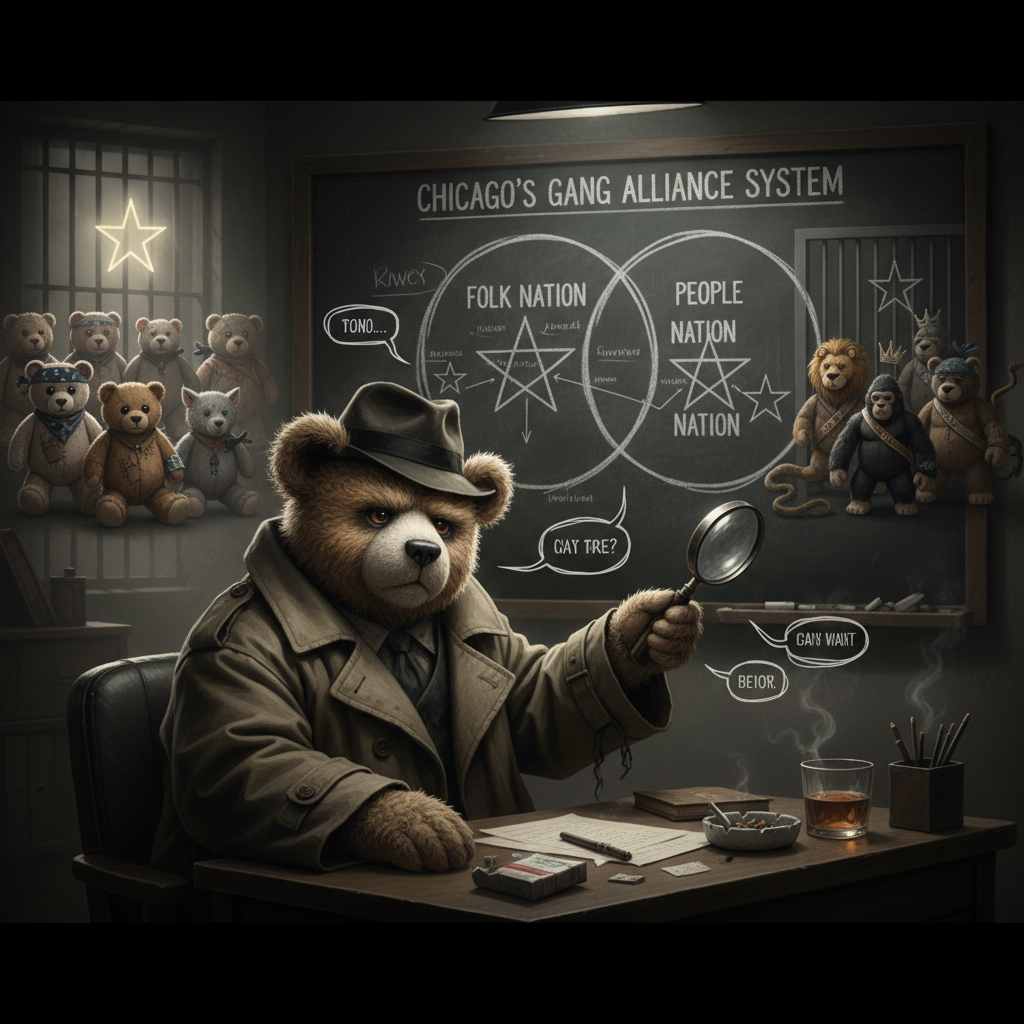
Chicago's gang war has two sides, but they are not the Crips and Bloods, and neither side is actually a gang. Folk Nation and People Nation are rival alliances that grouped Chicago's street gangs into two blocs, starting inside Illinois prisons in the late 1970s and early 1980s. Folk gangs, anchored by the Gangster Disciples, use the six-point star and represent to the right; People gangs, anchored by the Black P Stones, Vice Lords and Latin Kings, use the five-point star and the crown and represent to the left.1 2
The alliances never meant unity. Some of the deadliest feuds in the city's history have been fought between gangs on the same side, and on the street today the two nations matter far less than the people who still use the words assume.3
The Prison System Created the Alliance Framework
By the mid-1970s, Illinois prisons were packed with members of Chicago's competing street organizations, and conditions inside were grim. According to the Chicago gang historian who runs chicagoganghistory.com, the turning point came in April 1978, when Larry Hoover, then leading the Black Gangster Disciples from inside Stateville, organized a work stoppage over rotten food and treatment by staff. Rivals joined in. In the aftermath, gangs friendly to Hoover started gathering as an informal brotherhood behind the walls.1
The brotherhood got its name in 1979, reportedly at the suggestion of the Simon City Royals: "Folks." By 1980 it had formal structure inside the prisons. In 1981, as the Folk framework was carried out to the streets, Jeff Fort's El Rukns called the large gangs outside it to their headquarters at 3947 South Drexel, a converted theater known as The Fort. The Black P Stones, Vice Lords, Latin Kings and Mickey Cobras came, and the People alliance was born there, blending Islamic and Christian imagery.1 2 4
The names were a joke with a point: Folk and People mean the same thing, which the historian who documented the founding argues was deliberate.4
The framework then ran in both directions. Members released from prison brought the sides home, and gangs that had been independent chose a side or needed a sponsor to join one. Within a few years nearly every established Chicago gang was Folk or People.4
Who's on Each Side
Membership lists come from the founding-era rosters compiled by chicagoganghistory.com and from law-enforcement guides of the 1990s.1 2 5 They are a snapshot, not a census.
| Folk Nation | People Nation | |
|---|---|---|
| Anchor gangs | Gangster Disciples, Black Disciples | Black P Stones (El Rukns), Vice Lords, Latin Kings |
| Other well-known members | Black Gangsters (New Breeds), Simon City Royals, Maniac Latin Disciples, Spanish Cobras, King Cobras, Imperial Gangsters, Two Six, Satan Disciples, Latin Eagles, Ambrose | Mickey Cobras, Four Corner Hustlers, Bishops, Latin Counts, Spanish Lords, Gaylords, Insane Unknowns |
| Primary symbol | Six-point star; pitchfork | Five-point star; crown; crescent moon |
| Number | 6 | 5 |
| Side | Right | Left |
| Colors (1990s guides) | Blue and black | Red and black |
| Greeting (as documented) | "All is one" | "All is well" |
Lists shift. Gangs have changed sides: chicagoganghistory.com records the Insane Deuces moving to Folk in 1992, the Cullerton Deuces in 1994 and the Latin Dragons in 1997.2 Three names also need untangling. The El Rukns and the Black P Stones are one lineage, not two gangs: Fort renamed the Black P Stone Nation as El Rukn in the 1970s, and the organization is known again today as the Black P Stones.2 11 And "Cobras" is not one gang. The Mickey Cobras, who split from the Stones, are People; the Spanish Cobras and King Cobras are Folk.1 6
What the Symbols Mean, as Documented
Law-enforcement trainers spent the 1990s cataloging the alliances' iconography, and their published guides recorded what members said the symbols stood for. A 1996 Police Magazine profile by Al Valdez, then an investigator with the Orange County District Attorney's Office, is a good example of that literature.5
On the Folk side, the six-point star was described as the Star of David, after King David Barksdale, with points standing for life, loyalty, knowledge, wisdom, understanding and love: the "six principles of King David." The pitchfork stood for the power to overcome suppression, the devil's tail for the oppression nonwhite people suffer, the heart for love of the nation.5 Internal Black Disciples documents collected by the National Gang Crime Research Center show the list itself drifting over time, with "unity" replacing "wisdom" in later versions.7
On the People side, the guides described the five-point star as the eye of Allah, the crescent moon as the division of the Black nation into east and west, the circle as 360 degrees of knowledge, and fire as knowledge of oppression.5 The religious language was not an accident. The People alliance was founded in the headquarters of a gang that had reorganized itself as a religious body.2 6
These are meanings members gave researchers and police, and they show what the alliances claimed to be: moral orders built by young men in institutions that offered them none.
Same Side, Still at War
The clearest proof that an alliance is not an army is the Disciples. The Gangster Disciples and Black Disciples share a founder myth, a star and a nation. They also share a long history of shooting each other.
Both came out of the Black Gangster Disciple Nation, the 1969 union of David Barksdale's Disciples and Hoover's Supreme Gangsters. After Barksdale died in 1974, the umbrella split along leadership lines, and by 1978 the Gangster Disciples, Black Disciples and Black Gangsters were separate organizations.7 All three stayed Folk. Researcher George Knox found that Black Disciples' main enemies were the People gangs, but that "on the streets BDs have been known to battle it out with GDs on a regular basis as well," and that inside prison both the BDs and BGs fought regularly with the GDs.7
People Nation had the same problem in its own key. By the 1990s, chicagoganghistory.com records, the Latin Kings were at war with several People gangs, and factions of the Stones, Vice Lords and Mickey Cobras were fighting each other in parts of the city.2
How the Framework Spread to Other Cities
The sides did not stay in Chicago. By the mid-1990s, Police Magazine was describing Chicago as "the center for many Midwestern black, Hispanic and mixed-race street gangs," with hundreds of gangs across the region aligning with one nation or the other.5 Knox's research documented Chicago gangs deliberately opening operations in Milwaukee, and informants told him a Black Disciples chapter was formed there in the mid-1980s.7
What traveled was the label more than the structure: a gang in a smaller city could adopt the star, the side and the enemies of a Chicago war it had never fought.
Why Prosecutions Didn't End It
The federal government spent the late 1980s and 1990s going after the men at the top of each nation. The cases are often lumped together as RICO prosecutions, but neither of the headline cases was one.
Jeff Fort, the El Rukn leader, was convicted in 1987 of conspiring to commit terrorist acts in the United States on behalf of Libya in exchange for $2.5 million, and was sentenced to 80 years, on top of a 13-year federal drug sentence.8 In 1988 he was convicted of ordering a 1981 murder and given 75 more years.11 Hoover, already serving a state murder sentence, was indicted federally in 1995 and convicted in 1997 on 40 counts; the appeals court later affirmed his conviction for running a continuing criminal enterprise, with a life sentence.9 10
The cases worked on their own terms. Fort has been in federal prison ever since and was held at the ADX Florence supermax as of 2026.11 What they did not do was end the sides. Removing the men at the top left the vocabulary, the prison politics and the enemies in place, and a younger generation inherited a map without the men who drew it.
A 2019 report from the University of Illinois at Chicago's Great Cities Institute, drawing on researchers including Hagedorn, concluded that "the old People and Folks coalitions are almost completely defunct on the streets." Many of the city's Black gangs have splintered into small neighborhood cliques, often named after a dead friend or a rap lyric, whose members can come from rival traditional gangs. Street loyalties now often run to the "families" around drill rappers rather than to a star.3 The same report notes that police and the Chicago Crime Commission still classify gangs as People or Folk, and that prisons may keep the old alliances alive.3 The founding chronicler of the alliances reaches a similar verdict: strong in the 1980s, hard to maintain by the end of that decade, and nearly gone from the streets by the 2000s.1
Frequently Asked Questions
Is Folk Nation a gang? No. Folk Nation is an alliance of gangs, and so is People Nation. Each member gang keeps its own name, leadership and territory. Being on the same side has never guaranteed peace between them.
Which side are the Black Disciples on? Folk. The Black Disciples share their roots with the Gangster Disciples in the Black Gangster Disciple Nation of 1969, and both use the six-point star. They split in the 1970s and have fought each other often since.
What do the 5 and the 6 mean? They are each alliance's number, tied to its star. Folk gangs use the six-point star and the number 6; People gangs use the five-point star and the number 5. Gangs on each side have also attached their own spiritual meanings to the points, which changed over time.
Are the Latin Kings People or Folk? People. The Latin Kings were among the founding gangs at the 1981 meeting at The Fort and are the largest Latino gang in the People alliance. New York's Latin Kings are a separate organization with their own history.
Do Folk and People still matter in Chicago today? Less than the labels suggest. Researchers at the University of Illinois at Chicago reported in 2019 that the alliances are "almost completely defunct" on the streets, replaced by small neighborhood cliques and rapper-centered "families." The labels persist in police files, in prisons and in music, which is where many people first hear them, including in Chicago drill.
Why do some Folk gangs fight each other? Because the alliance was a prison-era framework, not a chain of command. Leadership disputes, money and personal vendettas have always outranked a shared star. The Gangster Disciples and Black Disciples are the most famous example.
The Map Outlived the Treaty
Folk and People began as a way for men in crowded, violent prisons to know who would and would not come at them. It became the map of a city. Our view: the map has largely dissolved on the street, but not because anyone fixed what produced it. The violence simply reorganized into smaller, less predictable units.
Related reading: The Gangster Disciples · The Black P Stones · The Vice Lords · The Latin Kings in Chicago · Chief Keef and Chicago Drill
Part of Chicago Gangs: ← Back to series hub
─────────
Sources:
- Chicago Gang History. "Folk Nation." chicagoganghistory.com/alliances/folk-nation
- Chicago Gang History. "People Nation." chicagoganghistory.com/alliances/people-nation
- Hagedorn, John, et al. The Fracturing of Gangs and Violence in Chicago: A Research-Based Reorientation of Violence Prevention and Intervention Policy. Great Cities Institute, University of Illinois at Chicago, January 2019. PDF via WTTW
- Chicago Gang History. "The Meaning Behind the Folk and People Alliances." June 20, 2019. chicagoganghistory.com
- Valdez, Al. "Nations at War Within Windy City Limits." Police Magazine, November 1, 1996. policemag.com
- "Almighty Black P. Stone Nation." Wikipedia. en.wikipedia.org
- Knox, George W. "The Black Disciples." National Gang Crime Research Center gang profile. ngcrc.com
- Taylor, John L. "Gang leader sentenced to 80 years." UPI, December 30, 1987. upi.com
- Meisner, Jason. "Trump commutes federal life sentence for former Gangster Disciples boss Larry Hoover." Chicago Tribune, via Corrections1, May 29, 2025. corrections1.com
- United States v. Hoover, 246 F.3d 1054 (7th Cir. 2001). FindLaw
- "Jeff Fort." Wikipedia (citing the New York Times, December 31, 1987 and October 20, 1988, and the Bureau of Prisons inmate locator). en.wikipedia.org
Further reading (books cited on the earlier version of this page):
- Venkatesh, Sudhir Alladi. Gang Leader for a Day. Penguin Press, 2008.
- Chicago Crime Commission. The Gang Book. Chicago Crime Commission, 2012.
- Perkins, Useni Eugene. Explosion of Chicago's Black Street Gangs: 1900 to Present. Third World Press, 1987.
- Kontos, Louis, David Brotherton, and Luis Barrios, eds. Gangs and Society: Alternative Perspectives. Columbia University Press, 2003.
- Hagedorn, John M. A World of Gangs: Armed Young Men and Gangsta Culture. University of Minnesota Press, 2008.