Slave Codes: The Laws That Made Cruelty Legal
How Southern colonies built a legal architecture that criminalized literacy movement and assembly — starting with Virginia's 1662 law that turned reproduction into property.
Part of The American Slave Machine — ← Back to series hub
Slave Codes: The Laws That Made Cruelty Legal
American slavery did not operate through violence alone — it operated through law. In 1705, the Virginia General Assembly passed a sweeping piece of legislation called the Virginia Slave Code. It consolidated and expanded earlier laws governing enslaved people, stripping away what few legal ambiguities remained. Among its provisions: enslaved people were to be considered real estate. They could be bought, sold, seized for debt, and inherited as property. A white person who killed an enslaved person while administering “correction” could not be charged with murder. And any enslaved person who lifted a hand against a white person — even in self-defense — could be legally dismembered.
The Virginia Slave Code was not an outlier. It was a template.
Southern Colonies Built the Legal Architecture of Slavery One Statute at a Time
Slavery existed in Virginia before there were formal slave codes. In the early 1600s, the legal status of Africans in Virginia was murky — some were held in perpetual bondage, some served indentures and gained freedom, some even acquired land. That ambiguity was not a sign of tolerance. It was a sign that the colony hadn’t yet decided what it needed slavery to be.
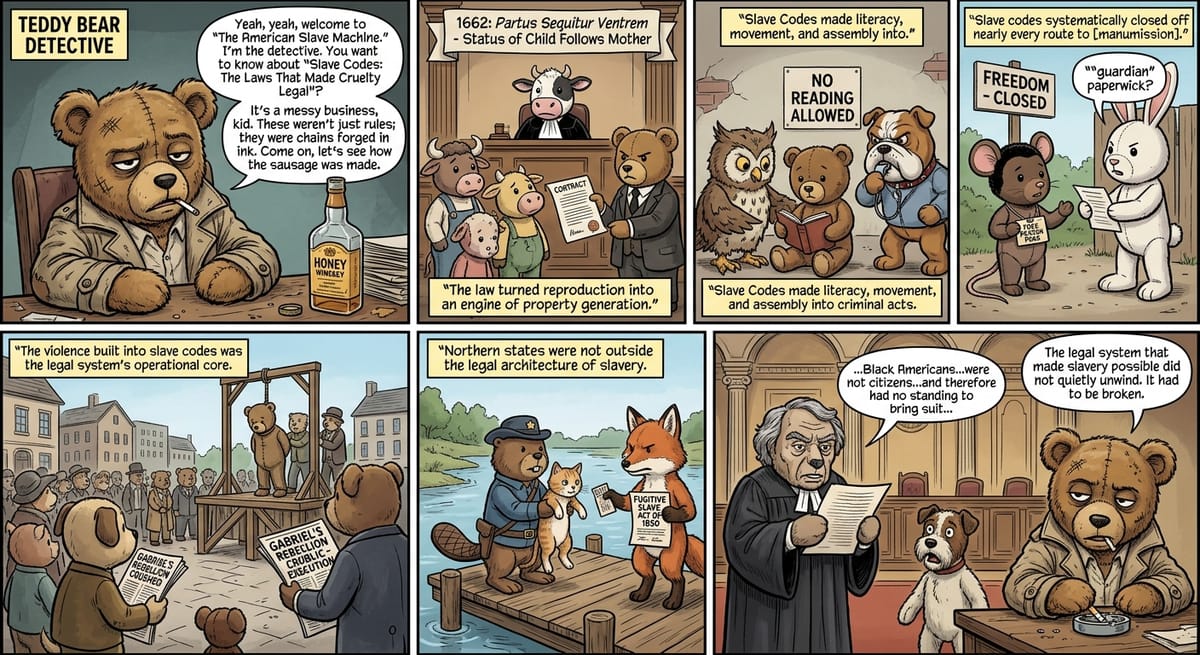
By the 1660s, the colony had decided. A 1662 Virginia law established that the status of a child followed the status of the mother — partus sequitur ventrem in the legal language borrowed from livestock breeding.^1^ This single provision had enormous consequences: it meant that any child born to an enslaved woman was enslaved regardless of the father’s status, it allowed slaveholders who fathered children with enslaved women to enslave their own offspring, and it severed the European common-law assumption that children inherited the father’s legal standing. The law turned reproduction into an engine of property generation. The domestic slave trade that later separated families at auction was built on this foundation — children as commodity began here.
Slave Codes Made Literacy, Movement, and Assembly Into Criminal Acts
Slave codes varied by colony and then by state, but they shared a core set of prohibitions aimed at preventing any condition that could lead to freedom, organization, or resistance. In South Carolina, the Slave Code of 1740 — enacted in direct response to the Stono Rebellion of 1739, in which approximately 60 to 100 enslaved people marched toward Spanish Florida — made it illegal for enslaved people to assemble in groups of more than seven without a white person present.^2^ It prohibited enslaved people from growing their own food for sale, owning boats, or earning money independently.
Across nearly every Southern state by the 1800s, codes prohibited:
- Teaching enslaved people to read or write. In North Carolina after 1830, teaching a enslaved person to read was a criminal offense punishable by fines and imprisonment — for the teacher.
- Enslaved people testifying in court against white persons.
- Enslaved people owning property, entering contracts, or marrying legally.
- Travel without written passes from the enslaver.
- Gathering for religious worship without white supervision.
The pass system was particularly pervasive. In practice, enslaved people throughout the South could be stopped by any white person on the road and required to produce written authorization for their movement. Patrols — organized groups of white men, sometimes paid by county governments — rode roads and broke up unauthorized gatherings. South Carolina’s slave patrol, formalized in 1704, is often cited by historians as one of the earliest organized law enforcement bodies in American history.^3^
Manumission Laws Ensured That Freedom Remained Almost Unreachable
Manumission — the legal freeing of an enslaved person — was theoretically possible throughout the antebellum period, but slave codes systematically closed off nearly every route to it. Virginia required freed people to leave the state within twelve months of manumission by the 1820s, effectively separating them from any family still enslaved. Mississippi made private manumission illegal outright in 1857. Louisiana required legislative approval for each individual act of freeing.
Even free Black people in the South existed in legal precarity. Free Black residents of South Carolina were required to have a white “guardian” who could vouch for their character. In Maryland, free Black men could be re-enslaved if convicted of certain offenses. The codes maintained a two-tier system in which freedom for Black Americans was conditional, revocable, and subject to white approval at every level.
The Violence Built Into Slave Codes Was the Legal System’s Operational Core
The slave codes did not merely permit violence — they required it as an enforcement mechanism. Patrols that failed to discipline people found off-plantation without passes could themselves be fined. Slaveholders who were perceived as too lenient were sometimes pressured by neighbors or local authorities. The violence was not incidental to the legal system. It was the legal system’s operational core.
The most extreme punishments were public by design. Executions of enslaved people convicted of crimes — usually defined as any act of resistance against white authority — were conducted publicly in Southern towns and advertised in local newspapers. The body of Gabriel Prosser, who organized a rebellion in Richmond, Virginia in 1800, was publicly executed along with 25 co-conspirators after the plot was betrayed before it could begin.^4^ The executions were meant to communicate to every enslaved person within hearing distance what organized resistance cost.
Northern States Were Not Outside the Legal Architecture of Slavery
The legal architecture of slavery didn’t stop at the Mason-Dixon line. Northern states had their own complicated histories with slavery — New York didn’t fully abolish it until 1827 — and even after abolition, Northern courts were regularly asked to adjudicate cases involving escaped enslaved people and the property claims of Southern slaveholders. The Fugitive Slave Act of 1793, updated and dramatically strengthened in 1850, created a federal legal obligation to return escaped enslaved people to their enslavers. That obligation extended to free states, free citizens, and federal officials who had no personal stake in slavery at all. The full story of how the North was conscripted into slavery’s enforcement apparatus is in The Fugitive Slave Act.
Dred Scott v. Sandford, decided by the U.S. Supreme Court on March 6, 1857, was the culmination of the legal architecture that slave codes had built over two centuries. Chief Justice Roger Taney’s majority opinion held that Black Americans — enslaved or free — were not citizens of the United States and therefore had no standing to bring suit in federal court. The Constitution, Taney argued, had never contemplated including people of African descent within its protections.^5^ The decision was intended to settle the question of slavery’s expansion permanently. Instead it fractured the Democratic Party, energized the Republican Party, and moved the country four years closer to a war that killed approximately 620,000 people. The legal system that made slavery possible did not quietly unwind. It had to be broken.
─────────
Sources:
- Hening, William Waller, ed. The Statutes at Large: Being a Collection of All the Laws of Virginia. Samuel Pleasants, 1809–1823.
- Wood, Peter H. Black Majority: Negroes in Colonial South Carolina from 1670 through the Stono Rebellion. Knopf, 1974.
- Hadden, Sally E. Slave Patrols: Law and Violence in Virginia and the Carolinas. Harvard University Press, 2001.
- Egerton, Douglas R. Gabriel’s Rebellion: The Virginia Slave Conspiracies of 1800 and 1802. University of North Carolina Press, 1993.
- Fehrenbacher, Don E. The Dred Scott Case: Its Significance in American Law and Politics. Oxford University Press, 1978.