The American Slave Machine: How It Worked
American slavery was a designed system — built by law, financed by banks, and defended by federal troops. Five articles explain the five mechanisms that kept it running for 246 years.

The American Slave Machine: How It Worked
American slavery was not a moral failing that eventually corrected itself. It was an engineered system — built deliberately over two centuries, maintained by law, financed by banks, insured by underwriters, and defended by the federal government up to and including the deployment of soldiers to return one man to bondage at a cost of $100,000. It worked because every part of it was designed to work.
Five Mechanisms That Kept the Machine Running
The articles in this series cover different corners of the same machine: the Atlantic trade that supplied it, the plantation system that ran it, the slave codes that legalized it, the domestic auction markets that sustained it, and the Fugitive Slave Act that nationalized it. What emerges across all five is a single consistent pattern — not of random cruelty, but of coordinated design.
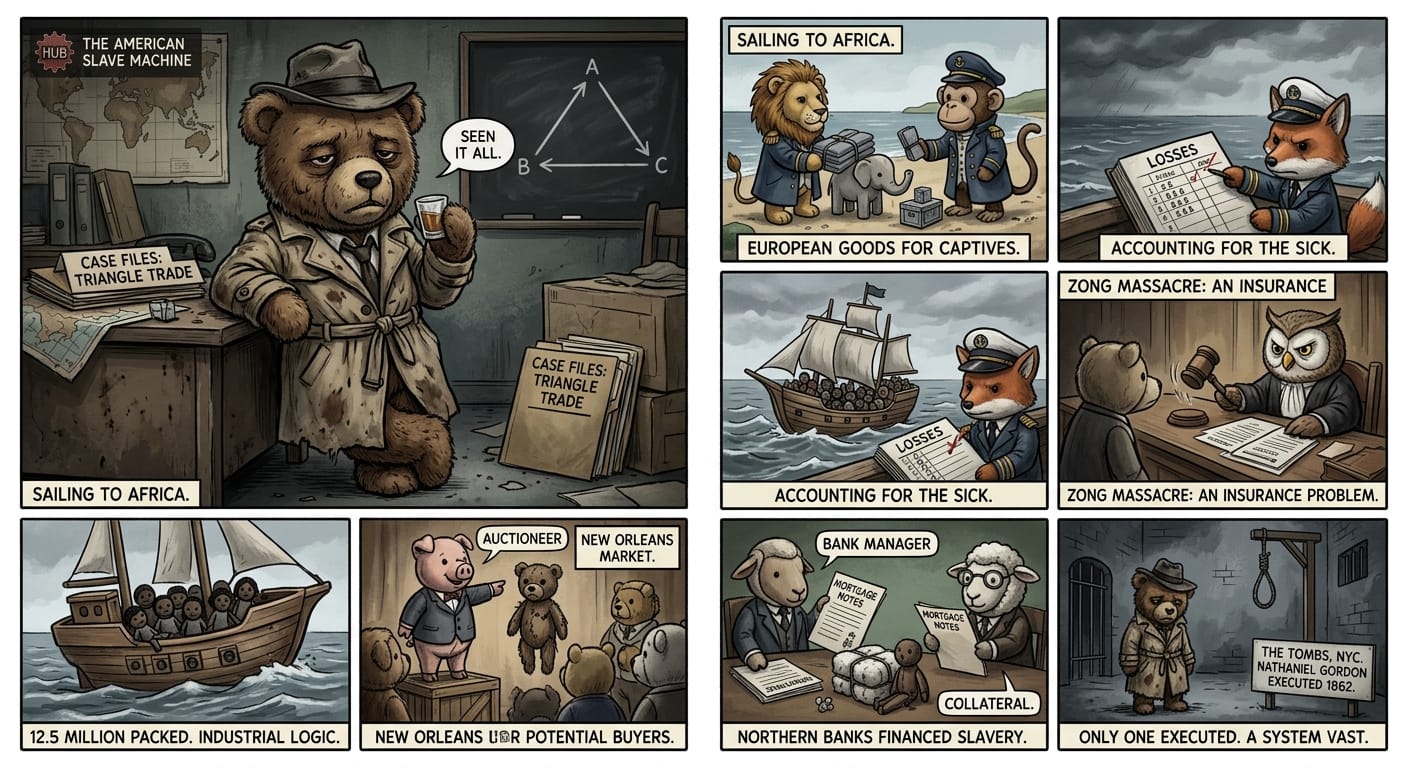
The Atlantic slave trade was not pirates and opportunism. It was a capitalist supply chain with shipping schedules, insurance policies, and investor returns. Newport, Rhode Island merchants sponsored at least 934 slaving voyages. New York banks financed cotton crops grown by enslaved labor. The trade had ledgers. It had actuarial tables that calculated the acceptable death rate of people on the Middle Passage against the profit margins of delivering survivors to market.
The plantation system was not disorganized brutality. It was an agricultural management system studied in journals, compared across neighboring properties, and optimized for output. The driver’s whip was a productivity tool. The gang system was a labor efficiency model. Planters tracked pounds of cotton per worker per day the way modern logistics firms track delivery times.
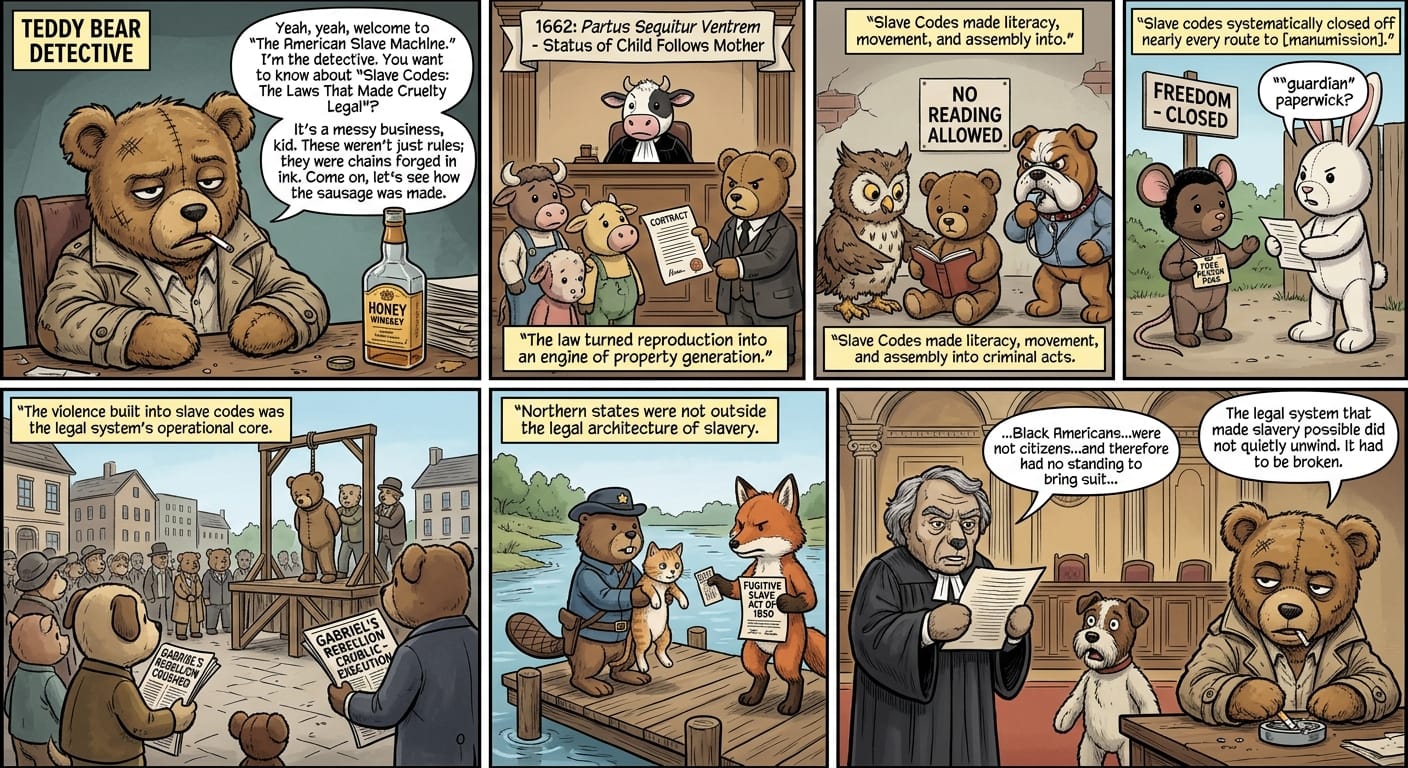
The slave codes were not improvised fear. They were a legal architecture built statute by statute over 200 years, beginning with Virginia’s 1662 law establishing that children inherited the status of their enslaved mothers. That single provision converted reproduction into property generation. Every subsequent restriction — on literacy, on movement, on testimony, on assembly — extended the same logic: close every exit, foreclose every alternative, leave no legal ambiguity that might create a path toward freedom.
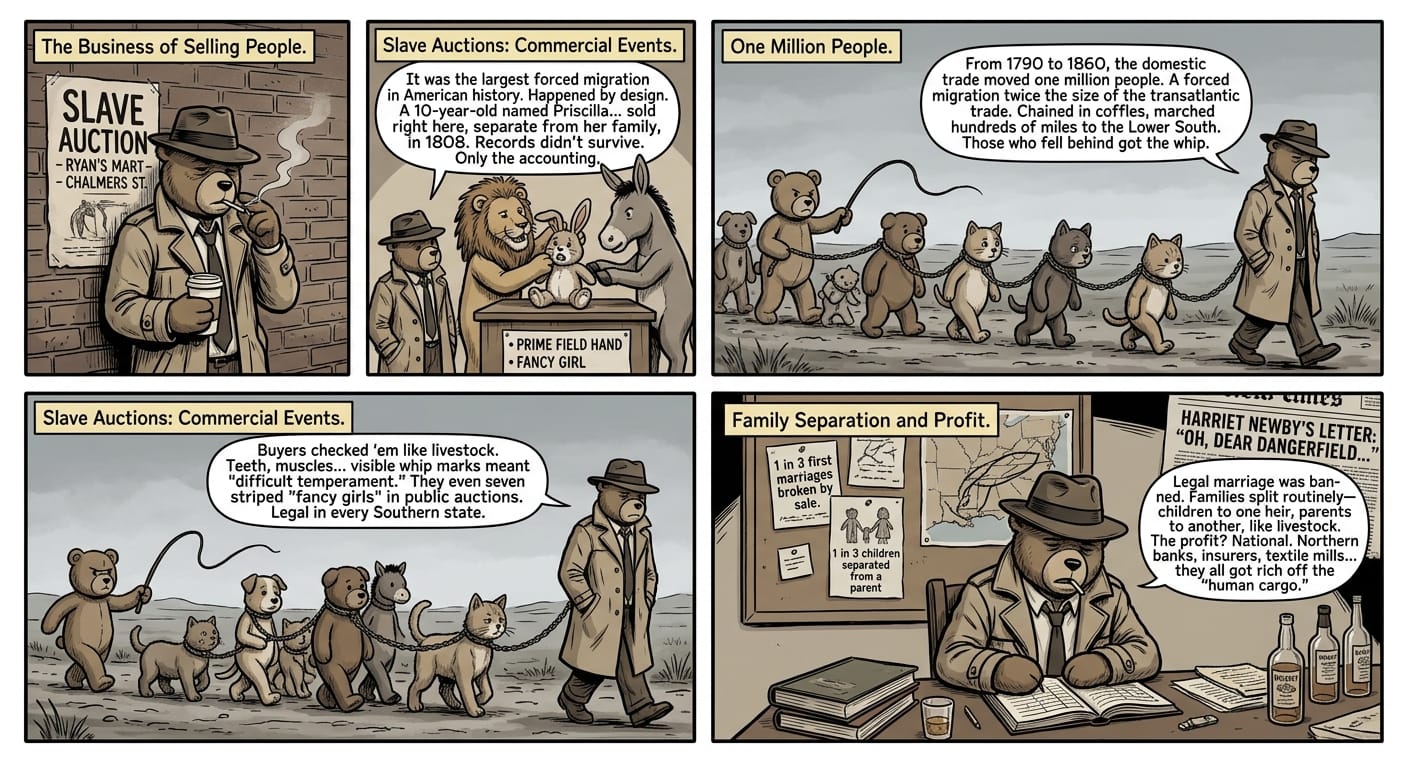
The domestic auction markets were not a Southern problem. They were a national financial system. Northern banks wrote the mortgage notes on enslaved people used as collateral. Northern insurance companies issued policies on human cargo shipped along the American coastline. The auction block in New Orleans’ St. Louis Hotel rotunda stood beneath a dome, in a hotel full of guests, advertised in local newspapers. The trade operated in broad daylight because the institutions that made it profitable had no incentive to look away.
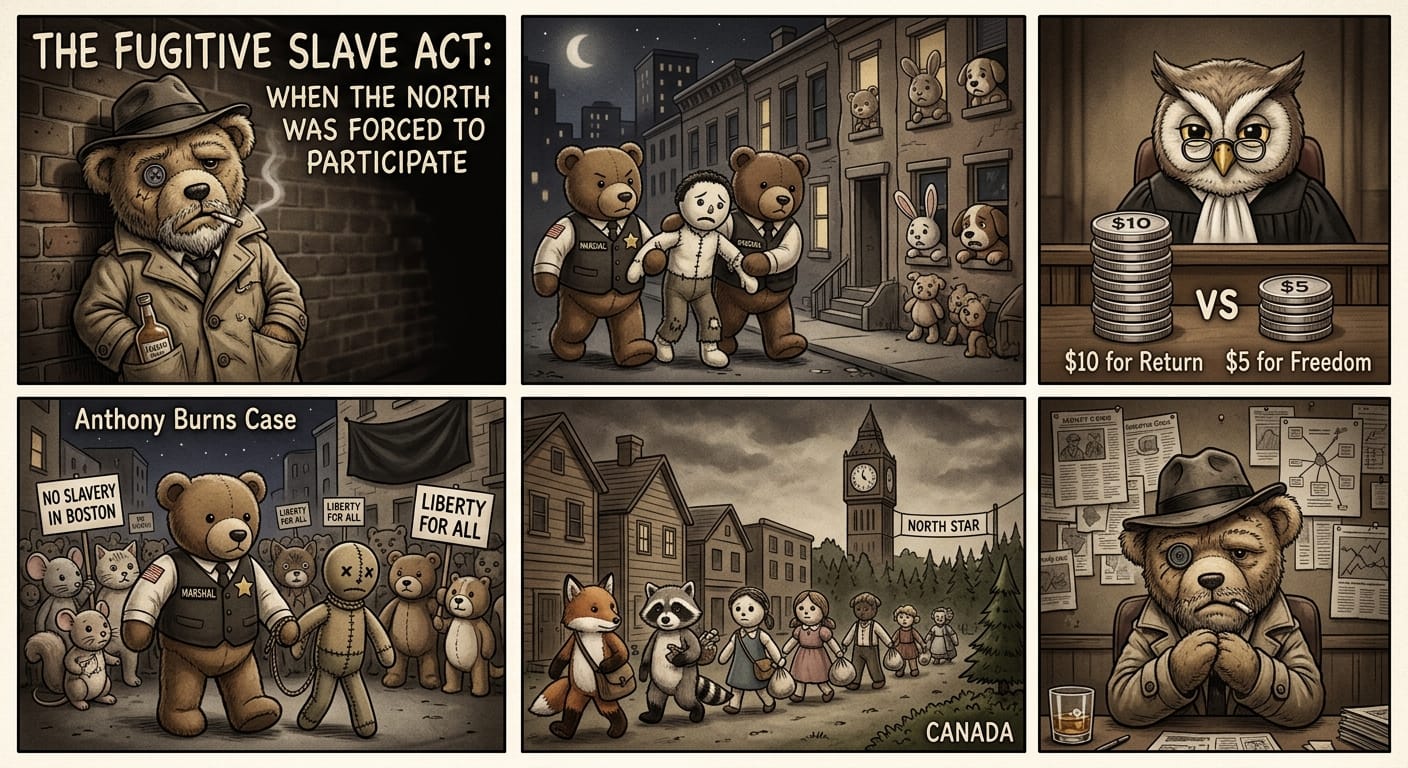
The Fugitive Slave Act of 1850 was not an overreach. It was the machine demanding that the rest of the country serve it. When Northern states passed personal liberty laws to prevent their courts and officials from participating in the return of escaped people, the South extracted a federal statute that conscripted every American citizen — on pain of fine — into the enforcement apparatus of slavery. The Act made complicity mandatory.
Why the Machine Required Dismantling, Not Just Moral Reform
The machine was not maintained by hatred alone, though hatred was present. It was maintained by interest. Slaveholders had financial interests — enormous ones. Banks had financial interests. Shipping companies had financial interests. Politicians in both parties had political interests in preserving the economic arrangements that funded their constituents. The legal architecture existed to protect those interests. The violence existed to enforce the architecture.
This is the thing the “moral failing” framing obscures: moral failings can be corrected by moral awakening. Machines require dismantling. The Civil War did not end because the South had a moral awakening. It ended because the Union Army destroyed the plantation system’s physical infrastructure and the Thirteenth Amendment made the legal architecture unconstitutional. Even then, the economic relationships survived — sharecropping, convict leasing, debt peonage — because the underlying logic of extracting cheap Black labor for white profit was never fully addressed.
In This Series
- The Atlantic Slave Trade — How the trade was structured, who profited, and how American ports connected to a global supply chain in human beings.
- Life on the Plantation — What daily life inside the plantation system actually looked like for the people who built it.
- Slave Codes — How Southern legislatures constructed a legal system designed to make freedom impossible.
- Auction Blocks and Broken Families — The domestic slave trade that separated approximately one million families after 1808.
- The Fugitive Slave Act — How the federal government forced Northern states and citizens to participate in the enforcement of slavery.
American slavery ended on December 6, 1865, with the ratification of the Thirteenth Amendment. The machine had been running for 246 years. The infrastructure it built — in wealth, in law, in political power, in the physical geography of American cities and counties — did not disappear on that date. The machine stopped. The landscape it had shaped remained. Understanding what the machine was and how it worked is not the same as resolving what it left behind. That’s a different conversation, and a longer one.
─────────
Sources:
- Baptist, Edward E. The Half Has Never Been Told: Slavery and the Making of American Capitalism. Basic Books, 2014.
- Blackmon, Douglas A. Slavery by Another Name: The Re-Enslavement of Black Americans from the Civil War to World War II. Doubleday, 2008.
- Berlin, Ira. Many Thousands Gone: The First Two Centuries of Slavery in North America. Harvard University Press, 1998.
The Series