The Fugitive Slave Act: When the North Was Forced to Participate
The 1850 Fugitive Slave Act conscripted every American citizen into slavery's enforcement — federal marshals returned Anthony Burns to bondage at a cost of $100,000 to taxpayers.
Part of The American Slave Machine — ← Back to series hub
The Fugitive Slave Act: When the North Was Forced to Participate
The Fugitive Slave Act of 1850 turned slavery from a Southern institution into a national enforcement obligation — and the North had no legal way to refuse. On October 1, 1850, less than two weeks after President Millard Fillmore signed the Fugitive Slave Act into law, federal marshals in Boston arrested a man named James Hamlet and shipped him to Maryland within 24 hours. No trial. No jury. Hamlet had escaped slavery and built a life in New York City. Under the new law, his enslaver filed an affidavit, a federal commissioner ruled in the enslaver’s favor, and Hamlet was on a train south before anyone could organize a legal challenge. The Black community of New York raised $800 to purchase his freedom, and Hamlet returned to New York six weeks later — but what had happened to him shook free Black communities across the North.^1^
The Fugitive Slave Act of 1850 did not create a new injustice out of nothing. It accelerated and nationalized one that had existed since the Constitution.
The 1793 Law Already Required the North to Return Escaped People — the South Wanted Stronger Teeth
The original Fugitive Slave Act of 1793 required Northern states to return escaped enslaved people to Southern claimants, consistent with Article IV, Section 2 of the Constitution, which stated that persons “held to Service or Labour” who escaped to other states must be “delivered up on Claim of the Party to whom such Service or Labour may be due.” The clause was not an accident — it was a deliberate concession to Southern states during the Constitutional Convention of 1787, without which several Southern delegations threatened to walk.
For decades, however, Northern states resisted enforcement. Personal liberty laws, passed by nine Northern states between 1820 and 1850, forbade state officials from participating in the capture of alleged runaways and extended due process protections to Black people claimed as property.^2^ The Supreme Court struck down those laws in Prigg v. Pennsylvania (1842), ruling that enforcement of the 1793 Act was a federal responsibility — but the practical effect was that without state cooperation, enforcement was nearly impossible.
The 1850 Act fixed that. It was the Southern bloc’s price for agreeing to admit California as a free state.
The 1850 Law Was Designed to Eliminate Every Procedural Protection for the Accused
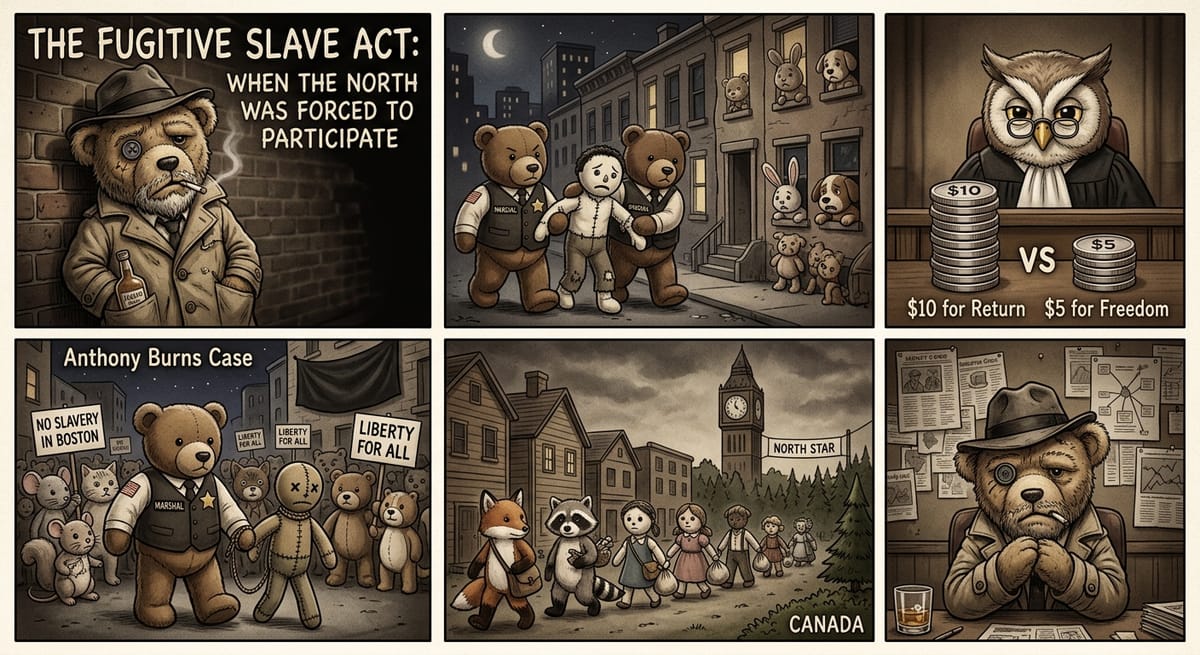
The Fugitive Slave Act of 1850, part of the Compromise of 1850 brokered by Kentucky Senator Henry Clay, was deliberately designed to eliminate every procedural obstacle that had slowed enforcement in Northern states. Federal commissioners — not judges — had authority to rule on fugitive slave cases. A commissioner received $10 for ruling in the claimant’s favor and $5 for ruling against. This payment disparity was written into the law. The alleged runaway had no right to testify on their own behalf. An affidavit from the claimant was sufficient evidence. Federal marshals who failed to enforce the law could be fined $1,000 — roughly $38,000 today. Any citizen could be conscripted to assist in the capture of an alleged runaway, under penalty of fine.
Free Black people in Northern cities who had lived free for decades were immediately vulnerable. The law required only an affidavit claiming that the person being seized was an escaped slave. No proof of prior enslavement. No requirement that the affidavit be accurate. Kidnappers quickly learned they could file affidavits on any free Black person, collect the $10 ruling, and sell the victim south before an appeal could be mounted. The slave codes had always made freedom precarious in the South; the 1850 Act made it precarious everywhere.
The Anthony Burns Case Cost the Federal Government $100,000 to Return One Man to Slavery
The arrest of Anthony Burns in Boston on May 24, 1854 became the most expensive and politically damaging enforcement of the Act. Burns had escaped slavery in Virginia in February 1854 and was working in a Boston clothing store when he was arrested. His case galvanized abolitionist resistance. A group led by Thomas Wentworth Higginson stormed the courthouse on May 26, attempting to free Burns by force. A federal marshal named James Batchelder was killed in the attempt.^3^
President Franklin Pierce ordered a full federal military escort to guarantee Burns’s return to Virginia. On June 2, 1854, approximately 1,000 soldiers and marshals marched Anthony Burns through the streets of Boston to a waiting ship, while an estimated 50,000 people lined the route in protest. Buildings were draped in black. A coffin was hung from a window above State Street. The total cost to the federal government of returning one man to slavery: approximately $100,000 — more than $3.6 million today.
Abolitionist and Massachusetts Senator Charles Sumner calculated in a Senate speech that Burns’s return had cost $40 for every step he took from the courthouse to the wharf.
Northern States Passed New Defiance Laws — and the South Cited Them as Grounds for Secession
The Burns case accelerated a political backlash across the North. Several Northern states passed new personal liberty laws after 1850 in direct defiance of the federal Act — Connecticut in 1854, Rhode Island in 1854, Massachusetts in 1855, Michigan in 1855. These laws prohibited state courts, jails, and officers from participating in fugitive slave enforcement and required jury trials for any Black person claimed as a runaway in state courts.^4^
These laws were largely unenforceable against federal action, but they were politically significant: Northern state governments were openly declaring that they would not cooperate with a federal law they considered unjust. Southern politicians seized on this as evidence that the North could not be trusted to honor the constitutional compact on slavery. By 1860, several Deep South states cited Northern noncompliance with the Fugitive Slave Act as a specific grievance in their declarations of secession.
What Did the Fugitive Slave Act Do to Free Black Communities in the North?
The 1850 Act triggered a mass exodus of free Black Americans from Northern cities. An estimated 3,000 Black residents of Pittsburgh, Pennsylvania left for Canada within months of the law’s passage. In Chicago, nearly all of the city’s Black community met in October 1850 and passed resolutions declaring they would resist enforcement by any means necessary. In Buffalo, New York, a vigilance committee of free Black men organized to monitor the movements of known slave catchers and warn community members of impending arrests.^5^
Frederick Douglass, writing in his newspaper The North Star in September 1850, advised free Black people in Northern cities to arm themselves. “The only way to make the Fugitive Slave Law a dead letter is to make a few dead slave catchers,” he wrote. Douglass had himself escaped slavery in Maryland in 1838 and understood that his own freedom, even as a celebrated public figure, could be legally challenged under the new Act. The Underground Railroad expanded rapidly after 1850 precisely because staying in the United States had become more dangerous — Canada, not the free North, was the only real safety.
The Fugitive Slave Act of 1850 remained federal law until June 28, 1864, when Congress repealed it — four years into the Civil War, a year before the war ended. By the time of its repeal, the practical question of returning escaped enslaved people had been settled by military reality: hundreds of thousands of enslaved people had already escaped to Union lines, where they were declared “contraband of war” and put to work supporting the Union Army. The legal machinery designed to drag people back south was still on the books when the people it targeted were already free in all but name. It took an act of Congress to take the law off the books. It took a war to make the law irrelevant.
─────────
Sources:
- Campbell, Stanley W. The Slave Catchers: Enforcement of the Fugitive Slave Law, 1850–1860. University of North Carolina Press, 1968.
- Morris, Thomas D. Free Men All: The Personal Liberty Laws of the North, 1780–1861. Johns Hopkins University Press, 1974.
- Stevens, Charles Emery. Anthony Burns: A History. John P. Jewett and Company, 1856.
- Finkelman, Paul. An Imperfect Union: Slavery, Federalism, and Comity. University of North Carolina Press, 1981.
- Bordewich, Fergus M. Bound for Canaan: The Epic Story of the Underground Railroad. Amistad Press, 2005.