The Stono Rebellion: South Carolina's Bloodiest Slave Revolt
The Stono Rebellion of 1739 was the deadliest slave revolt in colonial American history — 20 Angolan men marched toward Spanish Florida and reshaped South Carolina law.
The Stono Rebellion: South Carolina’s Bloodiest Slave Revolt
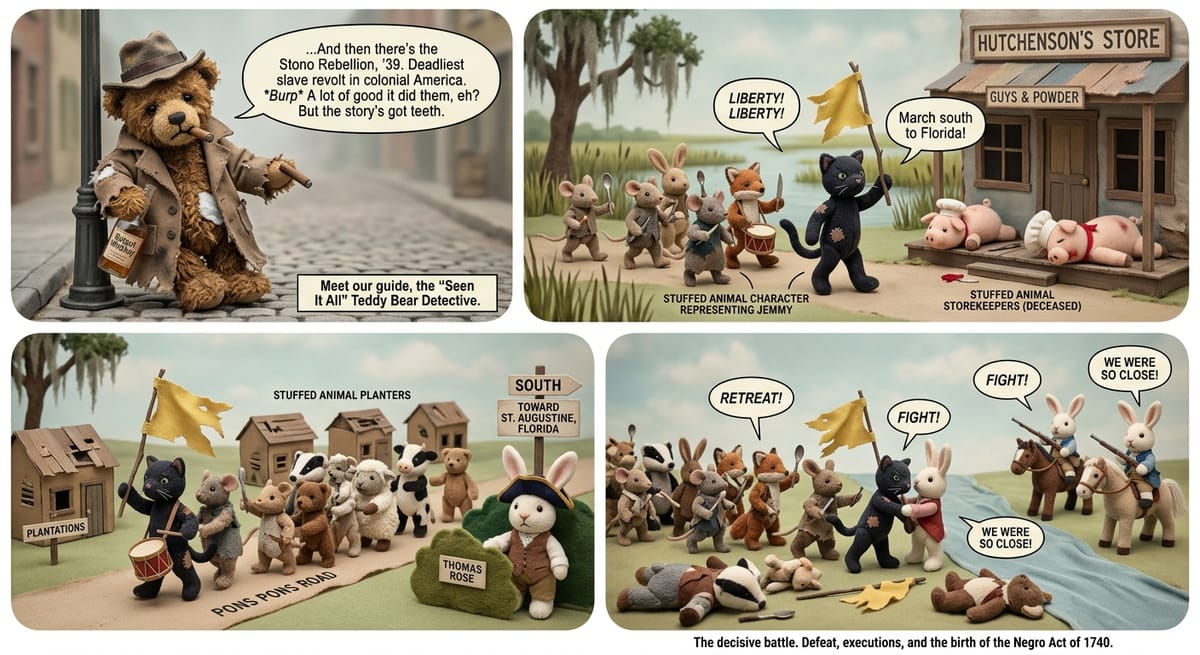
The Stono Rebellion of 1739 was the deadliest slave revolt in American colonial history. On the morning of Sunday, September 9, a man named Jemmy led about 20 enslaved Angolans to a store called Hutchenson’s near the Stono River, roughly 20 miles southwest of Charles Town, South Carolina. They broke in, seized guns and powder, beheaded the two storekeepers, and set the heads on the steps outside. Then they raised a banner, beat drums, and marched south toward Spanish Florida, shouting “Liberty” as they walked. Before it ended, the rebellion forced Britain’s most profitable American colony to confront something it had been carefully not thinking about: that it was sitting on a powder keg.
Part of Fighting Back: Slave Resistance in America — ← Back to series hub
Why That Sunday Morning Was Not an Accident
Jemmy — also recorded as “Cato Jemmy” in some colonial documents — was almost certainly from the Kongolese kingdom of Angola, one of thousands of enslaved Africans brought to South Carolina in the 1720s and 1730s as rice cultivation exploded along the coastal lowcountry.^1^ South Carolina’s enslaved population outnumbered its white population by 1708, and by 1739 the ratio had grown to roughly 2 to 1. The colony’s planters knew this was dangerous. They passed a series of increasingly restrictive slave codes throughout the early 1700s, but enforcement was uneven and the demand for labor kept driving imports.
The timing was not random. In 1739, Britain and Spain were on the verge of the War of Jenkins’ Ear, and Spain had issued an edict promising freedom to any enslaved person from British colonies who reached St. Augustine in Spanish Florida. Word traveled. The choice of Sunday morning was also deliberate — most white colonists would be at church, weapons locked away, patrols at minimum.^2^
How the Rebellion Moved 10 Miles Down the Stono River Road
From Hutchenson’s store, Jemmy’s group moved south along the Pons Pons Road, recruiting enslaved men from plantations as they went. Not everyone joined willingly — some were pressed in. The group grew to somewhere between 60 and 100 people by midday, moving with drums and a banner.
The column attacked at least seven plantations along the road. Among the households destroyed was the home of planter Thomas Rose, though Rose himself hid and escaped. In one documented instance, the rebels passed over an innkeeper named Wallace who was reported to be “a good man” — a detail suggesting the violence was targeted, not indiscriminate.^3^
By early afternoon, Lieutenant Governor William Bull encountered the column while riding with four other men. He escaped and raised the alarm. Within hours, armed planters on horseback intercepted the group at the Edisto River. The battle lasted less than an hour. The main group was defeated, though some escaped into the woods and continued to be hunted for the next several weeks. At least 21 white colonists were killed. The official count of enslaved people killed in battle and subsequent executions was approximately 44, though historians believe the actual number was higher.
The Negro Act of 1740 Turned Fear Into Law
South Carolina’s response to Stono was systematic and lasted years. In the immediate aftermath, captured rebels were executed — some beheaded, their heads placed on stakes along the road as the Kongolese fighters had done to the storekeepers. The terror was intentional and bidirectional.
The colonial assembly passed the Negro Act of 1740, one of the most comprehensive slave codes in American history. It prohibited enslaved people from assembling in groups, learning to read and write, earning their own money, or growing their own food. It created a formal system of slave patrols — some historians argue this was the first formalized police force in American history — and required a specific ratio of white overseers to enslaved workers on every plantation. It remained South Carolina’s foundational slave law until the Civil War.^4^
The assembly also reduced slave imports sharply for the next decade. They were not moved by conscience — they were moved by fear. The Stono rebels had used European military training (many Kongolese men had served in European-style armies in Africa) and moved with a coordination that colonial militia had not expected. The colony needed time to reinforce its control structures before it could safely import more people.
What Stono Revealed About the Logic of the Lowcountry System
Stono exposed a contradiction that South Carolina planters had been managing through denial: you cannot build an economy on the labor of people you are actively terrorizing and expect those people not to fight back. The lowcountry rice economy required enormous concentrations of enslaved people — the crop was physically brutal and the mortality rate was high, meaning planters constantly needed to import more workers. The more workers they imported, the more outnumbered they became. The more outnumbered they became, the more violent the control system had to be. The more violent the control system, the more reasons people had to rebel. This feedback loop — labor demand driving up the enslaved population, which drove up the violence needed to contain it — is the structural story that connects Stono to every subsequent uprising in the antebellum South.
Jemmy and the Kongolese men who followed him had not been dehumanized into passivity. They had watched, waited, identified a strategic moment, and acted. The Spanish freedom edict gave them a destination. The War of Jenkins’ Ear gave them a window. And a Sunday morning in September gave them a head start.
The men who marched down the Stono River Road in 1739 did not reach Florida. Most of them died within a week. The ones who escaped into the swamps were hunted down over the following months. But the reverberations of what they started in a few hours on a Sunday morning reshaped the legal framework of slavery in colonial America — and the fear they struck into the planter class never fully faded.
─────────
Sources:
- Peter H. Wood. Black Majority: Negroes in Colonial South Carolina from 1670 through the Stono Rebellion. Norton, 1974.
- John K. Thornton. “African Dimensions of the Stono Rebellion.” American Historical Review 96, no. 4 (1991): 1101–1113.
- Mark M. Smith, ed. Stono: Documenting and Interpreting a Southern Slave Revolt. University of South Carolina Press, 2005.
- Robert Olwell. Masters, Slaves, and Subjects: The Culture of Power in the South Carolina Low Country, 1740–1790. Cornell University Press, 1998.