Auction Blocks and Broken Families: The Business of Selling People
The domestic slave trade forcibly relocated one million people after 1808 — one in three marriages in the Upper South was broken by sale and the law provided no protection.
Part of The American Slave Machine — ← Back to series hub
Auction Blocks and Broken Families: The Business of Selling People
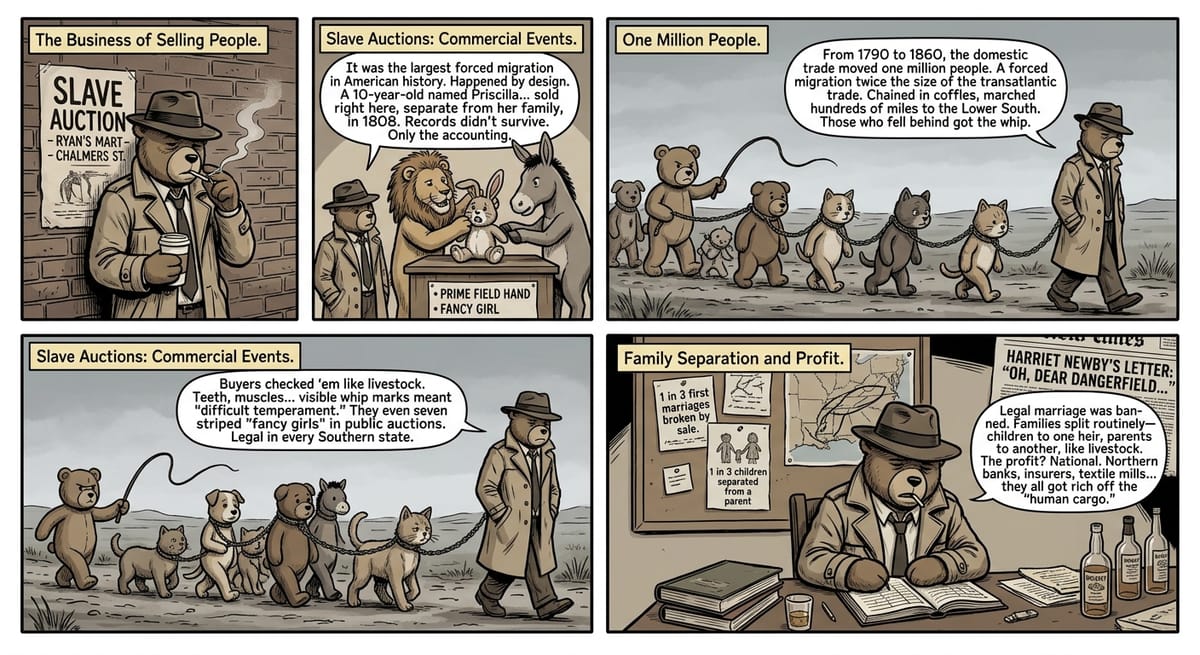
The domestic slave trade was the largest forced migration in American history — and it operated by design, not by accident. On January 11, 1808, a ten-year-old girl named Priscilla was sold at auction on the steps of Ryan’s Mart on Chalmers Street in Charleston, South Carolina. She had been brought from Africa on the Hare, a slave ship, and was sold separately from any family she may have had. A plantation owner named Elias Ball purchased her for an undisclosed price. Priscilla spent the rest of her life on the Ball family’s Comingtee Plantation in Berkeley County, South Carolina. Her descendants were still enslaved on Ball family land fifty years later.^1^
Priscilla’s name survived because a journalist named Edward Ball, a descendant of her enslaver, found her purchase record while researching his family history in the 1990s. The records of most people sold at American slave markets did not survive. What survived was the accounting.
Slave Auctions Were Commercial Events, Not Marginal Aberrations
Slave auctions were commercial events, advertised in local newspapers and scheduled around agricultural seasons — when plantation owners had cash from recent harvests and need for labor before planting. The largest markets operated out of dedicated buildings or city squares in Richmond, Virginia; Natchez, Mississippi; and New Orleans, Louisiana. New Orleans’ St. Louis Hotel held auctions in its main rotunda, beneath a domed ceiling, while hotel guests dined in adjacent rooms.^2^
Buyers examined enslaved people the way they examined livestock — checking teeth, feeling muscles, forcing people to walk or run to demonstrate physical fitness. Women were stripped and examined for signs of pregnancy or disease. Men were made to strip to demonstrate the absence of scarring from previous whippings, since visible whip marks were read as evidence of a “difficult” temperament that would lower the sale price. Enslaved people who could be shown to have no prior disciplinary record — meaning, who had not visibly resisted — commanded higher prices.
Auctioneers used the language of commerce without euphemism. Enslaved people were described in sales documents as “prime field hands,” “fancy girls,” or “likely young Negroes.” A “fancy girl” was the market’s term for a young enslaved woman or girl being sold explicitly for sexual exploitation. These sales occurred in plain sight, at public auction, and were legal in every Southern state. The slave codes that made these transactions possible prohibited enslaved people from legal marriage, which meant family bonds had no standing in any court.
The Domestic Trade Moved One Million People After the International Trade Was Banned
Between 1790 and 1860, an estimated one million enslaved people were sold through the domestic slave trade — the internal American market that operated after the 1808 ban on international imports.^3^ This was a forced migration roughly twice the size of the entire transatlantic trade to North America. It moved people from the Upper South — Virginia, Maryland, Kentucky, the Carolinas — to the expanding cotton and sugar economy of the Lower South: Alabama, Mississippi, Louisiana, Texas.
Professional slave traders operated networks of “slave coffles” — groups of enslaved people chained or roped together who were marched hundreds of miles overland to southern markets. Charles Ball, who was enslaved in Maryland and sold south in 1805, described in his 1836 narrative watching a coffle of more than 50 people pass through Columbia, South Carolina, including women with infants in arms and children too small to keep the pace.^4^ Those who fell behind were whipped forward.
The firms handling this trade were national in scope. Franklin & Armfield, headquartered in Alexandria, Virginia — then part of Washington, D.C. — was the largest slave-trading firm in the United States in the 1830s. Partners John Armfield and Isaac Franklin shipped approximately 1,000 enslaved people per year south to Natchez and New Orleans, using a fleet of ships and an overland route staffed by hired guards. Franklin retired in 1836 with a fortune worth approximately $500,000 — roughly $17 million in 2024 dollars. The Atlantic slave trade had supplied the initial population; the domestic trade extracted maximum value from it.
How Did Family Separation Actually Work, and How Often Did It Happen?
One in three first marriages among enslaved people in the Upper South was broken by sale, according to research by historian Steven Deyle.^5^ One in three children born to enslaved parents in the Upper South was sold away from at least one parent before reaching adulthood. These are estimates drawn from surviving records; the actual numbers were almost certainly higher because many sales were not formally recorded.
The law provided no protection. Legal marriage between enslaved people was prohibited in every Southern state, which meant that family relationships had no standing in courts, in contracts, or in the transfer of property. When an enslaver died and his estate was divided among heirs, enslaved families were routinely split in the settlement — children to one heir, parents to another, siblings across three counties. Probate court records from Virginia and South Carolina through the antebellum period contain thousands of such distributions, noted in the same ledger columns as furniture and livestock.
Harriet Newby carried a letter from his enslaved wife, Harriet, when he joined John Brown’s raid on Harpers Ferry, Virginia, in October 1859. The letter, found on his body after he was killed, read in part: “Oh, dear Dangerfield, come this fall without fail, money or no money. I want to see you so much. That is the one bright hope I have before me.” Harriet Newby had been told she was about to be sold further south. She was. After Dangerfield Newby’s death at Harpers Ferry, his wife and children were sold into the Deep South. No further record of them survives.
The Profits From Family Separation Were National, Not Regional
The domestic slave trade generated enormous wealth that was not limited to the sellers and buyers. Slave traders paid fees to auction houses, commissions to brokers, premiums to insurers, and interest to banks that financed the purchases. Insurance companies in Hartford, Connecticut and New York wrote policies on “human cargo” transported on domestic slave ships along the Atlantic coastline. Northern textile manufacturers paid cotton prices that reflected the labor costs of enslaved people — costs kept artificially low by the fact that the workers received nothing.
The trade was not invisible to Northern observers. Abolitionists published accounts of domestic slave markets from the 1820s onward. The American Anti-Slavery Society, founded in Philadelphia in 1833, circulated pamphlets describing auction practices in detail. The response from proslavery politicians was not to dispute the facts but to argue that the economic necessity of the trade justified it.
The Thirteenth Amendment abolished slavery on December 6, 1865. It did not restore a single separated family. By 1865, more than 200,000 formerly enslaved people had already been sold so many times, across so many state lines, that they had no way to locate spouses or children. The Freedmen’s Bureau, established in March 1865, received tens of thousands of requests from formerly enslaved people searching for family members lost in the trade. The Bureau had almost no capacity to help. Some families were never located. Some searched for decades. The separation that began on the auction block did not end when the block was taken down.
─────────
Sources:
- Ball, Edward. Slaves in the Family. Farrar, Straus and Giroux, 1998.
- Johnson, Walter. Soul by Soul: Life Inside the Antebellum Slave Market. Harvard University Press, 1999.
- Deyle, Steven. Carry Me Back: The Domestic Slave Trade in American Life. Oxford University Press, 2005.
- Ball, Charles. Slavery in the United States: A Narrative of the Life and Adventures of Charles Ball. John S. Taylor, 1836.
- Gutman, Herbert G. The Black Family in Slavery and Freedom, 1750–1925. Pantheon Books, 1976.