School Shootings: What the Data Actually Shows
School shootings have tripled in frequency since 2011. The data on definitions, trends, shooter profiles, and what $5 billion in school security actually accomplished.
School Shootings: What the Data Actually Shows
School shootings exist in two parallel conversations — the one driven by catastrophic events like Columbine and Sandy Hook, and the one driven by data that looks different than most people expect. The two conversations talk past each other constantly, and the result is a policy debate that often isn’t about what’s actually happening.
Here’s what the data shows.
Part of School Shootings — ← Back to series hub
How You Define School Shooting Determines Everything
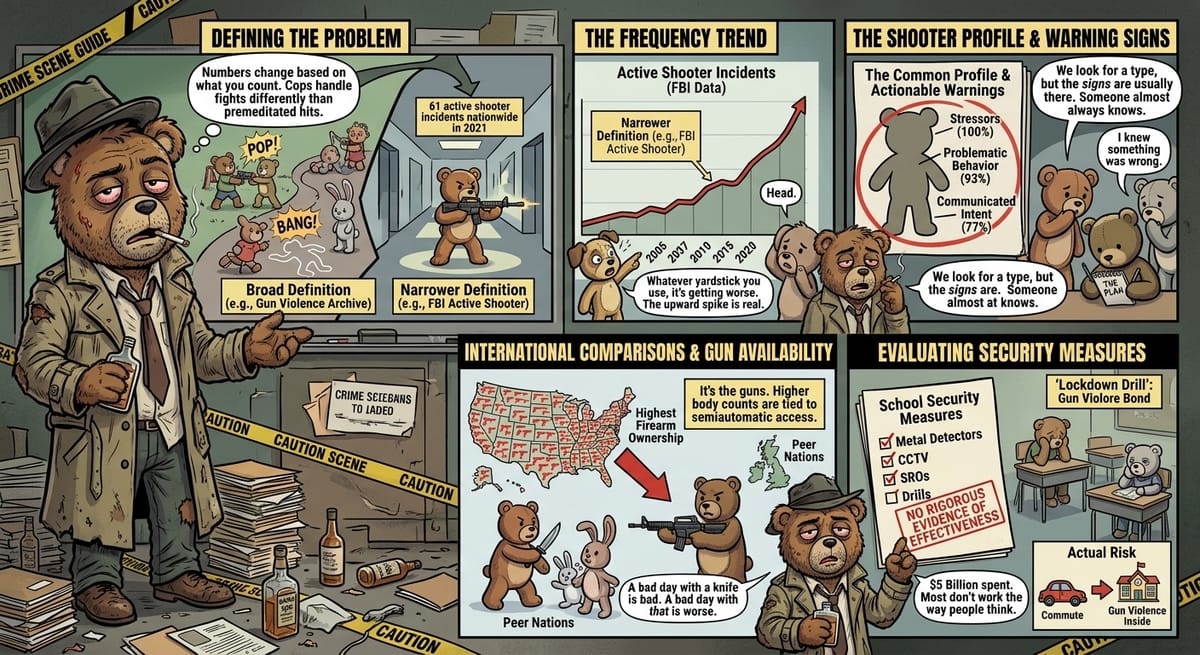
There is no single agreed-upon definition of a school shooting, and the choice of definition produces dramatically different numbers. The Gun Violence Archive records any incident in which a gun is fired on school property, including fights, suicides, and accidental discharges — producing 348 school shootings in 2022. The K-12 School Shooting Database maintained by Everytown for Gun Safety uses a similarly broad definition and records over 100 incidents per year in most recent years.
The narrower definition used by the FBI’s active shooter program counts only incidents in which a person actively attempts to kill people in a populated area. By that measure, the FBI identified 61 active shooter incidents nationwide in 2021, with schools representing a subset. The Congressional Research Service, reviewing “mass public shootings” defined as four or more victims killed in a public place, identified 27 such events between 2009 and 2018 that occurred at schools, out of 277 total mass public shootings across all locations.
The distinction matters because the policy responses appropriate to a gang-related fight that results in a shooting on school grounds are completely different from those that might address a premeditated attack on the school itself. Conflating them produces overinflated numbers that make school shootings appear more common than mass attacks on schools are, while undercounting the genuine harm of everyday gun violence in school communities.^1^
The Frequency Trend Is Real and Getting Worse
Whatever definition is used, the trend is upward. The Mother Jones database of mass shootings — which defines the category as four or more victims killed, in a public place, by a lone shooter, excluding gang-related violence and armed robbery — found that mass shootings overall tripled in frequency between 2011 and 2019 compared to the previous three decades. Attacks on educational institutions increased within that trend.
The FBI’s data on active shooter incidents shows a sharp increase from 2000 to 2022: an average of 6.4 incidents per year from 2000–2006, rising to 16.4 per year from 2007–2013, and 20.0 per year from 2014–2019. Schools consistently represent one of the largest venue categories, second only to businesses. In 2022, educational environments accounted for 14 of the FBI’s 50 active shooter incidents — 28 percent.^2^
The Shooter Profile Is Both Consistent and Misleading
The most commonly cited profile of a school shooter — male, teenager, social outcast, bullied — is statistically common enough to describe the majority of cases but specific enough to describe tens of millions of people who never commit violence. The risk factors include suicidal ideation, previous trauma, access to firearms, documented prior threats, and a history of interpersonal conflict — but these factors together still have extremely poor predictive value for identifying specific future attackers.
The Secret Service’s National Threat Assessment Center has been the most rigorous in analyzing pre-attack behavior. Its 2019 study of 41 school attacks occurring between 2008 and 2017 found that 100 percent of attackers experienced at least one significant stressor in the year before the attack, that 93 percent had shown signs of problematic behavior noticed by others, and that 77 percent had communicated intent to others before the attack — through direct statements, social media posts, or writings shared with peers. In 93 percent of cases, at least one person other than the attacker knew about the attack in advance and said nothing, or raised concerns that were not escalated appropriately.^3^
This finding — that school shootings are rarely truly sudden, random, or invisible before they occur — is the most actionable data point in the research. The warning signs are usually present and often disclosed. The failure is institutional, not informational.
Guns Are the Constant Variable Across All International Comparisons
Researchers studying mass violence internationally have identified one consistent distinguishing factor between the United States and peer nations: the availability of firearms, particularly high-capacity semiautomatic weapons. A 2016 study by criminologist Adam Lankford found that the United States accounted for 31 percent of global mass shooters between 1966 and 2012, despite representing 4.4 percent of the global population, and that the variable most strongly correlated with this disparity was civilian firearm ownership rates.
American children are not statistically more mentally ill than children in other countries, nor are they raised in more violent media environments. The specific variable that consistently differentiates the United States from peer nations is the accessibility and lethality of the weapons involved. A would-be attacker with a knife attacks fewer people and kills fewer of those attacked than one with a semiautomatic rifle capable of firing 45 rounds per minute.^4^
This does not mean mental health, threat assessment, or school security are irrelevant — they’re not. It means the evidence that access to high-capacity firearms elevates the body count is not seriously contested in the research literature, regardless of how contested it is politically.
Did $5 Billion Worth of School Security Measures Work?
Since Columbine in 1999, American schools have spent approximately $5 billion implementing security measures including metal detectors, surveillance cameras, controlled entry systems, school resource officers (SROs), and active shooter drills. A 2019 report by the Government Accountability Office found that between 2000 and 2013, roughly 95 percent of public schools conducted lockdown drills, and 40 percent participated in active shooter drills involving law enforcement. There is no rigorous evidence that these measures reduce the frequency or lethality of school attacks.
School resource officers are present in approximately 43 percent of American public schools. The evidence for their effectiveness as a deterrent to mass violence is weak. Studies of their presence show mixed effects on school discipline and student mental health, with particularly negative documented effects on Black and Latino students who are more likely to be arrested or disciplined with law enforcement involvement. Scot Peterson, the resource officer at Parkland in 2018, did not enter the building. The first responders who ended the Uvalde, Texas shooting in May 2022 were not school resource officers but Border Patrol tactical agents — and they took 77 minutes from the first 911 call to enter the classroom.^5^
The Gap Between Fear and Actual Risk
School-aged children are statistically safer at school than almost anywhere else. A child is more likely to be killed in a car accident during the school commute than by gun violence inside a school building. The perception that American schools are uniquely dangerous environments is driven by the intensity of media coverage around high-profile attacks rather than by the actual distribution of risk in children’s lives.
Policy responses driven by fear rather than evidence tend to invest heavily in measures that make adults feel safer — drills, armed guards, hardened entries — while underinvesting in the measures that the research most consistently identifies as effective: threat assessment programs that take pre-attack warning signs seriously, mental health support, and reducing access to the weapons that convert a bad day into a mass casualty event.
The 20 children killed at Sandy Hook were 6 and 7 years old. The 17 people killed at Parkland were high school students in the last period of the school day. The pattern connecting these events is not mysterious. What’s missing is not information. It’s the political will to act on what’s known.
─────────
Sources:
- Riedman, David, and Desmond O’Neill. K-12 School Shooting Database. Center for Homeland Defense and Security, 2020.
- Federal Bureau of Investigation. Active Shooter Incidents in the United States in 2022. U.S. Department of Justice, 2023.
- United States Secret Service, National Threat Assessment Center. Targeted School Violence: Examining School Attack-Related Behaviors Prior to a School Attack. 2019.
- Lankford, Adam. “Public Mass Shooters and Firearms: A Cross-National Study of 171 Countries.” Violence and Victims, 2016.
- Government Accountability Office. School Safety: Federal Agencies Have Helped Address Violence But Could Better Assess the Effects of Efforts. 2020.