Charles Whitman and the Texas Tower: America's First Mass Shooting
On August 1, 1966, Charles Whitman killed 14 people from the UT Austin tower in 96 minutes — and a brain tumor found at autopsy changed the debate about mass violence forever.
Charles Whitman and the Texas Tower: America’s First Mass Shooting
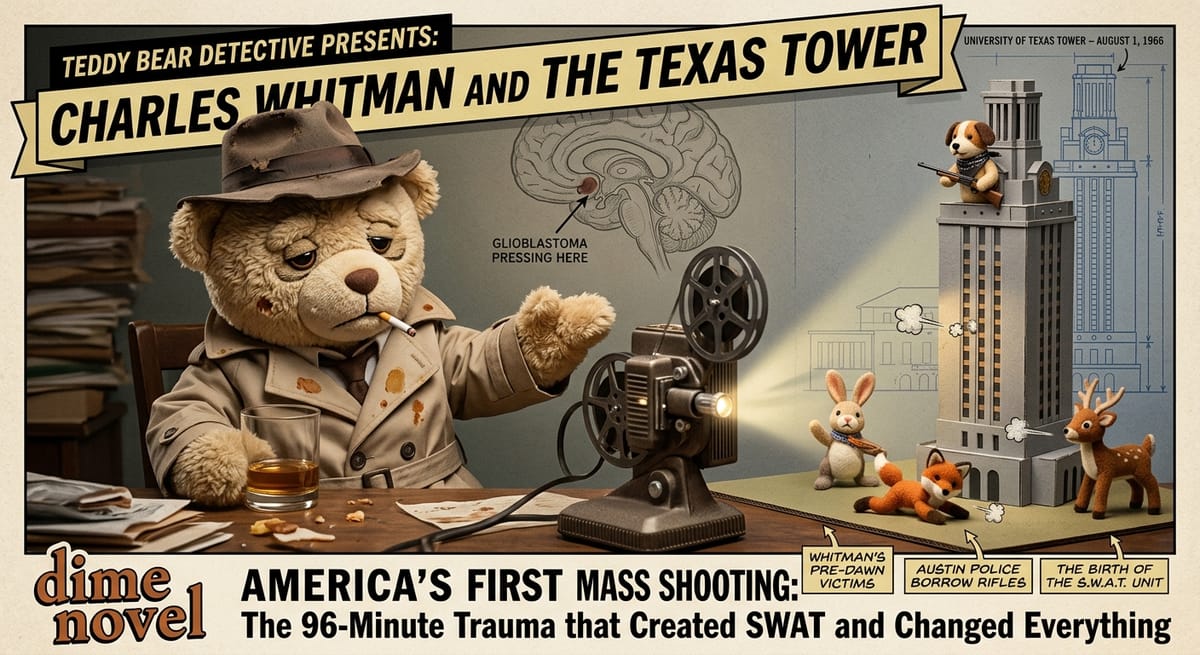
On August 1, 1966, Charles Whitman, a 25-year-old University of Texas student and former Marine, climbed to the observation deck of the 307-foot University of Texas Tower in Austin and spent 96 minutes shooting at people on the campus and surrounding streets below. He killed 14 people from the tower and wounded 31 more. A fifteenth victim died 35 years later from complications related to injuries sustained in the attack. Before reaching the tower, Whitman had also killed his wife, Kathy, and his mother, Margaret, in the hours before dawn. He was shot and killed on the observation deck by Austin police officers Ramiro Martinez and Houston McCoy.
The Texas Tower shooting is often cited as the opening event in the modern era of American mass violence — the moment when a single motivated individual with a rifle and an elevated position established a template that has been repeated, studied, and referenced ever since. It was the first major mass shooting in the United States covered live on television, the first analyzed clinically in its immediate aftermath, and the first to raise the possibility — unresolved to this day — that neurological illness might be a causal factor in mass violence.
Part of Workplace and Public Shootings — ← Back to series hub
Who Charles Whitman Was Before August 1
Whitman grew up in Lake Worth, Florida, the eldest of three sons of a plumbing contractor who, by his own son’s later journal entries, was a physically abusive man who beat his wife and children regularly. Whitman joined the Marine Corps in 1959 at age 18, qualified as a sharpshooter, and was accepted to UT Austin in 1961 under a Marine Corps scholarship program. By most measures he was a model student and a presence his neighbors and professors found charming, helpful, and energetic.
By 1966, his scholarship had been revoked due to poor grades. He was working multiple jobs, struggling academically, and writing journal entries describing violent impulses he couldn’t explain. On March 29, 1966, he visited the university’s student health center and told Dr. Maurice Heatly, a psychiatrist, that he was having violent thoughts, including “fantasies about going up on the tower with a deer rifle and shooting people.” Heatly noted the visit and saw Whitman once more, two weeks later. The file was closed.^1^
In the weeks before the attack, Whitman wrote extensively in his journal — describing his father’s abuse, his own feelings of rage and failure, and his confused attempts to understand what he was experiencing. He also wrote: “I do not really understand myself these days. I am supposed to be an average reasonable and intelligent young man. However, lately (I cannot recall when it started) I have been a victim of many unusual and irrational thoughts.”
The Brain Tumor That Changed the Debate
Whitman wrote, in the note found after his death, that he wanted an autopsy performed on his body. He suspected there was something physically wrong with him. He was right. The post-mortem examination found a glioblastoma multiforme — a highly aggressive brain tumor the size of a pecan pressing on his amygdala, the brain region associated with emotional regulation and fear response.
The discovery generated immediate medical debate about whether the tumor caused the violence. The consensus that emerged over subsequent decades is carefully hedged: brain tumors can alter personality and behavior, and tumors pressing on the amygdala in particular have been associated with increased aggression and loss of impulse control. But the connection to premeditated, organized mass violence — Whitman planned the attack carefully, assembled supplies, wrote notes — remains contested. A 2009 examination of the case by neuroscientist David Eagleman concluded that the tumor likely contributed to his state but couldn’t be said to have “caused” the attack in any deterministic sense.^2^ Whitman’s brain was preserved and has been used in medical education ever since.
96 Minutes on the Tower Deck
Whitman reached the observation deck at approximately 11:48 a.m. He had brought a footlocker containing a Remington 700 bolt-action rifle with a scope, a 35-caliber pump rifle, a 12-gauge shotgun, a .357 Magnum revolver, a 9mm Luger pistol, a .25 caliber pistol, and approximately 700 rounds of ammunition — along with food, water, a compass, binoculars, earplugs, and a radio. He killed the tower’s receptionist, Edna Townsley, with a rifle blow to the head, and killed two visitors on a stairwell. Then he began shooting from the parapet.
His first shots killed four people instantly. He wounded a pregnant woman, Claire Wilson James, 18, whose boyfriend Thomas Eckman, 18, was killed when he ran to her aid. James survived; she lay in the sun for approximately 90 minutes before rescue. Whitman’s shots struck people as far as four blocks from the tower. Austin police were not equipped or trained for anything like this — officers returned fire from ground level using hunting rifles borrowed from a nearby hardware store. A small plane with two officers forced Whitman below the parapet during the final minutes. Martinez and McCoy reached the observation deck via an interior tunnel, surprising Whitman from behind, and killed him.
What the Tower Attack Created
The Austin shooting directly produced the first SWAT team in the United States. Los Angeles Police Inspector Daryl Gates, watching the Texas coverage and recognizing that conventional patrol officers had no tactical options against an elevated shooter, began organizing a Special Weapons and Tactics unit in 1967. LAPD SWAT became operational in 1968. By 2014, an estimated 85 percent of American cities with populations over 25,000 had a SWAT team — a direct legacy of the proliferation of specialized tactical training that began in the aftermath of August 1, 1966.^3^
The shooting also produced the modern active shooter protocol — the idea that law enforcement must move toward the threat and stop the killing rather than establish a perimeter and wait for specialized units. The Columbine shooting in 1999 reinforced this protocol after officers held the perimeter for hours while shooting was ongoing inside the school. The failure at Columbine to immediately breach led to a national retraining effort across law enforcement. The failure at Uvalde in 2022 — where officers with the same training waited 77 minutes — demonstrated that establishing a protocol and executing it under pressure are different problems.
The Victims
The dead killed from the tower and in Whitman’s path: Thomas Eckman, 18; Mark Gabour, 16; Mike Gabour, approximately 40; Marguerite Lamport Gabour, approximately 55; Thomas Ashton, 22; Robert Boyer, 33; Thomas Karr, 24; Roy Dell Schmidt, 29; Harry Walchuk, 38; Billy Snowden; Paul Sonntag, 18; Karen Griffith, 17, who died July 22, 1966 from her wounds; and university math assistant professor Robert Hamilton Boyer. David Gunby, shot in the attack, died in 2001 from kidney failure related to his injuries — making him the fifteenth fatality, 35 years later.
Kathy Whitman, 23, and Margaret Whitman, approximately 50, were killed in the hours before the tower attack. Edna Townsley and the stairwell victims were killed before Whitman reached the parapet.
Claire Wilson James, who survived after being shot and lying in the sun for 90 minutes while eight months pregnant — her baby did not survive — became an activist and teacher. In 1999 she met, by chance, one of the students who had helped drag her to safety that day. They had not spoken since August 1, 1966. The tower observation deck was closed after the shooting and remained closed for 32 years, reopening in 1999 for visitors. A plaque on the campus lists the names of those killed. Whitman’s name is not on it.^4^
─────────
Sources:
- Gary M. Lavergne. A Sniper in the Tower: The Charles Whitman Murders. University of North Texas Press, 1997.
- Eagleman, David. “The Brain on Trial.” The Atlantic, July 2011.
- Balko, Radley. Rise of the Warrior Cop: The Militarization of America’s Police Forces. PublicAffairs, 2013.
- Maitland, Leslie. “Austin Sniper Victims Remember the Day.” The New York Times, August 2, 1986.
- Governor’s Committee and Consultant’s Report. Report to the Governor: Medical Aspects, Charles J. Whitman Catastrophe. State of Texas, 1966.