The Atlantic Slave Trade: How American Ports Built an Economy on Bodies
How American ports built an economy on bodies — the supply chain investors insurance policies and ledger books behind 12.5 million kidnappings.
Part of The American Slave Machine — ← Back to series hub
The Atlantic Slave Trade: How American Ports Built an Economy on Bodies
The Atlantic slave trade was not a marginal or isolated phenomenon in American history — it was the economic foundation on which the country’s early wealth was built. In the summer of 1619, a Portuguese slave ship called the São João Bautista arrived near Point Comfort, Virginia, carrying more than 350 captive Africans who had been seized from what is now Angola. An English privateer intercepted the ship and took “20 and odd” of the captives, selling them to Virginia colonists. Those were the first recorded Africans brought to English North America as bound labor. Within two centuries, that trickle had become an industry.
The Atlantic Slave Trade Was an Industrial System, Not Opportunistic Capture
Slavery existed before the Atlantic trade — in ancient Rome, in West Africa, across the Ottoman Empire — but none of those systems came close to the scale, the machinery, or the racial architecture of what the Americas built between the 1500s and the 1860s. An estimated 12.5 million Africans were forcibly shipped to the Americas over roughly 400 years, according to the Trans-Atlantic Slave Trade Database (Slave Voyages), the most comprehensive historical record of the trade.^1^ Of those, approximately 1.8 million died during the Middle Passage before they ever saw land.
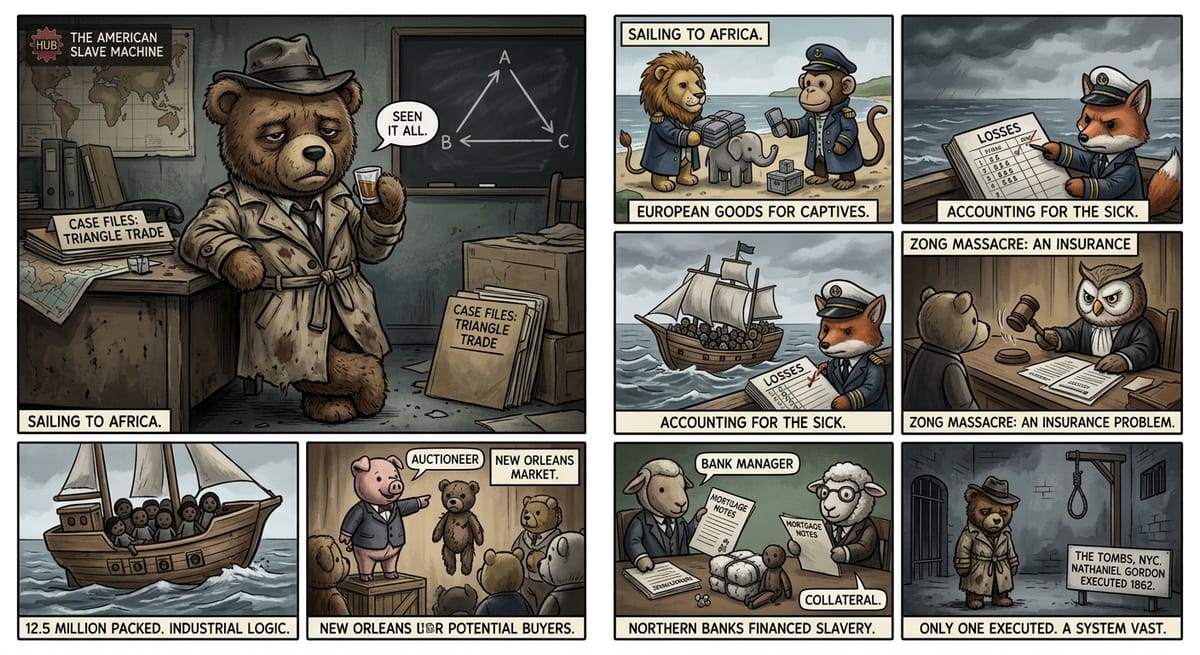
What set the Atlantic trade apart was its industrial logic. This was not opportunistic capture — it was a coordinated supply chain connecting European capital, African coastal kingdoms, American plantation owners, and port cities from Liverpool to Newport, Rhode Island. The trade had investors, insurance policies, ledger books, and shipping schedules. It ran like a business because it was one.
How the Triangle Actually Worked
The “triangular trade” is taught in history classes as a tidy diagram, but the human mechanics were brutal. Ships departed European ports — Bristol, Lisbon, Nantes — loaded with manufactured goods: textiles, iron bars, firearms, alcohol. They sailed to the coast of West Africa, where those goods were exchanged for enslaved people, often sold by African rulers and merchants who participated in and profited from the trade. The captives were then packed into ships for the Middle Passage west to the Americas, where survivors were sold at auction. The ships returned to Europe loaded with sugar, tobacco, cotton, and indigo — the crops that enslaved labor made possible.
American colonial ports plugged directly into this network. Newport, Rhode Island alone sponsored at least 934 slaving voyages between 1725 and 1807, making it the largest slave-trading port in colonial North America.^2^ Rhode Island merchants like the DeWolf family — one of the most prominent slave-trading dynasties in American history — made fortunes that funded banks, insurance companies, and political careers. James DeWolf of Bristol, Rhode Island personally oversaw the transport of thousands of enslaved people and later served as a U.S. senator.
The Middle Passage Treated Dying People as an Insurance Accounting Problem
The Middle Passage — the ocean crossing from Africa to the Americas — lasted between six and fourteen weeks depending on weather and route. During that time, enslaved people were packed into the holds of ships with roughly 18 inches of vertical clearance, chained together in rows. When disease spread, captains sometimes ordered sick captives thrown overboard to prevent further contagion and to collect insurance claims, since “cargo lost at sea” was covered and diseased cargo was not.
The most documented case of this occurred in 1781, when the captain of the Zong, a British slave ship, ordered 133 enslaved people thrown into the Atlantic after a navigational error extended the voyage and water supplies ran low. The ship’s owners filed an insurance claim. The case, Gregson v. Gilbert (1783), reached British courts — not as a murder trial, but as an insurance dispute.^3^ The court ultimately sided with the insurers, not because the act was deemed criminal, but on procedural grounds. No one was charged with murder.
American Ports Shifted to the Domestic Trade After 1808 — and the Numbers Got Larger
Congress banned U.S. participation in the international slave trade in 1808, effective January 1 of that year, under the Act Prohibiting Importation of Slaves. But the ban did not end American slavery or the trade in human beings — it shifted it. The domestic slave trade, centered in cities like New Orleans, Louisiana and Richmond, Virginia, expanded rapidly after 1808 to meet the demand from cotton and sugar plantations spreading into the Deep South.
New Orleans became the largest slave market in North America. Between 1820 and 1860, an estimated 1 million enslaved people were sold and transported within the domestic trade — forcibly relocated from the Upper South to the expanding cotton belt of the Lower South.^4^ Prices tracked with cotton. When cotton prices rose in the 1850s, the price of an enslaved man considered “prime field hand” in New Orleans reached $1,800 — roughly equivalent to $65,000 in 2024 dollars. The calculation was explicit: a body’s worth was its labor output minus its upkeep. The auction block and the family separations it caused were the human cost of that arithmetic.
Northern Banks Financed Slavery and Knew Exactly What They Were Doing
The argument that slavery was a Southern institution, contained to the plantation states, collapses under the financial record. Northern banks financed the cotton crop through a credit system that used enslaved people as collateral. New York City, specifically, functioned as the commercial hub of the cotton economy. By the 1830s, cotton accounted for more than half of all U.S. export value, and New York banks and merchants handled the letters of credit, the shipping insurance, and the brokerage fees that moved that cotton to European markets.^5^
Historian Edward Baptist, in The Half Has Never Been Told (2014), documents how enslaved people were “mortgaged” — used as collateral for loans — by plantation owners who borrowed against their “human capital” to finance expansion. Those mortgage notes were sold, bundled, and traded by Northern financial institutions. The cotton economy was not a regional aberration. It was a national financial system with slavery at its foundation. The slave codes that legalized this system, and the Fugitive Slave Act that nationalized its enforcement, completed the legal architecture that kept the supply chain running.
Congress made the international slave trade a capital offense in 1820, punishable by death. Not a single person was executed under that law until 1862, when Nathaniel Gordon of Portland, Maine, became the first and only American slave trader hanged for the crime. He was arrested after his ship, the Erie, was intercepted off the coast of Africa in 1860 with 897 captive Congolese people aboard. President Lincoln, under pressure to enforce the law, refused to grant clemency. Gordon was executed at the Tombs prison in New York City on February 21, 1862. He was the only one. By the time Gordon was hanged, the trade that made American slavery possible had run for more than two centuries and moved more than 400,000 people directly to North American shores. What grew from that foundation was a system vast enough to require its own architecture of law, violence, and mythology to sustain it.
─────────
Sources:
- Eltis, David, and David Richardson, eds. Extending the Frontiers: Essays on the New Transatlantic Slave Trade Database. Yale University Press, 2008.
- Coughtry, Jay. The Notorious Triangle: Rhode Island and the African Slave Trade, 1700–1807. Temple University Press, 1981.
- Walvin, James. The Zong: A Massacre, the Law and the End of Slavery. Yale University Press, 2011.
- Johnson, Walter. Soul by Soul: Life Inside the Antebellum Slave Market. Harvard University Press, 1999.
- Baptist, Edward E. The Half Has Never Been Told: Slavery and the Making of American Capitalism. Basic Books, 2014.