The Five Families: New York's Ruling Mob Dynasty
New York's five crime families — Genovese, Gambino, Lucchese, Colombo, Bonanno — were established in 1931 and persisted for nearly a century. Six articles covering each family and the Commission that governed them.

The Five Families: New York’s Ruling Mob Dynasty
New York’s five crime families — Genovese, Gambino, Lucchese, Colombo, Bonanno — were not the inevitable shape that organized crime would take in the city. They were the product of a specific historical moment, established through a series of murders in 1931, and they persisted in recognizable form for nearly a century because the structure Lucky Luciano designed was functional enough to survive leadership changes, government prosecution, internal conflict, and the collapse of the specific economic conditions that created them.^1^
In This Series
- The Commission: How the Mafia Organized Itself
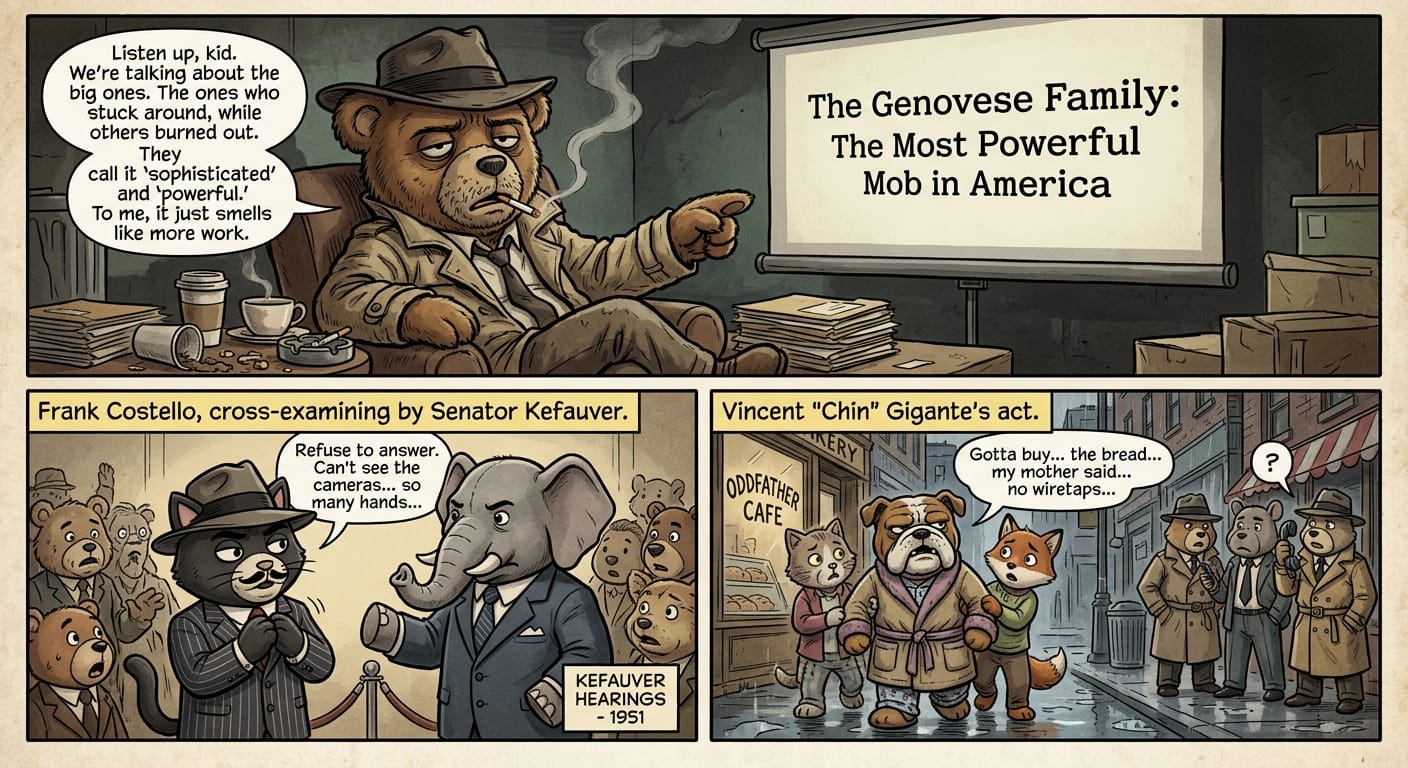
- The Genovese Family: The Most Powerful Mob in America
- The Gambino Family: From Don Carlo to John Gotti
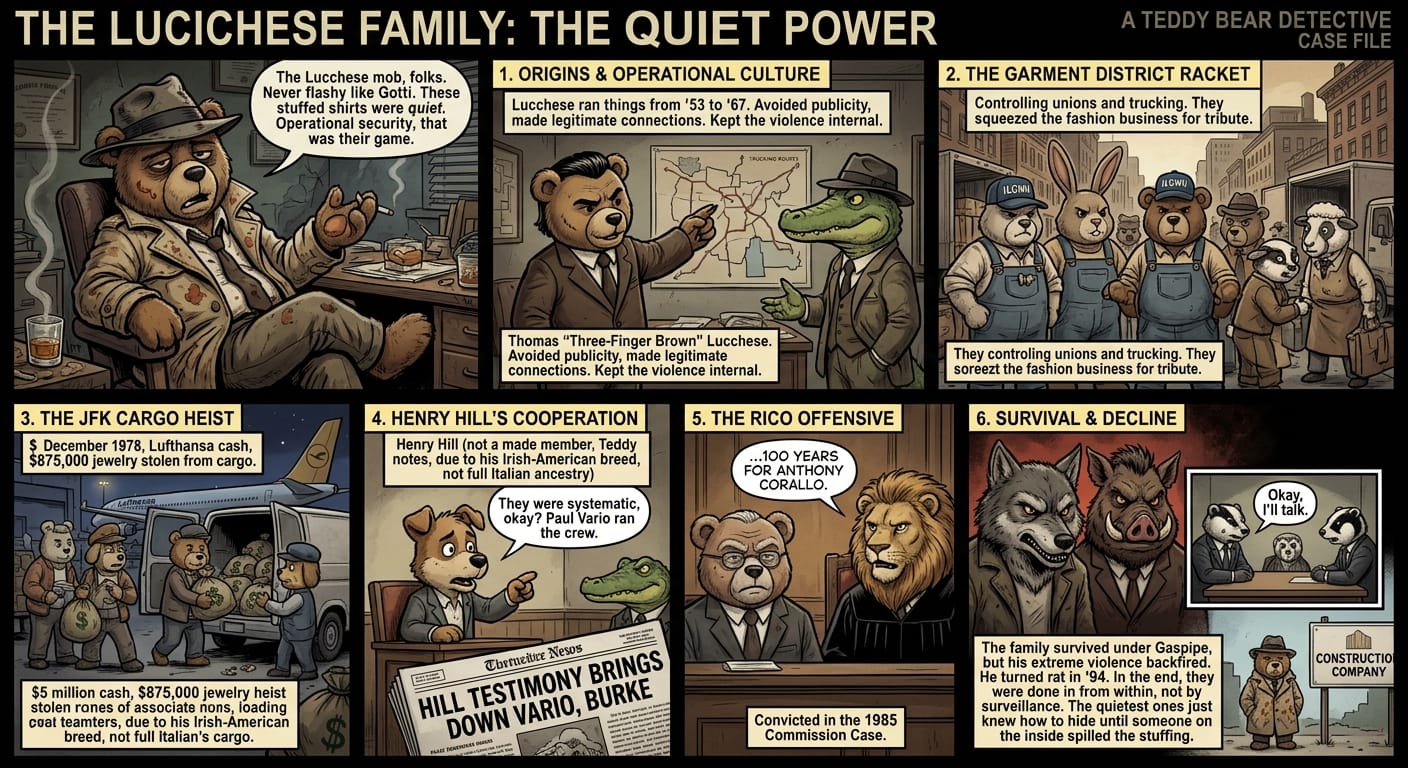
- The Lucchese Family: The Quiet Power
- The Colombo Family: Blood Feuds and FBI Rats
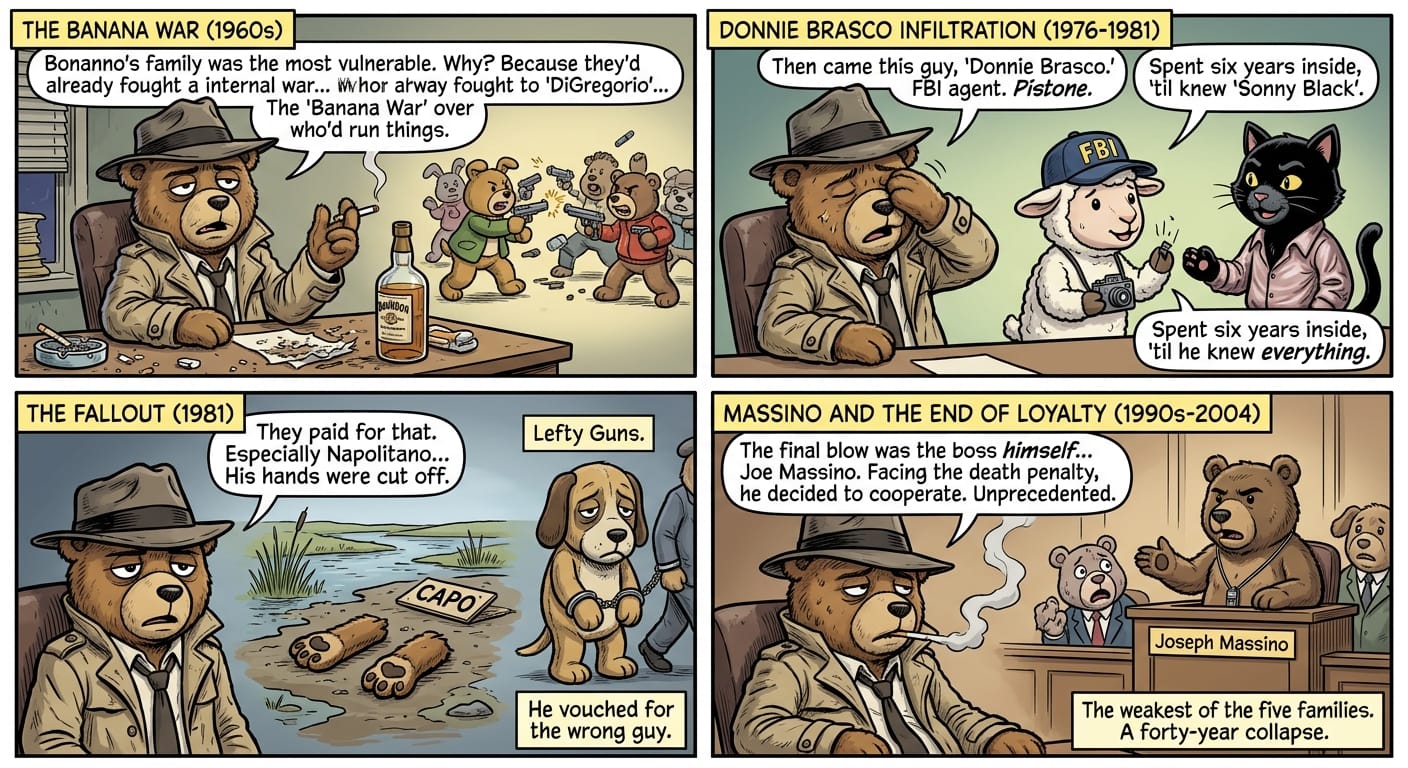
- The Bonanno Family: Donnie Brasco and the Mob’s Worst Nightmare
What Each Family’s History Reveals That the Others Don’t
Six articles in this series cover five families and the governing body they created. Each family is distinct. The Genovese family cultivated institutional depth through labor racketeering and political access, building the kind of structural presence that persisted regardless of who was boss. The Gambino family built the largest membership under Carlo Gambino’s patient leadership and then destroyed its own visibility under John Gotti, demonstrating that organizational scale without operational discipline produces a prosecution waiting to happen. The Lucchese family ran the Lufthansa heist and the garment district and the JFK cargo routes for decades by maintaining the kind of quiet that other families abandoned. The Colombo family’s recurring internal wars — three distinct conflicts over six decades — demonstrate what organized crime looks like when succession disputes can’t be resolved through any legitimate mechanism. The Bonanno family had an FBI agent proposed for associate membership.
The Commission, the governing body Luciano created in 1931, was the mechanism that held the five-family structure together. It arbitrated disputes, set rules of conduct, and managed the collective responses to threats that individual families couldn’t handle alone. Its conviction in 1986 effectively ended the New York Mafia’s golden era, not because any individual family was dismantled but because the coordination mechanism was gone.
What Made New York Different from Every Other American City
Organized crime existed in every major American city during the twentieth century, and several cities — Chicago, Detroit, Philadelphia, Kansas City — had significant criminal organizations. New York was different in two respects. First, scale: the city’s population, wealth density, and economic complexity created opportunities for labor racketeering, construction corruption, and market manipulation that dwarfed what was available anywhere else in the country. Second, the five-family structure created competition within the city that maintained organizational discipline — each family had to perform because the others were watching.
The competition was managed through territorial division. Each family had geographical strongholds and industry concentrations recognized by the others. The Genovese family dominated waterfront labor and had the strongest presence in New Jersey. The Gambino family controlled significant portions of Brooklyn and Staten Island and had particular depth in garbage hauling and construction. The Lucchese family ran the Bronx, parts of Queens, and the garment district. The Colombo family was primarily a Brooklyn organization. The Bonanno family operated in Queens and had the strongest presence in heroin trafficking routes through Montreal and Toronto.
The territorial divisions were not absolute and not perfectly stable. But they were recognized, and the Commission’s role in defending and adjusting them reduced the cost of competition enough to make the multi-family structure viable over time.
Why the FBI Waited Thirty-Seven Years to Treat Organized Crime as a Federal Problem
The FBI under J. Edgar Hoover officially denied the existence of a national organized crime conspiracy until the Apalachin Meeting of 1957 made the denial untenable. Hoover’s reasons were partly bureaucratic — he didn’t want to take on an investigation he might lose — and partly personal. What is established is that for thirty-seven years, from the establishment of the Commission in 1931 until Hoover’s forced acknowledgment after Apalachin, the federal government did not treat organized crime as a federal problem. State and local prosecutors made individual cases. The federal government left the structure alone.^1^
The McClellan Committee hearings and Joseph Valachi’s 1963 testimony changed public understanding without immediately changing enforcement strategy. The Organized Crime Control Act of 1970, which created RICO, provided the legal tool that would eventually be used to prosecute the Commission as a single enterprise. But it took another fifteen years, and the development of sophisticated electronic surveillance technology, before the Southern District of New York had the evidence it needed. The Commission Case conviction of November 19, 1986 — four family bosses convicted on a single conspiracy indictment — was the culmination of an enforcement effort that had required decades to build.
What Remained After RICO Dismantled the Structure
The five families did not disappear after the RICO prosecutions of the 1980s and 1990s. FBI assessments through the 2000s and 2010s consistently found that all five families continued to operate, with reduced membership and revenue but preserved organizational structures. The Genovese family remained the most functional. The Bonanno family, after Joseph Massino’s cooperation, was assessed as the weakest.
What changed was the relationship between the families and the economic structures they had historically exploited. Union pension funds became subject to independent oversight. Construction contracts in New York required integrity monitoring that made systematic skimming harder. Garbage hauling companies were broken out of mob-controlled cartels through antitrust enforcement in the 1990s. The specific rackets that had sustained the families for decades became more difficult and more dangerous as law enforcement developed sophisticated understanding of how they worked.
The five-family structure persisted. The conditions that had made it enormously profitable did not.
─────────
Sources:
- Raab, Selwyn. Five Families: The Rise, Decline, and Resurgence of America’s Most Powerful Mafia Empires. St. Martin’s Press, 2005.
- Jacobs, James B., Christopher Panarella, and Jay Worthington. Busting the Mob: United States v. Cosa Nostra. NYU Press, 1994.
- Critchley, David. The Origin of Organized Crime in America: The New York City Mafia, 1891–1931. Routledge, 2009.
The Series